Unknown's avatar

About Daniel Edelstein

1) Consulting Biologist (and Certified Wildlife Biologist Asc.) — Conducting wildlife and plant surveys for common and special-status species, with federal permits for Ridgway's Rail (formerly CA Clapper Rail), California Tiger Salamander, and California Red-legged Frog, in addition to California Department of Fish and Wildlife (CDFW) general scientific permit, and CDFW general plant permit. Secure permits for clients who must comply with local, state, and federal regulatory measures. Since 1998, author of more than 100 Initial Studies, Biological Assessments, EIR "Biological Resource" chapters, habitat alteration plans, and planting plans. 2) Adjunct faculty at Merritt College, teaching all its bird classes to adults (see warblerwatch.com and its "College Classes & Slide Shows" area to note some of my birding class theme options). 3) Birding Guide — Birding Guide in Marin County, Birding Guide in Sonoma County, San Francisco birding guide, and California birding guide. (See warblerwatch.com and click on "Birding Tours" tab.)

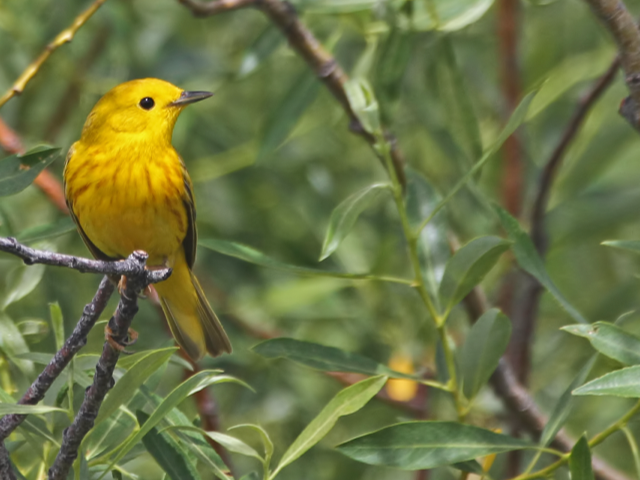
Warbler Guy, how long does a warbler — say, a Yellow Warbler — sit on her eggs before they hatch? Then how long before newborns fly? Thanks from Donna…

Donna (in Tacoma, WA):

Nice question.

Typically, the female (who chooses the male partner) in your area incubates eggs for 10 or 11 days {Bigglestone, H. C. (1913). A study of the nesting behavior of the Yellow Warbler (Dendroica aestiva aestiva). Wilson Bulletin 25:49-67.).

Newborns generally often leave the nest 8–10 days after hatching, but this amount of days may vary by latitude……Washington (your location) is somewhat on par with Manitoba’s latitude where young left the nest an average 8.2 days after hatching (among 12 observed subjects) {Briskie, J. V. (1995). Nesting biology of the Yellow Warbler at the northern limit of its range. Journal of Field Ornithology 66:531-543.}

Of course, exceptions happen….and more details are written about this subject at several sources. One of the easiest places to read more is at: allaboutbirds.org….or the classic, excellent The Birder’s Handbook: A Field Guide to the Natural History of North American Birds (Paul Ehrlich, David S. Dobkin, Darryl Wheye, Simon & Schuster, Inc.,1988). (See below image of the book’s cover.)

Meanwhile, please feel free to visit my web site: WarblerWatch.com where my bird survey and bird classes are noted……….and, I’m happy to note: I’m glad to prepare for two upcoming birding tours: 1) I’ll guide four birders from San Francisco to Bodega Bay (Sonoma County, CA) at low tide, given some shorebird family members are already back for the non-breeding season here in northern/central California where I regularly lead outings…..and/or some of the individuals we’ll see (e.g., Short-billed Dowitcher, Least Sandpiper, and several other shorebird species are merely transients, but forage at ample “wayside” mudflats amid Bodega Bay at low tide.). An night-time “owl prowl” to the same area features a Coastal Redwood forest where four to six owl species are nesting, with the resident Northern Spotted Owl subspecies present and, as you can imagine, a highlight to hear (and sometimes see) (We leave promptly after detecting it and never use playback; we do not wish to harass the adults or newborns at this undisclosed site that seems to be a perennial nesting activity center.)

Daniel Edelstein, M.S.

Avian Biologist & Certified Wildlife Biologist Asc. & Birding Guide
based in the San Francisco Bay area (Novato, CA)

415-382-1827 (office)

415-246-5404 (iPhone)

WarblerWatch.com (features my resume)

WarblerWatch.blogspot.com (This blog’s #)

Warbler Guy, I know some wood-warblers have already given birth to newborns, so when will the initial dispersal movement of adults occur that completed nesting? For example: Do post-nesting adults leave their nesting ground before migrating? Or do they stay near their current year’s newborns?

Great question, Sylvia (in Duluth).

The short answer: Yes, as in many songbirds, including most wood-warbler species in the USA disperse (BUT do not necessarily migrate) soon after their nest is independent of their newly-born hatch year clutch.

Now the answer gets more complex: 1) Dispersal occurs for all wood-warblers away from the nest, but some species likely go farther astray from the nest than others. 2) Then, if the wood-warbler species is an obligate migrator from the northern latitudes (e.g., upper Midwest or New England as two valid examples), it will eventually migrate from its dispersal grounds.

Note I’ve introduced the concept of “dispersal” and “migration” above. They mean different behaviors, with dispersal a pre-migration behavior that includes foraging to “bulk up” and add calories for wood-warbler species that need to have plenty of fat for their upcoming post-breeding migration to over-wintering grounds.

Migration is the short or long distance trek birds (including most N. American wood-warbler species) undertake as early as July (e.g., Tennessee Warbler and Yellow Warbler are known to be early nest site dispersers and, hence, migrators south). Laggards that may leave later than other south-bound wood-warbler species include Yellow-rumped, Palm, and Common Yellowthroat, though, of course, Christmas Bird Count results in wintery, inclement areas have detected several other wood-warbler species beyond the aforementioned three.

Meanwhile, if you’ve read this far, congratulations. Wish to know more about this topic? I suggest you consider reviewing the following links: 1) https://scholar.google.com/scholar?hl=en&as_sdt=0%2C5&q=Parulidae+Wood-warbler+migration&oq=wood-warbler+migration and 2) https://royalsocietypublishing.org/doi/abs/10.1098/rspb.2011.1045

Regards and best birding, Daniel Edelstein, DanielEdelstein@att.net, 415-246-5404 (WarblerWatch.com features my Bird Guiding and bird tour information, as well as my resume, etc., et al.)

Got wood-warbler questions?

Featured

yellow bird

If so, I have answers for you. I’m Daniel Edelstein — Independent, Consulting Biologist, Birding Guide (since 1988), college Birding Instructor (WarblerWatch.com) and DanielEdelstein@att.net — who ponders: 
Are there any Wonders In Our World more fascinating than the elegant beauty of wood-warblers? 

(All photos ©Martin Meyers unless otherwise noted.) 

Warbler Guy, which web site is good for seeing warbler photos and learning warbler songs? Which web site will help me improve my birding by ear for warblers? Will my song identification of warblers get better with your recommendations?

Sally (in Tucson)….

It’s amazing how fantastic the web site AllAboutBirds.org is the answer to all your (excellent) questions.

Simply type in the name of the warbler you think is the one you detected.

Result, you’ll see photos of it and corresponding vocalizations (both songs and calls).

Even if your ID is wrong, the “look-alike,” similar appearing warbler species will be shown at every choice you make when trying to ID a warbler that causes both enjoyment and puzzlement, in terms of knowing its common name identity.

Does this answer your questions, Sally?

Please feel free to visit my web site — WarblerWatch.com — where other information about N. American warblers and the myriad other USA birds are highlighted.

Regards, Daniel Edelstein

WarblerWatch.com (features wood-warbler info. & other birding information for N. CA & the USA)

Warbler Guy, which warbler species are the initial ones that return to the San Francisco Bay in spring? Are migrating warblers returning now?

Warbler Guy, which warbler species are the initial ones that return to the San Francisco Bay in spring? Are migrating warblers returning now?

Haley, those are excellent questions.

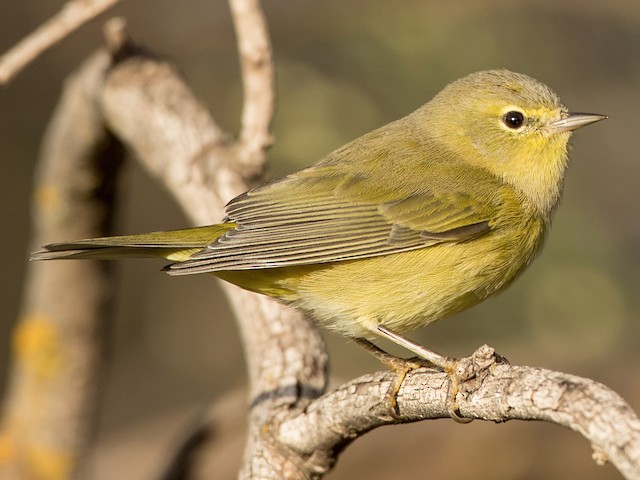
The short answer is Orange-crowned Warbler is the typical, initial wood-warbler species to appear annually by February as a true, returning migrant among the nine SF Bay Area counties.

The true, arriving migrants that settle to nest here may join a small number that appear to “over-winter” in the SF Bay Area. (It’s also possible the “over-wintering” individuals leave during spring and seek other breeding ground territory.

Next on the landscape as arriving migrant wood-warblers here: Common Yellowthroat and Wilson’s Warbler appear by no later than later March (or, if late, early April) annually. Soon after, the initial Black-throated Gray and Hermit Warbler nesters arrive. (Note the latter four noted above sometimes, also, are detected as “over-wintering” individuals, especially during Christmas Bird Count surveys that occur throughout the holiday season period of late December – early January, annually, in the SF Bay Area.

A good source for noting the “Arrival Times” of northern CA wood-warbler species: Go to the pulldown menu at my web site (WarblerWatch.com) and choose “Bird Arrival Times” at the “Birding Links” pulldown menu option at the top of the home page for WarblerWatch.com

Regards and happy birding, Daniel Edelstein

WarblerWatch.com

WarblerGuy, when does the first true migrant warbler species return to the SF Bay Area?

Lori (in Kentfield, CA):

In February annually, Orange-crowned Warbler individuals arrive as the earliest wood-warbler migrant…….and they join a few over-wintering individuals……though it’s possible the latter may leave to nest elsewhere (See range map, below).

(Orange-crowned Warbler, above….courtesy of Cornell Lab of Ornithology)

A far larger pulse of this common nester throughout n. CA arrives on breeding grounds by March.

Interestingly, among all wood-warblers to complete their nesting cycle early, this ground-nesting one often does so….I’ve walked forested areas where hearing their song is a daily experience. Then, by mid-May, I never hear their trilling lyricism until I visit the higher altitudes in the state (such as the Sierra Madres mountain range three hours east of Marin County where I live and host the majority of my n. CA birding tours as a guide.

One amazing aspect of Orange-crowned Warblers’ behavior occurs post-breeding. Upon leaving a nesting area, many do not migrate south, but instead move to higher altitudes, including foothill areas east of Marin Co. and as high as 6,000+ feet. Bird banders have noticed these movements by recapturing banded individuals in the Sierra that were initially temporarily captured in nets in SF Bay Area counties, including Marin Co.

At the higher altitudes where periodic summer rainstorms occur (especially in the afternoon), larger abundance of insect fauna exist as prey base for Orange-crowned. By August and beyond into autumn, it’s thought these individual eventually migrate south to s. CA and as far as s. Mexico and portions of Belize (adjacent to Mexico).

Warbler Guy, my California bird tour means I’m looking for rare birds in California. Where do I find rare California birds on a listserv?

Hi Jeremiah….and your query is a periodic question I receive, so I’m glad to help, below.

Here’s the answer to your question, above: I suggest your first move is to check:
http://digest.sialia.com/?rm=all_lists

….as this site a composite list featuring all the listserv sites in California where birders add their bird sightings.

At sialia.com, you’ll see a left column by which you can one-by-one click on a chosen region of California….Upon doing so for one region, you’ll see a list of the latest bird sightings lists posted by birders.

As for common annual and upcoming migration, I am pleased to note that I 
currently have begun to hear the courtship “peek” sound from male Anna’s Hummingbirds (and, actually, since October, 2022). 

During this process, males descend during their courtship dance, air rushing through their tail feathers at the bottom of their elevator drop initiates the “peek” sound.

By December annually, eggs are added to nests in the SF Bay Area, with Great Horned Owl joining the maternity ward by January annually as females incubate eggs or hatch them.

Interestingly, also, the earliest returning Allen’s Hummingbirds may begin returning by next and beyond through February and March to SF Bay Area coastal breeding locations. I expect the initial report of a returning Allen’s Hummingbird to appear at sialia.com by 1/15/23 or soon after.

Other questions? Glad to help: danieledelstein@att.net

Please feel free to see the “Birding Tours” and “Birding Links sections.

Regards, Daniel

Problem Upgrading Site

My web site — warblerwatch.com — is “enabled” but I am not able to “upgrade” it…..I’m trying to eliminate ads at my web site.

Solution?

I sent the following message via the “help forum” a moment ago as backup to this one:

Please note: For 8 weeks with your kind help, a solution is STILL not happening for me to upgrade my web site so that I can eliminate ads. I’ve tried. You have tried. But no one who has suggested remedies from your team has been able to help me. The problem remains that no one has told me how to send an attachment to show my situation. An attachment would show you a screenshot of the screen I encounter where the problem occurs. Here’s where the problem occurs and I’ll describe it because this “Contact Us” area has no ability to send an attachment: the two-year payment screen is present. I choose it. I add all my essential information. All is perfect. But the screen never gets past “thinking” as it states a recalculation of how much I owe occurs…..and the final ability to click on “submit” never occurs. Solution?
Regards, Daniel

*

Daniel Edelstein

Certified Wildlife Biologist Asc.
(Surveys, Permitting, Regulatory Services…possess five survey permits) (Permit #101743-0)

Avian Biologist & Birding Guide

12 Kingfisher Ct.
Novato, CA 94949

415-382-1827 (O) 415-246-5404 (iPhone)

warblerwatch.com
(hosts my resume)

warblerwatch.blogspot.com
(My 12-year-old warbler-centric blog, featuring articles, warbler news, & photo quizzes)