Unknown's avatar

About Daniel Edelstein

1) Consulting Biologist (and Certified Wildlife Biologist Asc.) — Conducting wildlife and plant surveys for common and special-status species, with federal permits for Ridgway's Rail (formerly CA Clapper Rail), California Tiger Salamander, and California Red-legged Frog, in addition to California Department of Fish and Wildlife (CDFW) general scientific permit, and CDFW general plant permit. Secure permits for clients who must comply with local, state, and federal regulatory measures. Since 1998, author of more than 100 Initial Studies, Biological Assessments, EIR "Biological Resource" chapters, habitat alteration plans, and planting plans. 2) Adjunct faculty at Merritt College, teaching all its bird classes to adults (see warblerwatch.com and its "College Classes & Slide Shows" area to note some of my birding class theme options). 3) Birding Guide — Birding Guide in Marin County, Birding Guide in Sonoma County, San Francisco birding guide, and California birding guide. (See warblerwatch.com and click on "Birding Tours" tab.)

Warbler Guy: Is the Yellow-Breasted Chat still a wood-warbler? Or did it get “kicked out” of its family? Why is the chat a wood-warbler?

Thanks for the question, Mary.

After many years of debate, the AOS (American Ornithological Society) in 2017 moved the Yellow-breasted Chat (Icteria virens) to the Icteriidae family. It is the only member of this family…..(NOT many bird species are an “only child” in their own family in N. America.)

As you may know, this seven-inch songbird was once a member of the New World warbler family (Parulidae)

The reorganization does not end the controversy among researchers. Several still believe blood analysis suggests the chat should remain in the Parulidae. In my view, they are NOW in the minority opinion, yet remain steadfast that the traditional Biological Species Concept (based on song/call expressions; behavior; skull/anatomical features) should, thus, persist……as the taxonomical organization device for separating the world’s bird species into orders and families (e.g., Parulidae, Icteriidae, etc…..There’s ~262 families in the world.)

Warbler Guy, I recently met you and was intrigued that you mentioned wood-warbler observations from your past Alaska visits….You mentioned heading there again this summer….When are you going and which warblers could you see……or could I see there?

Mary (in Sausalito, CA), depending on where you go birding in Alaska, here’s the typical, annual

nesters in our 49th, Final Frontier (amazing) state:

Blackpoll

Wilson’s

Orange-crowned

Yellow-rumped

&

Northern Waterthrush

have the largest ranges throughout the state….but several other documented sightings of other wood-warbler species occur annually to periodically throughout the region, per this link to a checklist of Alaska (via eBird):

Note the above checklist ALSO lists the “Leaf Warblers” that may occur in Alaska — which is a a different family than the Parulidae family that comprises the vast majority of New World/N. America wood-warbler species.

Now to go birding for rare gull species before they leave for more northern latitude breeding grounds.

Regards, Daniel

Consulting Avian Biologist

(My resume is at my web site: WarblerWatch.com)

Birding Guide

(See “Birding Tours” at WarblerWatch.com)

Warbler Guy, when I see a wayward, “lost” wood-warbler species in the fall, does “vagrant” mean the same as “accidental?” Which vagrant wood-warbler species show up where you live in Marin County and the SF Bay Area?

Kelsey, those are two fine questions.

Answers: 1) In common, typical vernacular, I think both popular and academic literature/articles uses these two terms synonymously, though “vagrant” is more typical. A fine, recent book titled Vagrancy In Birds may help my contention point here, given research ornithologists seem (in my experience) to usually employ “vagrant.”

2) There’s no absolute abundance order for the so-called Eastern and Midwestern USA wood-warbler vagrant species that are observed at, say, the Point Reyes lighthouse or nearby among “islands of green” (e.g., Monterey Cypress groves on cattle ranch land within Point Reyes National Seashore, the farthest western longitude in the lower 48 USA….and, thus, a magnet for wood-warbler individuals expressing MIrror-image Misorientation — an innate navigation problem that changes their typical in-born proclivity to migrate southwest INSTEAD of southeast during their initial* autumn trek away from natal grounds). (* = Most songbird species vagrants seen in coastal West Coast areas are hatch year/first-year individuals.)

My opinion is that the following species from are usually the most typical vagrant species to appear from approximately mid-August through October vagrants in Marin County and along the coast near or within Pt. Reyes National Seashore: Tennessee, Blackpoll, American Redstart (though it’s reported periodically to nest in N. CA), Black & White, Blackburnian, Chestnut-sided, Bay-breasted, and Northern Parula.

Meanwhile, it’s time to look for a) more of our typical nesting West Coast wood-warblers that sometimes remain in small numbers during the current non-breeding season near me in Novato (inland Marin County) and along the coast: Black-throated Gray, Wilson’s, Yellow, and Orange-crowned (that, actually, begin returning this week to nest here in SMALL numbers, with a larger pulse beginning by March, annually) and b) Gull species; and c) Non-breeding season hawk species visitors, including Ferruginous and Rough-legged. I hope my upcoming Marin Audubon Society and Golden Gate Bird Alliance field trips see both of these Buteo members along Skaggs Island Rd. (near Novato).

Lastly, my Bird Guiding tours are noted at my web site, WarblerWatch.com. In addition, it features information about where my upcoming “Birding By Ear In The Sierra” week-long workshop for San Francisco State University (June 9 – 14, 2024). Details and registration are at: http://siera.sfsu.educ/classes-workshops

Warbler Guy, what’s an example of a “superspecies” in the wood-warbler family?

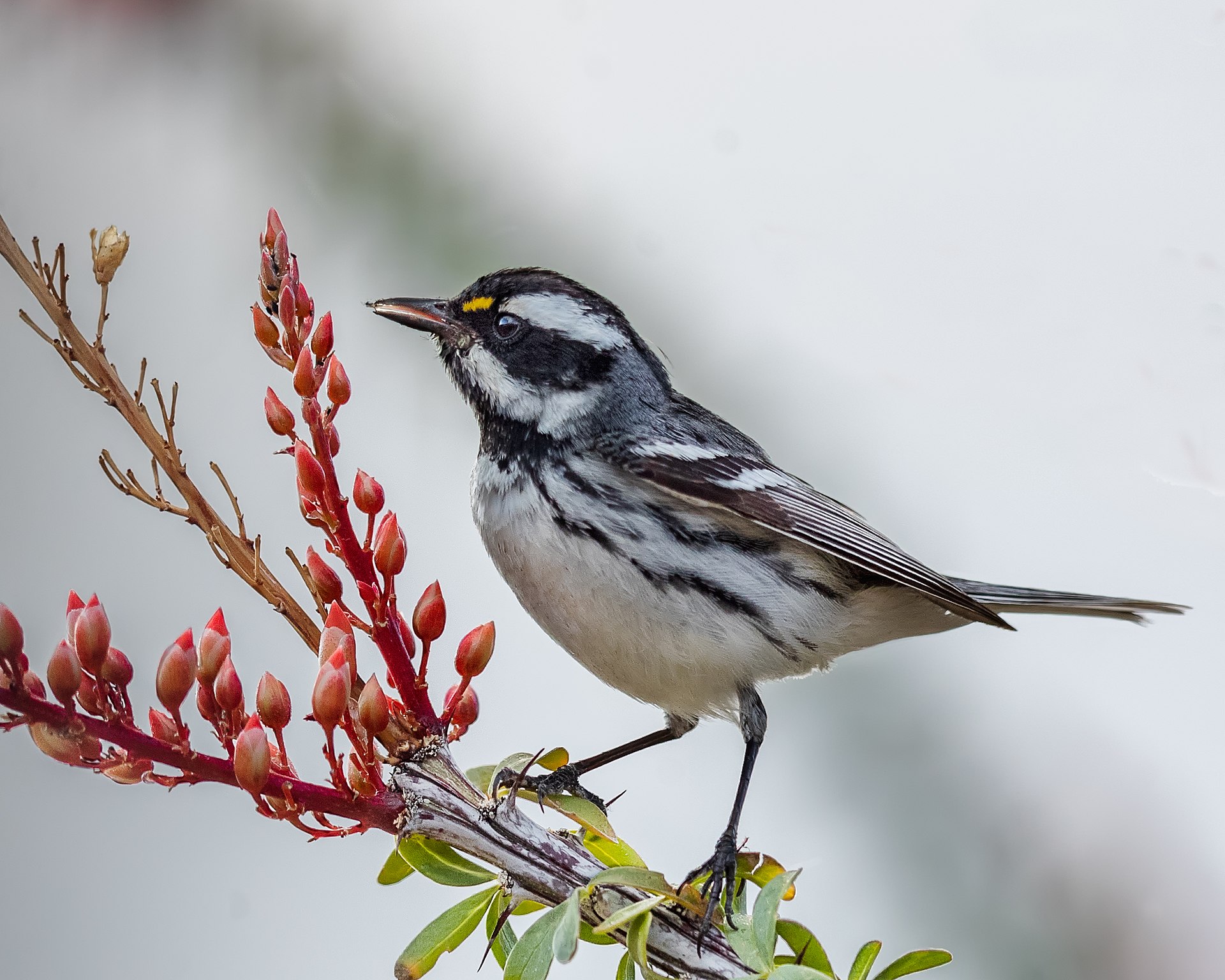
(The Black-Throated Gray Warbler in the above photo is one of five species within the Black-Throated Green superspecies group.)

Thanks for the query, Ms. Jones (in Santa Barbara, CA).

Think of a superspecies as a group of related species that evolved from a common ancestor, but live in distinct ranges apart from each other. A good example of a superspecies is the Black-Throated Green Warbler group that includes this species as well as Townsend’s, Hermit, Golden-Cheeked, and Black-Throated Gray Warblers.

Each of the latter four species in the above group is thought to have evolved from its Black-Throated Green ancestor. As this species expanded from its southeastern USA deciduous forest territory into coniferous forest created by the most recent glacial advances, isolation occurred among populations. As generations of separated populations slowly spread west and north throughout lower North America, each population became a divergent “island.” Gene flow ceased as reproductive isolation caused speciation to occur over eons. The resulting five species share various field marks, but also express their own unique characteristics.

Nonetheless, despite their status as species, hybridization sometimes occurs among species within a superspecies, including the Black-Throated Green superspecies wherein populations of Townsend’s and Hermit hybridize in Oregon and Washington. To simplify, where both species occur, over time Townsend’s appear to usually dominate and increase in number.

More technical, the five species within the Black-Throated Green superspecies have parapatric distributions. That is to say, each of the five species has ranges that do not significantly overlap but are immediately adjacent to each other (and/or occur together in a narrow contact zone, with the aforementioned reference to Townsend’s and Hermit Warbler hybridization a scenario where overlapping occurs).

To learn more about this subject, read a classic article by R.M. Mengel titled “The probable history of species formation in some northern wood warblers.” One source where this article appears is in a 1964 edition of “Living Bird” (page 943).

Warbler Guy, do you ever see wood-warblers on your Christmas Bird Count efforts? Which wood-warblers typically occur on Christmas Bird Counts in the Midwest and East where I bird?

Andrea, that’s a fine question….My past Xmas Bird Count(s) when living and teaching in the Midwest rarely included detections of wood-warblers…but, if so, it was typically Yellow-rumped Warbler (Myrtle subspecies, Setophaga coronata coronata).

More rare in s. WI, I’ve seen people list Common Yellowthroat and Palm Warblers.

Here in N. CA in the SF Bay Area where I have lived for 25+ years, my Xmas Bird Counts sometimes yield the auduboni subspecies of the Yellow-rumped (with rare to periodic Myrtle subspecies)…..Common Yellowthroat (resident here)…..and rarely: Black-throated Gray and Wilson’s….Even more rarely: Nashville, Hermit, and Yellow.

I hope this helps? Now it’s off for more gulling later today at Shollenberger Park in Petaluma — a fine venue for seeing rare Laridae/gull family member species…but, oops, this blog is supposed to be wood-warbler-centric. Sorry.

Happy Holidays! Daniel

(with my “Birding Tours” information noted elsewhere in my web site, WarblerWatch.com)

Warbler Guy, I’m in n. WI and wonder which wood-warbler species are the most likely to see as winter approaches? Which late, persisting warblers hang around in the northern USA?

Good question, Elsie (in Rhinelander)

Typically, there’s a few lingering wood-warbler species that typically are the most likely to see in November and, even, on Christmas Bird Count surveys in northern latitudes in the Lower 48 USA states, including:

Yellow-rumped

Palm

Common Yellowthroat

Orange-crowned

and

Pine Warbler

Other candidates?

I believe Black & White and Cape May are more infrequent than the aforementioned species as malingers.

Readers may have valid opinions to share. Please let me know.

Meanwhile, it’s back to birding fun….I’m excited to soon lead some birding trips as a guide….and my ZOOM show will highlight rare and vagrant bird species behavior, including the ecology of vagrancy.

Interested in a birding tour? Please contact me at DanielEdelstein@att.net …and my web site (WarblerWatch.com) has a “Birding Tours” section for information.

Warbler Guy, I have one more question about Kirtland’s Warbler: is it still an endangered species? Or has it rebounded in number enough to be delisted?

Thanks again for writing….Great question, per your last ones last month here at this blog.

Beg my pardon for a moment before I answer your question, please….as I wish to note that your question arrives as this blog celebrates its 17th anniversary this month. So thanks to all the readers.

Now to answer your question. Indeed, this one-time endangered wood-warbler species continues to thrive, with breeding success ongoing annually…..and, as a result, it was delisted and removed from the federal endangered species list in 2019.

A fine article noting this trend is at: https://www.michigan.gov/dnr/about/newsroom/releases/2021/10/25/kirtlands-warbler-census-shows-once-endangered-songbird-continues-to-thrive

Additional interest information (and more recent updates) for this Michigan, Wisconsin and, at one nesting site in Ontario, is present at:

https://www.cell.com/current-biology/fulltext/S0960-9822(20)31081-2?_returnURL=https%3A%2F%2Flinkinghub.elsevier.com%2Fretrieve%2Fpii%2FS0960982220310812%3Fshowall%3Dtrue

Meanwhile, it’s time for an upcoming birding tour this week to the Sonoma County coastline with a group of birders* that I’ll meet there.

(* = my background and tour information is at WarblerWatch.com

PS: Other news updates:

My bird surveys for shorebird family members will keep me busy for the rest of November, including several in the SF Bay north bay….in addition to volunteering for the annual Point Blue Conservation Science Shorebird Survey (that I have assisted for the last 11 years….i.e., 11 years? Yes, hard to believe the years “fly” by so fast…).

Warbler Guy: Do Kirtland’s Warbler nest elsewhere in the USA besides Michigan? Nesting Kirtland’s Warblers occur in Wisconsin as breeders?

Good questions, Theo (in Illinois). Here’s a link to the history of Kirtland’s Warblers recent breeding success in Wisconsin….below:

https://silvis.forest.wisc.edu/research/here-to-stay-endangered-kirtlands-warblers-call-red-pine-dominated-plantations-in-wisconsin-home/

For 2023, preliminary results of Kirtland’s Warbler nesting surveys in Wisconsin have yielded the following information:

  • 13 males in Adams County, 2 in Douglas County, and 4 in Marinette County in 2023.
  • 1 pair in Douglas County, and 7 pairs in Adams County in 2023.
  • nest success in WI was not intensively monitored this year, but there was successful fledging of young in Adams County

As for Michigan, I’m assuming many of you readers already know this rare species continues to annually nest in at least 10 Michigan counties and at one nesting spot in Ontario.

Is it federally endangered? No, as the good news the US Fish & Wildlife Service delisted this species in 2019.

Why? During the past century, timber rotations and fire suppression helped populations to rebound above 2,200 pairs. Thus, 50 years on the Endangered Species List was a good news victory for the avalanche of professional and volunteer work performed on behalf of saving this wood-warbler from the brink of extinction.

Regards, Daniel Edelstein

WarblerWatch.com

Birding Guide & Consulting Avian Biologist

Warbler Guy, which apps are the best for identifying warblers? Warbler song identification is on some of the apps?

Thanks for the question, Gloria (in Florida).

There’s free bird ID apps at your Google Play or Apple App Store. All are good.

BUT the best, comprehensive apps cost money at different levels.

These include my favorite ones…and I use all of them for different reasons in the field, so there’s four:

Sibley Birds Version 2 (Sibley V2 is the name that also works to find it)

Sibley Birds

Merlin Bird ID

BirdsEye

Note that all of the above apps feature songs for learning them, except for BirdsEye.

Details follow:

In short, I use Sibley Birds Version 2 for a fine reason: A user can compare and contrast two look-alike species next to each other. That’s because clicking a button accesses side-by-side images of the two “difficult decision” birds in question. Great feature.

Otherwise, Sibley Birds is similar to Sibley Birds that I’ve been using for 10+ years. It’s also wonderful.

Merlin Bird ID is one I seldom use, but I recommend it as one tool worthwhile for birders wishing to improve their “birding by ear” skills. It’s not an app I typically require, I’m flattered to note (i.e., My birding by ear skills have been honed for 40+ years, so I’m comfortable IDing the vast majority of bird species where I typically go in the eight-county SF Bay Area and throughout central and northern CA.

Otherwise, “yes,” I’d use this app in the future when birding elsewhere where I’m unfamiliar with the songs and calls of bird species.

That written, I’ll admit that Merlin has its virtues, ala my Alaskan trip in the summer of 2023. There, amid the hinterlands of the Anvik River for 12 days (100 miles southeast of Nome), I enjoyed how Merlin claimed three Catharus thrush genus members (Gray-cheeked, Swainson’s, and Hermit) were all present within a couple of hundred feet from each other. That was an amazing moment.

Then again, please let me again state the aforementioned thought that I believe Merlin is a good tool….but also believe birders should never rely on it for the final ID of a bird in question. Better to employ Merlin as a fact checker after first relying on the Good Old Ears and self-knowledge.

Lastly, BirdsEye is excellent. Imperative, actually. Why? It helps me plan my birding route for the day. Consider how one species may be the goal for the day. With BirdsEye, you can type in the name of your target species. Then see on a map the most recent sightings…and, in turn, travel from one to the next in the most time effective manner. Perfect. For this reason, BirdsEye could also easily be titled “Bird Concierge” (i.e., It has all the answers.)

Happy Birding…I’m out now to the gorgeous wilds of Door County, WI where the southbound neotropical songbird birding should again be fine today. Its 18 species of nesting wood-warblers are largely dispersed or migrated from natal grounds, of course, but the transients are still passing through for my viewing pleasure.

After birding here, it’s back home to the SF Bay Area where I’m already guiding a birding tour the day after I step off the plane. So, I’m counting my blessings…and wishing you the best, Daniel Edelstein, WarblerWatch.com (features a “Birding Tours” button with tour details along with other bird information, including my resume).

Warbler Guy, how many years does a warbler usually live?

Good question, Christian (in Dallas, TX)….According to several citations noted in Birds of the World (Birdsoftheworld.org), many species of wood-warblers perish in their first year of life, with the average lifespan 6-10 years….BUT I recommend looking at the following article to see the range of some wood-warbler species’ age ranges: Longevity records of North American birds: Remizidae through Parulinae (Klimkiewicz, M. K., B. Clapp, and A. G. Futcher (1983). Journal of Field Ornithology 54:287–294)….and accessed via: https://nwrc.contentdm.oclc.org/digital/collection/NWRCPubs1/id/20856

Amazingly, a Yellow Warbler was documented to live at least 11 years based on banding records (i.e., a banded Yellow Warbler was recaptured, so field biologists were able to determine its age).

Meanwhile, it’s time to see our local West Coast wood-warblers….yet I’m also looking forward to pursuing sightings of vagrant wood-warblers at the Outer Point within Point Reyes National Seashore. I’m lucky to live only 40 minutes away….though when I visited today, the dense fog prevented perusing the Monterey Cypress trees where vagrants tend to be seen from mid-August through October annually.