Warbler Guy, I’m soon visiting California, meaning I’ll be looking for rare birds in your state. Where do I find rare California birds on a listserv?

Hi Jeremiah….and your query is a periodic question I receive, so I’m glad to help, below.

Here’s the answer to your question, above: I suggest your first move is to check:
http://digest.sialia.com/?rm=all_lists

….as this site a composite list featuring all the listserv sites in California where birders add their bird sightings.

At sialia.com, you’ll see a left column by which you can one-by-one click on a chosen region of California….Upon doing so for one region, you’ll see a list of the latest bird sightings lists posted by birders.

As for common annual and upcoming migration, I am pleased to note that I 
currently have begun to hear the courtship “peek” sound from male Anna’s Hummingbirds (and, actually, since October, 2022). 

During this process, males descend during their courtship dance, air rushing through their tail feathers at the bottom of their elevator drop initiates the “peek” sound.

By December annually, eggs are added to nests in the SF Bay Area, with Great Horned Owl joining the maternity ward by January annually as females incubate eggs or hatch them.

Interestingly, also, the earliest returning Allen’s Hummingbirds may begin returning by next and beyond through February and March to SF Bay Area coastal breeding locations. I expect the initial report of a returning Allen’s Hummingbird to appear at sialia.com by 1/15/23 or soon after.

Other questions? Glad to help: danieledelstein@att.net

Please feel free to see the “Birding Tours” and “Birding Links sections.

Regards, Daniel

Warbler Guy, where do I learn about “reading” warbler songs (sonograms or spectrograms)? Is Warbler song easy to “read?”

Kathy, there’s a one-stop shopping venue for all your edification needs related to Birding By Ear for wood-warblers: earbirding.com
Here, Nathan Pieplow, an erudite sound recordist and expert birder, highlights many “ear birding” elements, including ways for you to easily read sonograms/spectrograms.

Please see his web site: earbirding.org and his recent book’s are excellent on this subject: a) Petersen Field Guide to Bird Sounds of Western N. America and b) Petersen Field Guide to Bird Sounds of Eastern N. America.

The above web site is so good that it gets a top rating from Warbler Guy’s advisory panel: me, myself, and I.

Seriously, reading and interpreting sonograms/spectrograms takes practice, but after a while you can
see the elements upon the page that originally looked like gibberish make sense.

Ergo, you’ll quickly have no problems identifying a song sparrow classic song via its sonogram in comparison to a common yellowthroat’s, and so on.

Other resources for identifying birds by sound and “ear birding” abound…..Some of my favorite are books by Dr. Donald Kroodsma, who authored the classic:
The Singing Life Of Birds.


Is warbler song easy to read on sonograms? Some people find them easier to comprehend than others. I think the above resources will help. My opinion is that some sonogram songs are easy to understand and others are more incomprehensible.

Warbler Guy, are there any New World warblers that occur in their own family and where shall I look?

The Olive Warbler, Peucedramus taeniatus,  is a small passerine bird. It is the only member of the genus Peucedramus and the family Peucedramidae.

Breeding from southern Arizona through New Mexico and south into Mexico and Nicaragua, the Olive Warbler is the only member of the genus Peucedramus and the family Peucedramidae. All our other New World warblers in the continental USA are in the Parulidae family (except for rare to occasional vagrant sightings of Old World Warbler sightings — among them being Arctic and Dusky Warbler).

The Olive Warbler status in its one-member family is distinctive in that it’s the only bird family endemic to North America (including Central America). Before it was classified into its current family, this warbler was considered a Parulidae, but DNA studies suggest that it split early in its evolutionary history from the other related passerines prior to the differentiation of the entire New World warbler/American sparrow/Icterid group.
Where should you look for this species?

Like many other New World warblers, it is an insectivorous species of coniferous forests.
According to the iBird Pro app I used to interpret its distribution range, Olive Warbler is restricted to breeding in central/east-central Arizona and a small portion of southwestern New Mexico. It’s non-breeding season range includes southern Arizona most of western Mexico and a restricted area of northeastern Mexico immediately south of Texas.

Though it is often said to be non-migratory, most New Mexican birds typically leave the state from November to late February.

Warbler Guy, where do I buy good binoculars? Can you share where binoculars are sold? Which kind of binoculars for birding do you recommend?

Peter (in Des Moines):
Plenty of choices, of course.

But where to start.

First, I ALWAYS sample any binocular or spotting scope before purchasing it. That’s common sense.

More challenging: WHERE to find a good optics resource? What’s a birder to do?

One quick fix: I have bought optics from the following online and storefront source that
features diverse choices for binoculars, spotting scopes, and optic accessories:

Out of This World Optics
(OutofThisWorldOptics.com)

The owners (Marilyn Rose and James Blackstock) provide personal service.

(They are at: 800-228-8252…..and Mendocino is a sweet, coastal town in southern Mendocino County, ~120 north of San Francisco)

Otherwise, visiting REI or a Wild Birds Ltd. store is a good idea because you can sample diverse binocular options BEFORE buying one.

Which brands are worth considering? This answer depends partially on your budget. If you have the $ and wish quality then Swarovski, Zeiss, and Leica are “top of the line”…For scopes, I recommend Swarovski, Zeiss, and Kowa.

10 x 42 or 7 x 35 are fine….but I prefer my 10 x 42 Swarovski NL Pure (2023 model).

Feel free to email me and I’ll send you an article that may be helpful: DanielEdelstein at att dot com

Regards, Daniel

WarblerWatch.com

(features my resume and my “Birding Tours” information if you click on these two words at the home page for this web site)

WarblerWatch.blogspot.com (the # for this blog)

Warbler Guy, what’s an example of a “superspecies” in the wood-warbler family?

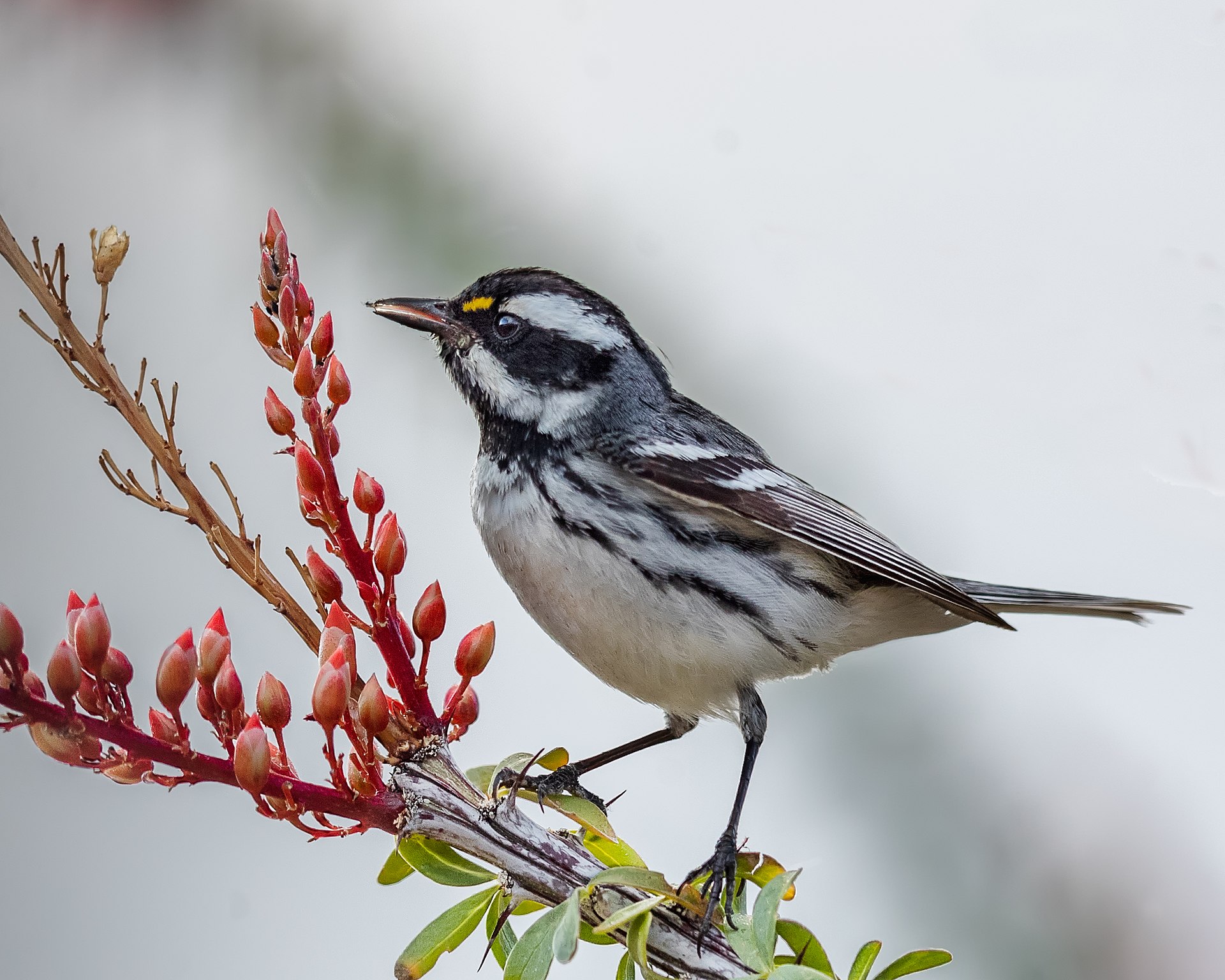
(The Black-Throated Gray Warbler in the above photo is one of five species within the Black-Throated Green superspecies group.)

Thanks for the query, Ms. Jones (in Santa Barbara, CA).

Think of a superspecies as a group of related species that evolved from a common ancestor, but live in distinct ranges apart from each other. A good example of a superspecies is the Black-Throated Green Warbler group that includes this species as well as Townsend’s, Hermit, Golden-Cheeked, and Black-Throated Gray Warblers.

Each of the latter four species in the above group is thought to have evolved from its Black-Throated Green ancestor. As this species expanded from its southeastern USA deciduous forest territory into coniferous forest created by the most recent glacial advances, isolation occurred among populations. As generations of separated populations slowly spread west and north throughout lower North America, each population became a divergent “island.” Gene flow ceased as reproductive isolation caused speciation to occur over eons. The resulting five species share various field marks, but also express their own unique characteristics.

Nonetheless, despite their status as species, hybridization sometimes occurs among species within a superspecies, including the Black-Throated Green superspecies wherein populations of Townsend’s and Hermit hybridize in Oregon and Washington. To simplify, where both species occur, over time Townsend’s appear to usually dominate and increase in number.

More technical, the five species within the Black-Throated Green superspecies have parapatric distributions. That is to say, each of the five species has ranges that do not significantly overlap but are immediately adjacent to each other (and/or occur together in a narrow contact zone, with the aforementioned reference to Townsend’s and Hermit Warbler hybridization a scenario where overlapping occurs).

To learn more about this subject, read a classic article by R.M. Mengel titled “The probable history of species formation in some northern wood warblers.” One source where this article appears is in a 1964 edition of “Living Bird” (page 943).

Warbler Guy, do you ever see wood-warblers on your Christmas Bird Count efforts? Which wood-warblers typically occur on Christmas Bird Counts in the Midwest and East where I bird?

Andrea, that’s a fine question….My past Xmas Bird Count(s) when living and teaching in the Midwest rarely included detections of wood-warblers…but, if so, it was typically Yellow-rumped Warbler (Myrtle subspecies, Setophaga coronata coronata).

More rare in s. WI, I’ve seen people list Common Yellowthroat and Palm Warblers.

Here in N. CA in the SF Bay Area where I have lived for 25+ years, my Xmas Bird Counts sometimes yield the auduboni subspecies of the Yellow-rumped (with rare to periodic Myrtle subspecies)…..Common Yellowthroat (resident here)…..and rarely: Black-throated Gray and Wilson’s….Even more rarely: Nashville, Hermit, and Yellow.

I hope this helps? Now it’s off for more gulling later today at Shollenberger Park in Petaluma — a fine venue for seeing rare Laridae/gull family member species…but, oops, this blog is supposed to be wood-warbler-centric. Sorry.

Happy Holidays! Daniel

(with my “Birding Tours” information noted elsewhere in my web site, WarblerWatch.com)