
(* = Phenology relates to recurring, seasonal events on land and in the heavens, many of which are often predictable based on weather, climate, temperature, latitude, time, and animal/plant physiology.)
(# = terrestrial events correspond to northern California where I reside as a Certified Wildlife Biologist Asc. and Avian Biologist.)
by Daniel Edelstein
WarblerWatch.com (Features a “Birding Tours” section that describes my 25+ years as a Birding Guide, with my guided bird watching trips for individuals and groups pursuing common and rare bird species throughout California — the majority of which occur in central and northern California (where I live in the eight-county San Francisco Bay Area.)
(My 18-year-old wood-warbler blog that features articles and photo quizzes.)
danielsmerrittclasses.blogspot.com
(my above blog # highlights adult bird-related classes I began teaching periodically in 2003 at Merritt College in Oakland, California)
January, 2026
Sky Watch: (Courtesy of earthsky.org)
Moon & Planet Rise & Set Times (Pacific Time)
(courtesy of https://www.timeanddate.com/astronomy/night/)
At the above link, type in your town/city to learn your area’s Moon & Planet Rise & Set Times.
Visible planets and night sky guide for January (Courtesy of earthsky.org)
January 1 evening: Moon near Jupiter and among bright stars

January 1: Moon reaches perigee
The moon will reach perigee – its closest point to us in its elliptical orbit around Earth – at 22 UTC on January 1, 2026. Then it’ll be 223,909 miles (360,348 km) away from Earth.
Overnight January 2-3: Full Super Wolf Moon
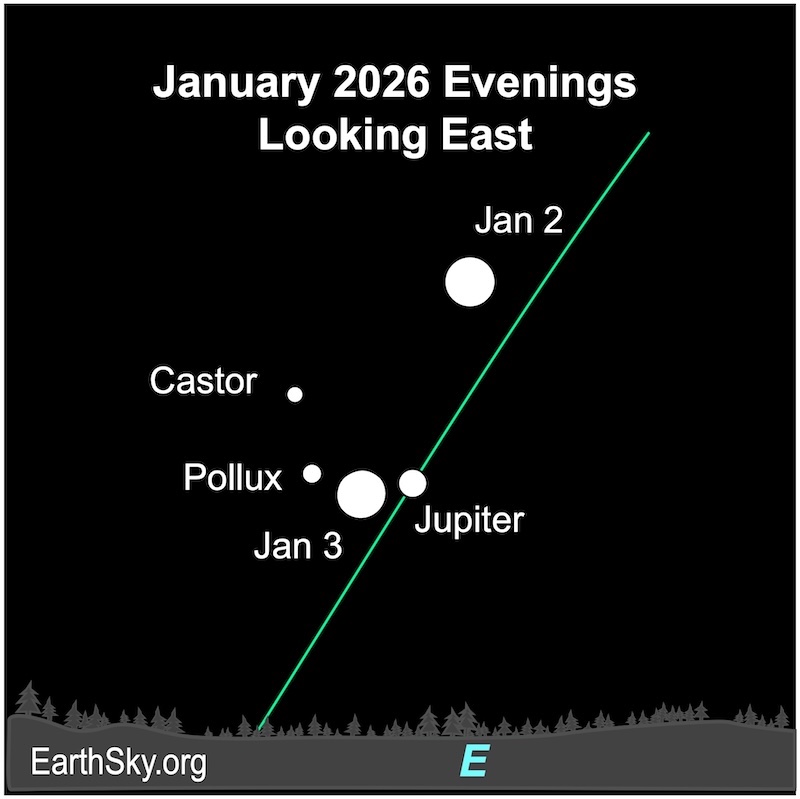
Read more: January full moon is the Super Wolf Moon. It’s near Jupiter!
January moon phases and alignments video
Join EarthSky’s Marcy Curran in a video preview of the moon phases – and planetary alignments – for the month of January 2026. See what’s in store in the night sky this month. Watch the video here or on YouTube.
January evening planets
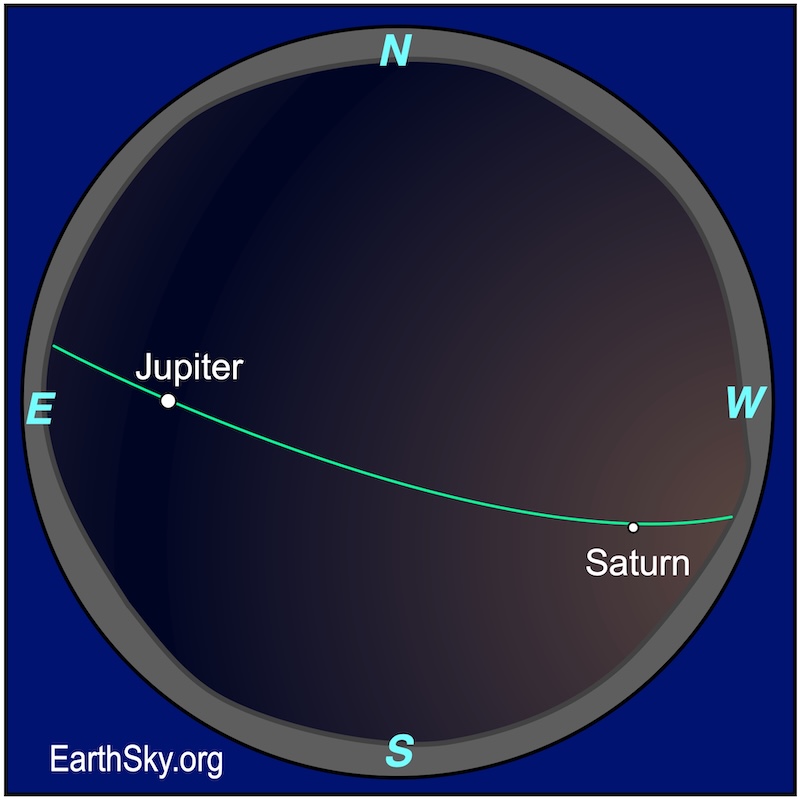
January 3: Earth closest to the sun
The Earth’s closest point to the sun is called perihelion. In 2026, it comes at 17 UTC on January 3 (11 a.m. CST). In early January, we’re about 3% closer to the sun – roughly 1.5 million miles (2.5 million km) – than we are during Earth’s aphelion (farthest point) in early July. And, on average, Earth is about 93 million miles (150 million km) from the sun.
Read more: Earth at perihelion – closest to sun – on January 3
Our charts are mostly set for the northern half of Earth. To see a precise view – and time – from your location, try Stellarium Online.
Early-January meteors … the Quadrantids
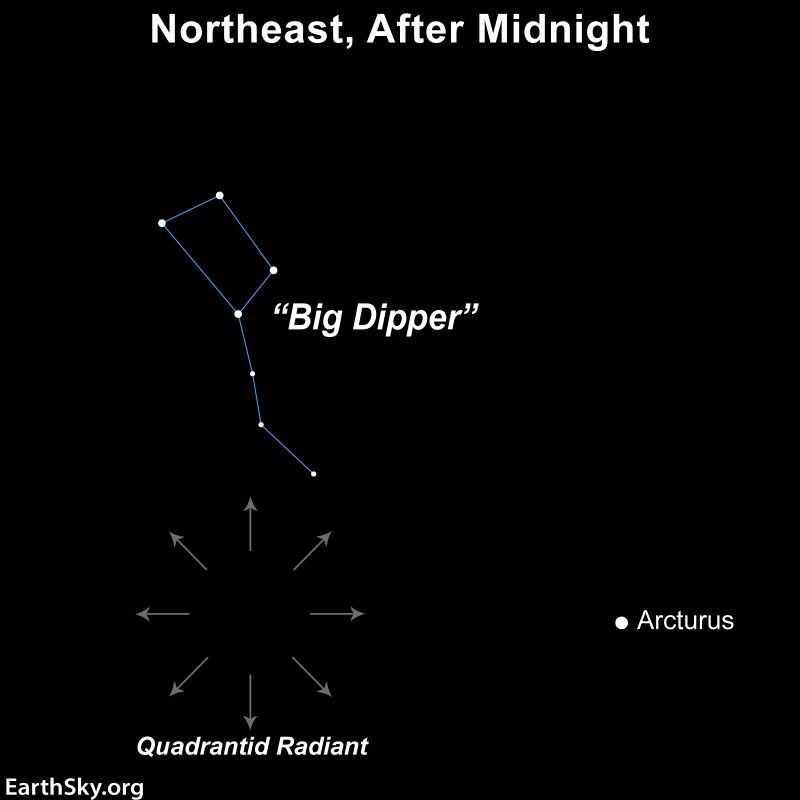
Read more: All you need to know about Quadrantid meteors
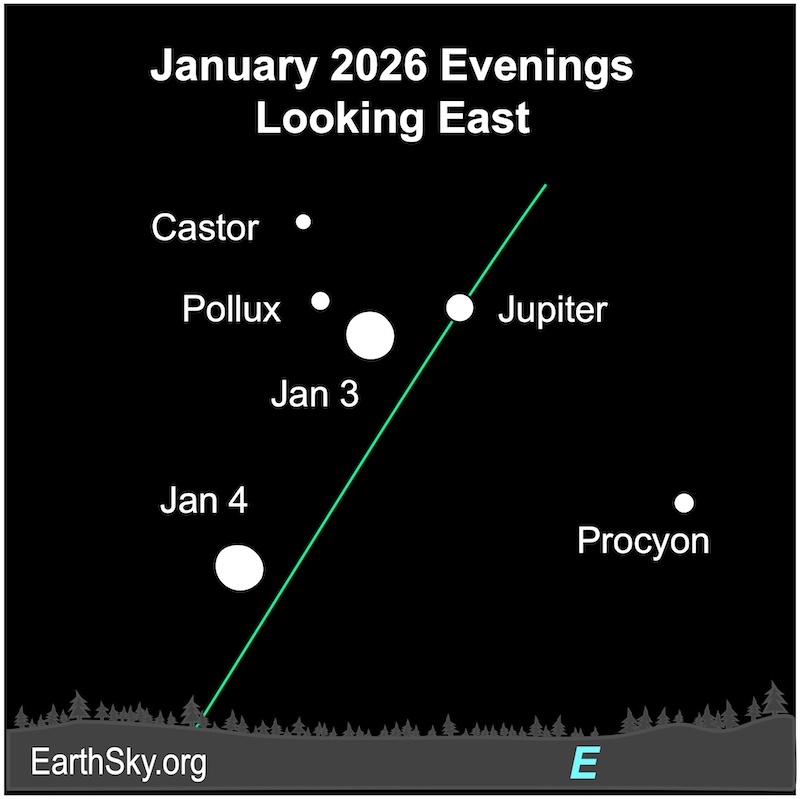
January 3 and 4 evenings: Moon, Jupiter and a trio of bright stars
January 5 and 6 evenings: Moon, Regulus and the Sickle
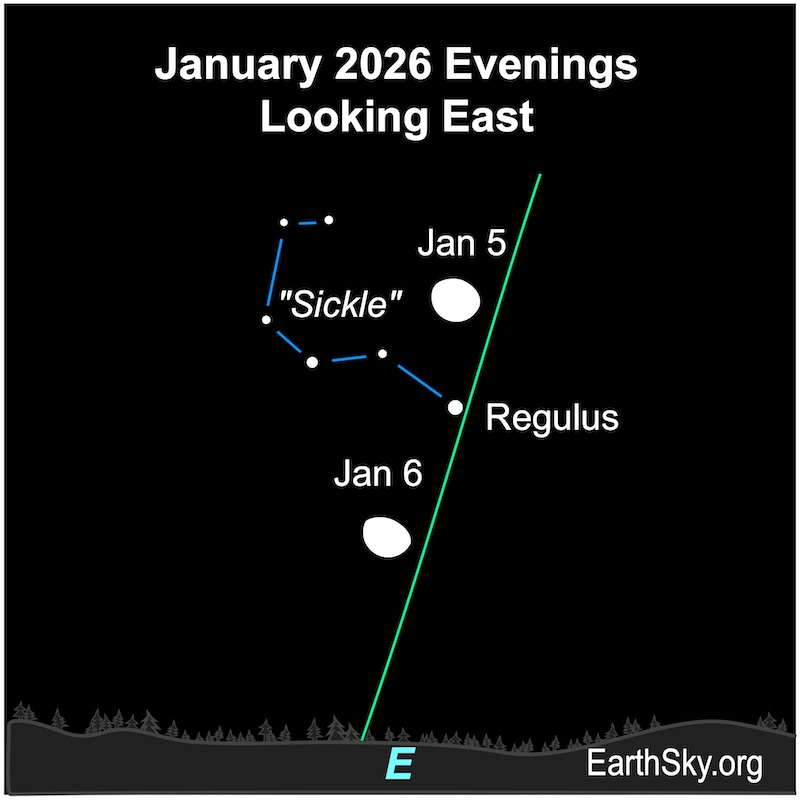
Read more: Meet Regulus, Leo the Lion’s Heart and brightest star
Our charts are mostly set for the northern half of Earth. To see a precise view – and time – from your location, try Stellarium Online.
January 10: Watch for the 3rd quarter moon
The moment of 3rd quarter moon will fall at 15:48 UTC on January 10, 2026. That’s 9:48 a.m. CST. It’ll rise after midnight your local time and set around noon. Look for it high in the sky before dawn.
Want more? Here are 4 keys to understanding the moon’s phases.
January 10: Jupiter reaches opposition

Read more: Earth flies between Jupiter and the sun January 2026
January 10 and 11 mornings: Moon and Spica
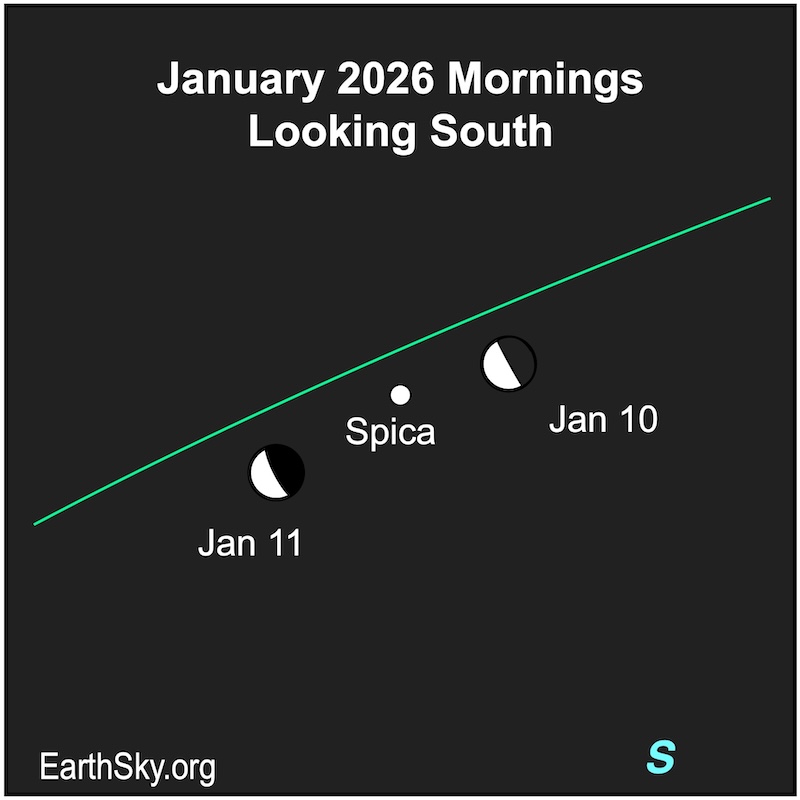
Read more: Spica, the bright beacon of Virgo, is 2 stars
January 13: Moon reaches apogee
The moon will reach apogee – its farthest distance from Earth in its elliptical orbit – at 21 UTC on January 13, 2026, when it’s 251,927 miles (405,438 km) away.
January 13 and 14 mornings: Moon and Antares
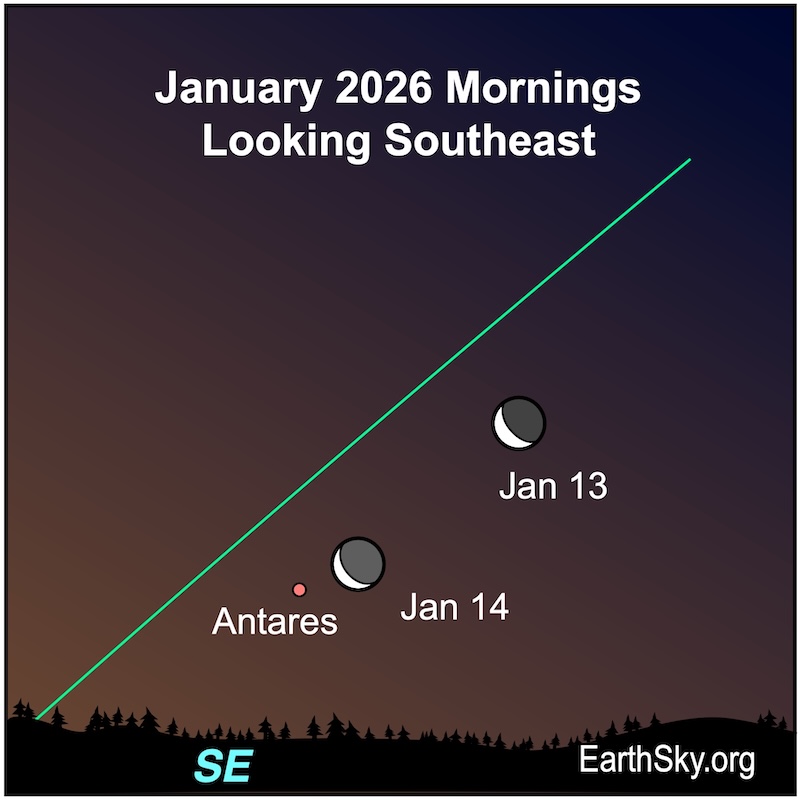
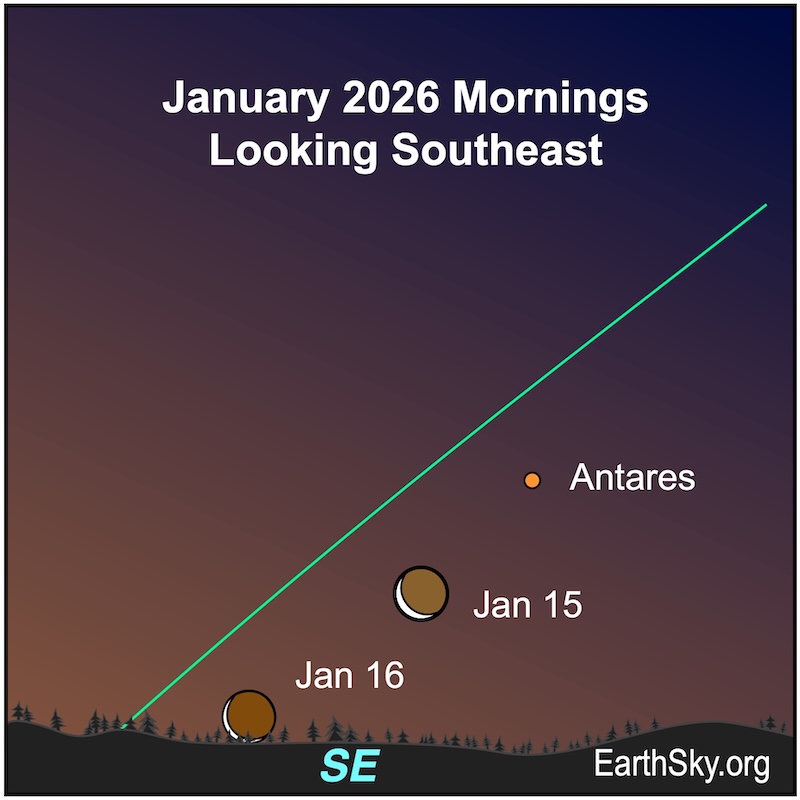
January 15 and 16 mornings: Slender crescent moon and Antares
January 18: New moon
The moment of new moon will fall at 19:52 UTC on January 18, 2026. That’s 1:52 p.m. CST. New moons rise and set with the sun. Nights around the new moon are perfect for stargazing. See EarthSky’s best places to stargaze.
Want more? Here are 4 keys to understanding the moon’s phases.
January 19-21 after sunset: The young moon
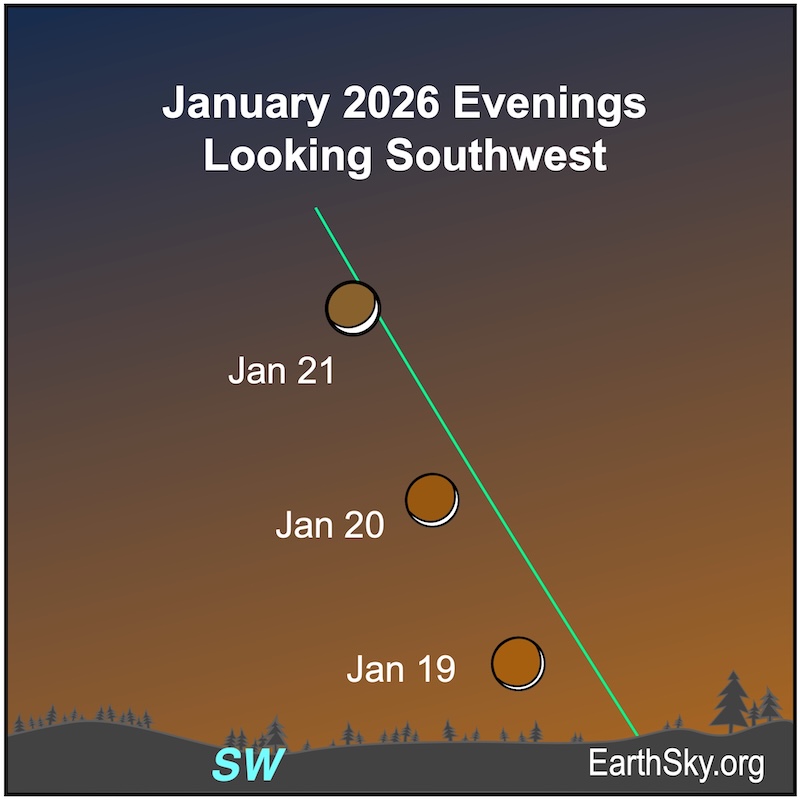
Read more: Do you love twilight? The 3 stages explained
January 22 and 23 evenings: Moon slips by Saturn
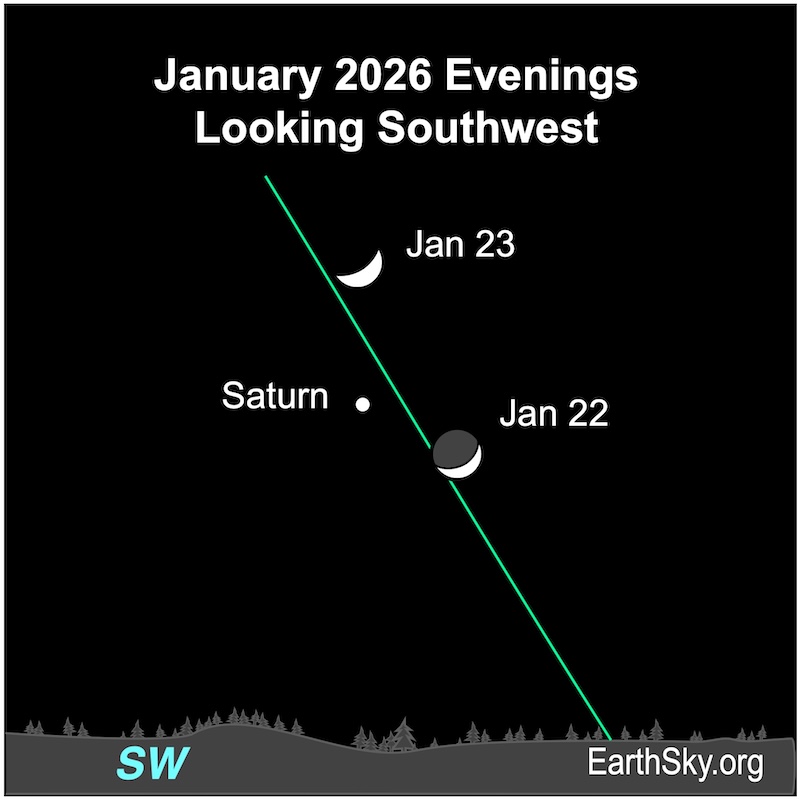
Read more: Saturn’s rings are weird and wonderful: 10 facts here
January 26: 1st quarter moon
The moment of 1st quarter moon will fall at 4:47 UTC on January 26, 2026. That’s 10:47 p.m. CST on January 25. A 1st quarter moon rises around noon your local time and sets around midnight. Watch for a 1st quarter moon high in the sky at sundown.
Want more? Here are 4 keys to understanding the moon’s phases.
January 26 and 27: Moon, Pleiades and Aldebaran
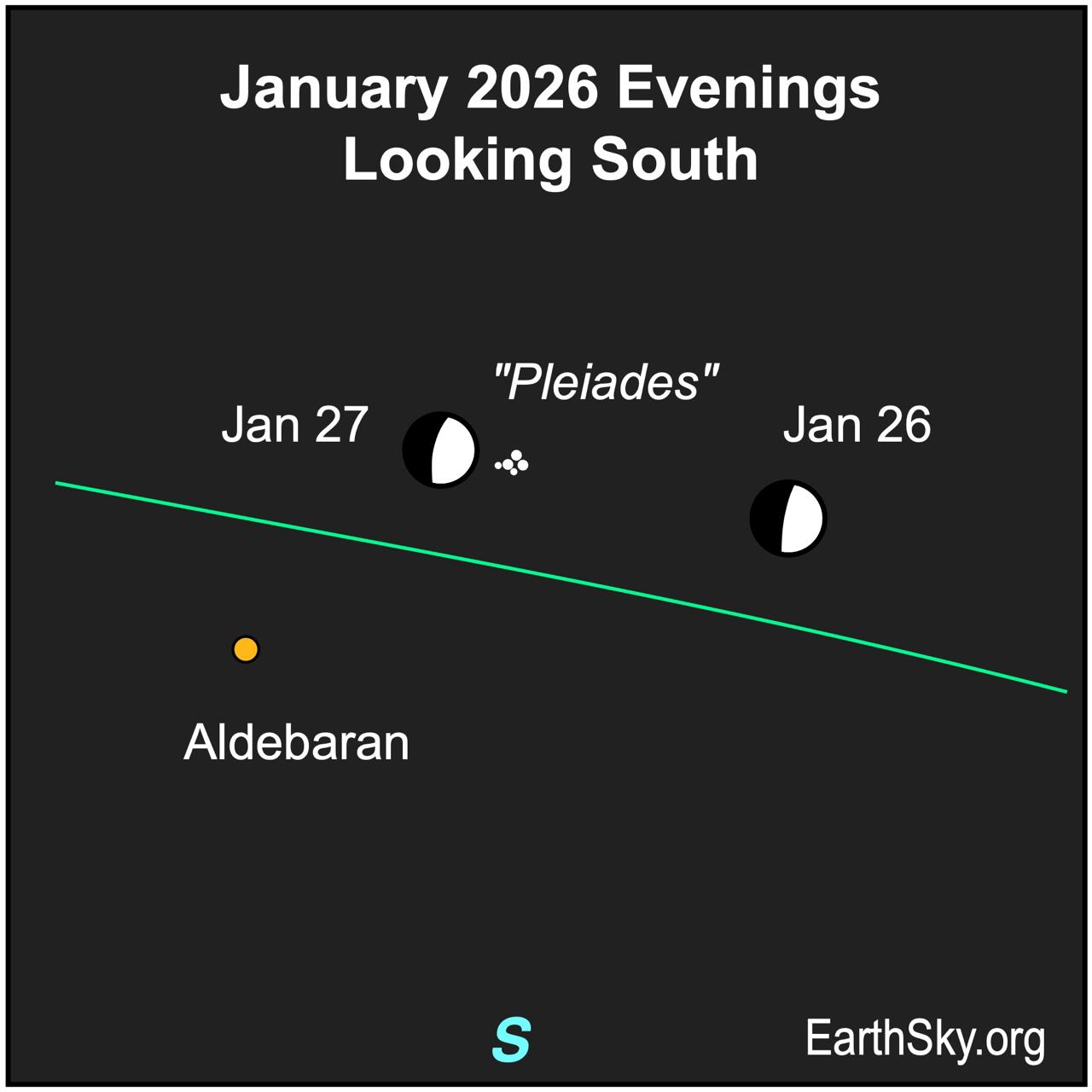
January 28 and 29: Moon and a trio of bright stars
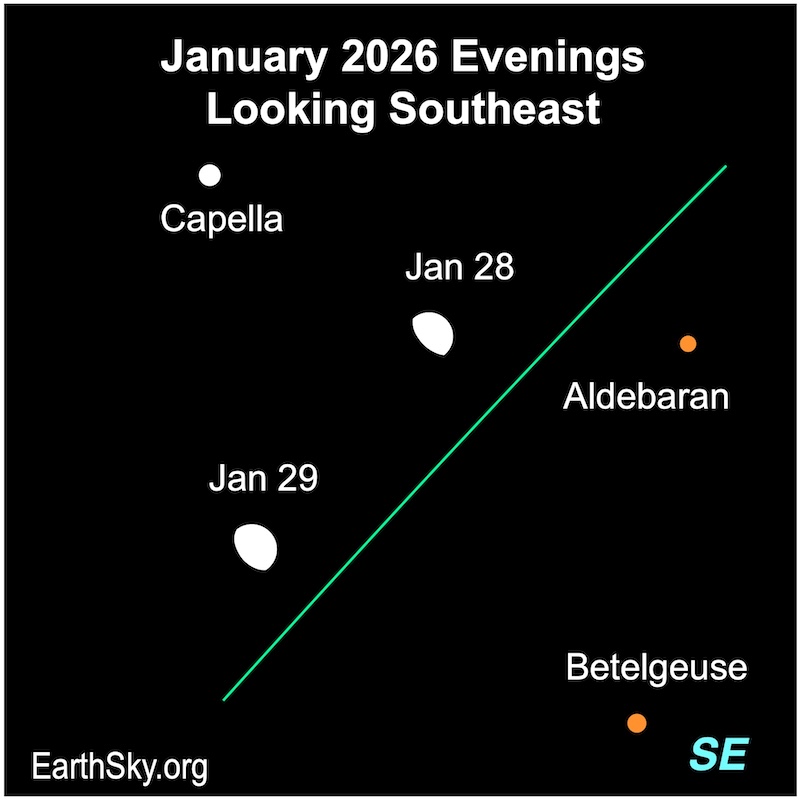
January 29: Moon reaches perigee
For the second time this month, the moon will reach perigee – its closest point to us in its elliptical orbit around Earth – at 22 UTC on January 29, 2026. Then it’ll be 227,341 miles (365,871 km) away from Earth.
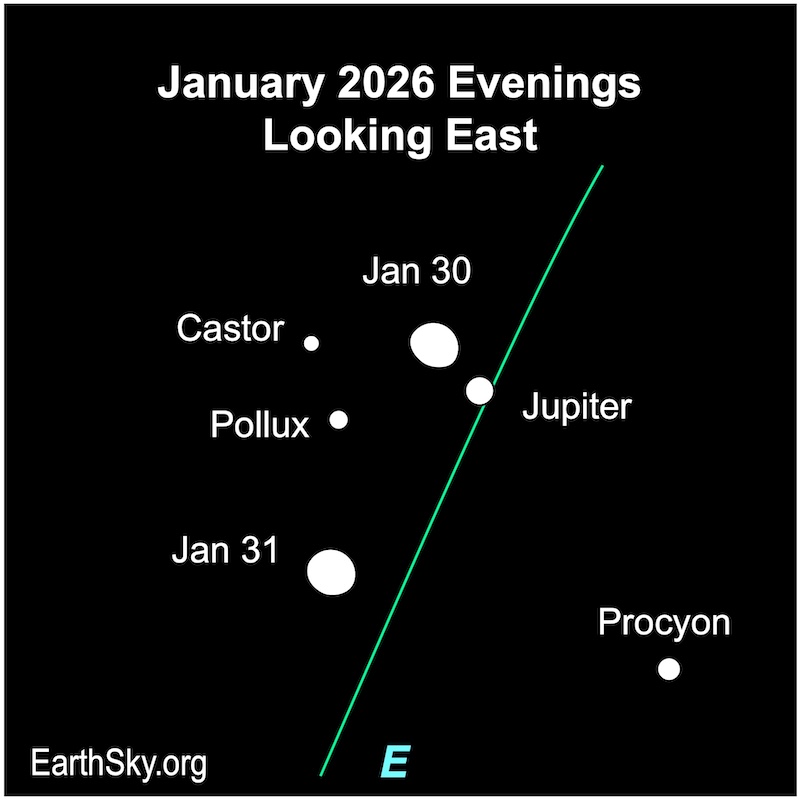
January 30 and 31 evenings: Moon, Jupiter and bright stars
Season Beginning Times For 2026:
| Date | Hour | Hem.North | Hem.South |
|---|---|---|---|
| March 20 | 14:45 | Spring | Autumn |
| June 21 | 08:25 | Summer | Winter |
| September 23 | 00:05 | Autumn | Spring |
| December 21 | 20:49 | Winter | Summer |
-
January 3, 4 – Quadrantids Meteor Shower. The Quadrantids is an above average shower, with up to 40 meteors per hour at its peak. It is thought to be produced by dust grains left behind by an extinct comet known as 2003 EH1, which was discovered in 2003. The shower runs annually from January 1-5. It peaks this year on the night of the 3rd and morning of the 4th. Unfortunately the full moon will obscure all but the brightest meteors this year. But if you are patient, you may still be able to catch a few of the brighter ones. Best viewing will be from a dark location after midnight. Meteors will radiate from the constellation Bootes, but can appear anywhere in the sky.
-
April 22, 23 – Lyrids Meteor Shower. The Lyrids is an average shower, usually producing about 20 meteors per hour at its peak. It is produced by dust particles left behind by comet C/1861 G1 Thatcher, which was discovered in 1861. The shower runs annually from April 16-25. It peaks this year on the night of the night of the 22nd and morning of the 23rd. These meteors can sometimes produce bright dust trails that last for several seconds. The first quarter moon will set shortly after midnight leaving dark skies for what should be a great show. Best viewing will be from a dark location after midnight. Meteors will radiate from the constellation Lyra, but can appear anywhere in the sky.
-
May 6, 7 – Eta Aquarids Meteor Shower. The Eta Aquarids is an above average shower, capable of producing up to 60 meteors per hour at its peak. Most of the activity is seen in the Southern Hemisphere. In the Northern Hemisphere, the rate can reach about 30 meteors per hour. It is produced by dust particles left behind by comet Halley, which has been observed since ancient times. The shower runs annually from April 19 to May 28. It peaks this year on the night of May 6 and the morning of the May 7. The waning gibbous moon will block out many of the fainter meteors this year. But if you are patient, you should still should be able to catch some of the brighter ones. Best viewing will be from a dark location after midnight. Meteors will radiate from the constellation Aquarius, but can appear anywhere in the sky.
-
July 28, 29 – Delta Aquarids Meteor Shower. The Delta Aquarids is an average shower that can produce up to 20 meteors per hour at its peak. It is produced by debris left behind by comets Marsden and Kracht. The shower runs annually from July 12 to August 23. It peaks this year on the night of July 28 and morning of July 29. Unfortunately the full moon will obscure most of the meteors this year. But if you are patient, you may still be able to catch a few of the brighter ones. Meteors will radiate from the constellation Aquarius, but can appear anywhere in the sky.
-
August 12, 13 – Perseids Meteor Shower. The Perseids is one of the best meteor showers to observe, producing up to 60 meteors per hour at its peak. It is produced by comet Swift-Tuttle, which was discovered in 1862. The Perseids are famous for producing a large number of bright meteors. The shower runs annually from July 17 to August 24. It peaks this year on the night of August 12 and the morning of August 13. This is an excellent year for the Perseids. There will be no moonlight to interfere with the show so be prepared for what could be an impressive display. Best viewing will be from a dark location after midnight. Meteors will radiate from the constellation Perseus, but can appear anywhere in the sky.
-
October 7 – Draconids Meteor Shower. The Draconids is a minor meteor shower producing only about 10 meteors per hour. It is produced by dust grains left behind by comet 21P Giacobini-Zinner, which was first discovered in 1900. The Draconids is an unusual shower in that the best viewing is in the early evening instead of early morning like most other showers. The shower runs annually from October 6-10 and peaks this year on the the night of the 7th. The waning crescent moon will not be much of a problem this year. Skies should be dark enough for a good show. Best viewing will be in the early evening from a dark location far away from city lights. Meteors will radiate from the constellation Draco, but can appear anywhere in the sky.
-
October 21, 22 – Orionids Meteor Shower. The Orionids is an average shower producing up to 20 meteors per hour at its peak. It is produced by dust grains left behind by comet Halley, which has been known and observed since ancient times. The shower runs annually from October 2 to November 7. It peaks this year on the night of October 21 and the morning of October 22. The waxing gibbous moon will block some of the fainter meteors in the evening. But it will set after midnight leaving dark skies for what could be an excellent early morning show. Best viewing will be from a dark location after midnight. Meteors will radiate from the constellation Orion, but can appear anywhere in the sky.
-
November 4, 5 – Taurids Meteor Shower. The Taurids is a long-running minor meteor shower producing only about 5-10 meteors per hour. It is unusual in that it consists of two separate streams. The first is produced by dust grains left behind by Asteroid 2004 TG10. The second stream is produced by debris left behind by Comet 2P Encke. The shower runs annually from September 7 to December 10. It peaks this year on the the night of November 4. The waning crescent moon should not be too much of a problem this year. Skies should still be dark enough for a good show. Best viewing will be just after midnight from a dark location far away from city lights. Meteors will radiate from the constellation Taurus, but can appear anywhere in the sky.
-
November 17, 18 – Leonids Meteor Shower. The Leonids is an average shower, producing up to 15 meteors per hour at its peak. This shower is unique in that it has a cyclonic peak about every 33 years where hundreds of meteors per hour can be seen. That last of these occurred in 2001. The Leonids is produced by dust grains left behind by comet Tempel-Tuttle, which was discovered in 1865. The shower runs annually from November 6-30. It peaks this year on the night of the 17th and morning of the 18th. This should be good year for the Leonids. The waxing gibbous moon will block some of the fainter meteors in the early evening. But it will set shortly after midnight leaving dark skies for what should be an excellent early morning show. Best viewing will be from a dark location after midnight. Meteors will radiate from the constellation Leo, but can appear anywhere in the sky.
-
December 13, 14 – Geminids Meteor Shower. The Geminids is the king of the meteor showers. It is considered by many to be the best shower in the heavens, producing up to 120 multicolored meteors per hour at its peak. It is produced by debris left behind by an asteroid known as 3200 Phaethon, which was discovered in 1982. The shower runs annually from December 7-17. It peaks this year on the night of the 13th and morning of the 14th. This is an excellent year for viewing the Geminids. The waxing crescent moon will set early in the evening leaving dark skies for what should be an excellent show. Best viewing will be from a dark location after midnight. Meteors will radiate from the constellation Gemini, but can appear anywhere in the sky.
-
December 21, 22 – Ursids Meteor Shower. The Ursids is a minor meteor shower producing about 5-10 meteors per hour. It is produced by dust grains left behind by comet Tuttle, which was first discovered in 1790. The shower runs annually from December 17-25. It peaks this year on the the night of the 21st and morning of the 22nd. Unfortunately the near full moon will block all but the brightest meteors this year. If you are extremely patient, you may be able to catch a few of the brighter ones. Best viewing will be just after midnight from a dark location far away from city lights. Meteors will radiate from the constellation Ursa Minor, but can appear anywhere in the sky.
January, 2026 Phenology:
Gray Whale Migration: Frequent Flyer Journeys
Giant mammals are now gliding past our coast on their journey south from feeding grounds in the Bering Sea to calving grounds near Baja California. Gray whales (Eschrichtius robustus) migrate more than 12,000 miles each year. Given they migrate close to shore, you may be able to see them from land along the Sonoma coast, at Pt. Reyes, and in Big Sur. Watch for the low, puffy (some call them heart-shaped) spouts produced when the whales exhale — with Point Reyes National Seashore’s lighthouse one of the best venues to view this phenomenon.
By Sea & Shore: Elephant Seals Are Currently “Must See” Viewing
Northern Elephant Seals (Mirounga angustirostris) spend most of their life in the open ocean, diving up to 5,000 feet to feed on pelagic fish and squid. They come ashore only to mate, give birth, and molt their old skin and hair. By January, female Northern Elephant Seals have returned to breeding beaches to give birth. The one 75-pound pup she produces each year gains 10 pounds a day as it nurses on her extra-rich (50% fat!) milk. Pups typically nurse for 28 days. After the pups are weaned, females mate with one or more of the dominant males before leaving the beaches. By mid-March all the adults are gone, leaving the pups to fend for themselves. In the ultimate Survivor test, the pups (now called weaners) must learn to swim and catch fish on their own. Once they’ve mastered these basic skills, the pups take to the sea, heading north to feed off the coast of Washington and British Columbia. They won’t return to land until the fall. In the Bay Area, you can see elephant seals pups at Chimney Rock in Pt. Reyes, or on a naturalist-led tour (reservations required) at Año Nuevo State Reserve.
Stinky Blooms Delight Senses
While its name sounds like an unpleasant affliction, Fetid Adder’s Tongue (Scoliopus bigelovii) is actually a lovely wildflower. January is a good time to start searching for this diminutive lily relative along trails in redwood forests. Three small, cream and maroon-striped sepals surround three delicate upturned petals and three stamens. The odorous blooms fade quickly but the dramatic mottled leaves persist for several months.
After tiny fungus gnats pollinate the flowers, the seed capsules’ weight pulls the stems to the ground, giving the plant its other common name, “Slink Pod.” Slugs and ants may help spread seeds. In Marin County, look for Fetid Adder’s Tongue in Muir Woods National Monument, Mount Tamalpais (Blithedale Canyon, Cataract Gulch, Fish Grade), Bolinas Ridge, San Geronimo Ridge, and San Rafael Hills. On the Peninsula, it may be found in early January along Crystal Springs Trail in Huddart County Park (Woodside) and later in the month along the Hazelnut Trail in San Pedro County Park (Pacifica).
Early Wildflower Bloom: 2023 Forbs/Ephemerals
Given our ample rainfall in 2022 and in early January, 2023, it will soon be time to enjoy blooming wildflowers. Where are excellent spots to enjoy their beauty and dozens of other colorful wildflowers? Check out:
Annadel State Park, Santa Rosa, CA, Sonoma County
Chimney Rock (near the Lighthouse, Outer Point, Point Reyes National Seashore), Inverness, CA, Marin Co.
Edgewood County Park (south of SF), off I-280 and adjacent to it, San Mateo County
Black Diamond Mines Regional Park (ebparks.org), near Antioch and, especially, on Somersville Road (that exits off of Highway 4), East Bay of SF Bay
Are Herring Here Yet?
Please note…..For herring infusion updates into the SF Bay, see: https://cdfwherring.wordpress.com/
Watch for frenetic collections of gulls, scoters, cormorants, and sea lions within shallow spots of the Bay. Their presence is an indication that Pacific Herring have made their annual arrival. As early as November, yet sometimes waiting until this time of year, adult males and females seek spawning (i.e., egg laying) locations in shallow intertidal and subtidal waters. A single female may lay as many as 20,000 eggs in one spawn following ventral contact with submerged substrates such as eel grass. Why spawning begins is not understood, but some researchers believe the male initiates the process by release of milt (the seminal fluid of herring) that contains a pheromone that stimulates a female to begin egg laying. Egg laying appears to be collective so that an entire school may spawn in the period of a few hours, producing an egg density of up to 6,000,000 eggs per square meter.
Pop Quiz:
Which bird species is probably the earliest breeder in Marin County?
Answer: Early nesting Anna’s hummingbirds may lay eggs this month or, in some cases, last month. More information about hummingbirds in California appears in the next account.
Note that some Anna’s Hummingbirds exhibit nesting/courtship behavior by October. I noticed this phenomenon in my backyard’s forested/open woods area this past autumn. The loud “pop” of diving males was heard regularly in our autumn landscape.
Of course, a second (and third brood) of Anna’s may result from the most prolific breeders of this species. Not that any male Anna’s would know about their brethren. That’s because the male Anna’s never bonds with his female partners. All males merely provide the “seed” by which newcomers develop in females, but they are left to fend for themselves on the nest. Males opt for quickly exiting Stage Left after impregnating their suitors. For this reason, you might say Anna’s males take “Speed Dating” to a new avian level and meaning.
Hummingbirds In California: Early Breeders
Anna’s Hummingbirds, year-round residents in northern California (and throughout much of the state), may already be laying eggs — perhaps initiating courtship and/or nesting as early as December (!). Some early-nesting females will play hostess to two broods during the breeding season, with second clutches hatching as late as mid-August. Peak breeding and greatest nest abundance occurs in May. Amazing but true, this year’s initial breeding cycle began in October in Marin County where I live. That’s when I began seeing courtship dances by male Anna’s on my land. Whether the females were receptive then is another question that remains unproven.
Research studies have indicated this hummer species memorizes and learns a song in its first year of life, similar to the behavior of most songbirds. Allen’s Hummingbirds, which breeds from s. California to s. Oregon, begin to arrive annually in the SF Bay Area early as mid-January after spending the winter in Baja California and Chihuahua in Mexico. Some of the arrivals may remain to breed in the area.
Other populations of this species are year-round residents in southern California.
Their preferred habitat is canyon woodlands, brush and highland meadows. This species breeds in the Bay Area, but by the end of July many have dispersed and/or left the Bay Area, and in mid- to late-August most of the species’ population has migrated south.
Rufous Hummingbirds are seen only during migration in California, except for the extreme northern part of the state where their breeding area begins (and stretches north throughout much of Oregon, all of Washington, and into parts of Idaho, Montana and Wyoming, as well as into British Columbia, Alberta and southeast Alaska). In Marin County, expect to begin seeing this transient species as early as mid-February, with a peak presence from mid-March through mid-April. By the end of May, Rufous are typically absent in Marin Co. The autumn migration spectrum is from mid-June through September in Marin Co., especially outside the County amid the Inner Coast Ranges, but sometimes along the coast, too.
Other hummingbirds occur in California, of course, but the aforementioned three species are usually the most common ones to see in the Bay Area/Marin County. Calliope, and Costa’s Hummingbird, and Black-Chinned Hummingbird are sometimes observed in the Bay Area, though the initial two of these three species is considered a “casual visitor” to Marin County (and Black-Chinned the most rare, yet still considered a “casual visitor”) — with all three occasional to common casual visitors in more eastward Bay Area counties.
See above for more information about the breeding dynamics of Anna’s Hummingbird in N. CA/the Bay Area.
Swallows During Winter In Northern California?
They are never a common sight, but it’s possible to see the following swallow species in Marin County (and the Bay Area) during the winter in the following order, from most common to rare: Tree (now annual during the non-breeding season in Marin County), Barn (not always annual, but typically seen during most “winters” in the Bay Area), and Violet-green (likewise, not always annual during the non-breeding season, yet often reported from November-February before migrants return to breed in the Bay Area). Our other northern California summer residents — Northern Rough-Winged, Cliff, and Bank — are considered rare to absent in January, though they may return on migration by no later than the end February during some to most years.
Purple Martin are also typically absent from our area in January and February. As for swift species, White-Throated are by far the most typical one to see, if any, from January-March, and they are considered year-round residents in the SF Bay Area. Vaux’s return on migration in April, while the more uncommon to “casual visitor” swift species — Chimney and Black — are usually spotted (if at all) from May through mid-October in northern California.
Checklists specific to a Bay Area region sometimes miss indicating the aforementioned swallows are potential winter sightings. I’ve noticed, for example, more reports by excellent birders in recent years of over-wintering Tree and Barn in the Bay Area. To wit, in the past, many of the same birders in the Bay Area used to believe that Tree Swallow completely left the Bay Area as an autumn migrant. Now, that dynamic has changed. Instead, Tree Swallow (and, increasingly, Barn Swallow) are considered a regular non-breeding season inhabitant (in small numbers) throughout the Bay Area (e.g., Las Gallinas Wildlife Ponds, San Rafael, Marin Co.).
Hibernating Birds in Our Area?
Not exactly. But our Common Poorwill (Phalaenoptilus nuttallii californicus) (also called the Dusky Common Poorwill as the nominate race among five subspecies in the species) does exhibit winter torpor. According to Wikipedia, the Common Poorwill is the only bird known to go into torpor for extended periods (weeks to months). Such an extended period of torpor is close to a state of hibernation, a condition not known among most other birds. It was described definitively by Dr. Edmund Jaeger in 1948 based on a Poorwill he discovered hibernating in the Chuckwalla Mountains of California in 1946.
By the way, don’t let this bird’s name fool you. It’s never “common” where we live in northern California. In Marin County, one of the best spots to see Common Poorwill is along open areas, hillsides and talus slopes on Mount Tamalpais. More typical, I hear this bird’s vocalizations only and, if I’m lucky, then find it. Tilden Park in Berkeley periodically hosts this species, too. My BEST success for finding this species is in Lake County’s higher altitude spots as they flee from perches on the road at dawn while I’m riding on backroads.
February, 2025
Sky Watch:
1) Moon & Planet Rise & Set Times
Go to: https://www.timeanddate.com/astronomy/night/
Then type in your location to see planet highlights for each day of the month.
For my area in February, 2024, here’s planet viewing information:
| Planetrise/Planetset, Tue, Feb 1, 2022 | ||||
|---|---|---|---|---|
| Planet | Rise | Set | Meridian | Comment |
| Mercury | Wed 6:00 am | Wed 4:03 pm | Wed 11:01 am | Difficult to see |
| Venus | Wed 4:56 am | Wed 3:15 pm | Wed 10:06 am | Great visibility |
| Mars | Wed 5:05 am | Wed 2:30 pm | Wed 9:47 am | Average visibility |
| Jupiter | Tue 8:28 am | Tue 7:31 pm | Tue 1:59 pm | Average visibility |
| Saturn | Tue 7:28 am | Tue 5:42 pm | Tue 12:35 pm | Extremely difficult to see |
| Uranus | Tue 11:06 am | Wed 12:45 am | Tue 5:55 pm | Difficult to see |
| Neptune | Tue 9:04 am | Tue 8:40 pm | Tue 2:52 pm | Very difficult to see |
All times are Pacific Standard Time at sea level.
Tonight’s Sky in Novato, Feb 1 – Feb 2, 2022 (7 planets visible)

Mercury rise and set in Novato
Fairly close to the Sun. Visible around sunrise and sunset only.
Wed, Feb 2↑6:00 am

Venus rise and set in Novato
View before sunrise.
Wed, Feb 2↑4:56 am

Mars rise and set in Novato
View before sunrise.
Wed, Feb 2↑5:05 am

Jupiter rise and set in Novato
View just after sunset.
Tue, Feb 1↓7:31 pm

Saturn rise and set in Novato
Very close to Sun, hard or impossible to see.
Tue, Feb 1↓5:42 pm

Uranus rise and set in Novato
View after sunset. Bring binoculars.
Wed, Feb 2↓12:45 am

Neptune rise and set in Novato
View after sunset. Use binoculars.
Tue, Feb 1↓8:40 pm
2) Planet Highlights (courtesy http://www.almanac.com):
- Early this month, Saturn materializes as a low morning star just before sunrise, joining higher-up Jupiter and Mars, all in Sagittarius. These three superior planets bunch closer together as the month progresses. It’s probably easiest to spot bright Jupiter; then look for Mars above and Saturn below.
- Venus: After sunset, Venus pops out at you as the brightest thing in the western sky. This shining beacon will continue to dazzle through the entire month as dusk falls. In the second half of the month, Venus is really the only bright object that appears in the west after sunset. It’s impossible to miss.
- Mercury: Look far to the lower right of Venus. Any “star” you see down there is Mercury! Look near the sunset point on the horizon shortly after sunset. During this month’s first 12 days, Mercury has its best showing of 2020 at a very bright magnitude 0, far below the more dazzling Venus, which stands 10 degrees high 40 minutes after local sunset. You no longer need telescope or binocoluars to find Mercury (though binoculars will help).
February Moon and Planet Pairings
- On February 18, the waning crescent Moon offers a strikingly close conjunction with Mars before dawn. Then on the 19th, the Moon passes to the right of Jupiter to be just below Saturn on the 20th, providing easy identification of these two gas giants that will astonish the world in December.
- On February 27 and 28, the waxing crescent moon pairs with bright Venus.
February 16-18, 2024:
Backyard Birdwatchers Unite As Citizen Scientists — The Annual Great Backyard Birds Count
Each February, backyard birdwatchers help scientists and bird enthusiasts learn more about bird populations across the United States by participating in The Great Backyard Bird Count, a joint project of the Cornell Lab or Ornithology and the Audubon Society. So, if you want to count your backyard birds and report your observations online, go learn more at: birdcount.org
Bird Classification Changes For 2024?
We’ll know as birders by this June or July, 2024 whether one or more of the following proposals are approved, per this link, if you wish to review them:
Insects Awakening:
Ladybird Beetles Becoming Active After Winter Slumber (Dormancy)
(Source: http://lancaster.unl.edu/hort/articles/2002/winterbugs.shtml)
Did you know that insects migrate? In May and June, one of our most familiar six-legged residents, the Convergent Ladybird Beetle (Hippodamia convergens), moves from the hot, dry valleys to the cooler climes of the High Sierra and Coast Ranges. Once in the mountains, the adult beetles bulk up in preparation for hibernation by eating pollen and nectar. When temperatures dip in the fall, the beetles follow river valleys to lower elevations (2,000-5,000 ft.), where they gather in huge numbers and take shelter for the winter under leaf litter, inside tree hollows, and in any other protected location. When the weather begins to warm up in late February and early March, tens of thousands of ladybird beetles emerge from hibernation and head back to the valleys.
Why so much movement? Aphids are the answer. Larval ladybirds are voracious carnivores, gobbling up to 50 aphids a day. Before home gardeners and farmers started artificially introducing water to the landscape, aphids were only present during the rainy season. So ladybird beetles evolved to exploit this seasonal abundance, timing their arrival in the valley and subsequent egg-laying to coincide with the early spring’s aphid population explosion.
Each ladybird beetle lives for only one year. After mating and laying eggs (usually by May), the adults die, making way for the next generation.
Heads Down: Looking for Newts On The Loose
(Source: http://amphibiaweb.org/cgi-bin/amphib_query?where-genus=Taricha&where-species=torosa)
In the San Francisco Bay Area, mature California Newt (Taricha torosa) individuals begin their annual migration to breeding ponds and streams in December and continue migrating until the end of this month. Look for these intrepid amphibians on land during wet weather near deep, slow pools. The East Bay’s Tilden Park and Sunol Regional Wilderness are two local Hot Spots.
In fact, Tilden’s South Park Drive is such a superhighway of amphibian traffic (as they cross the road while oblivious to the approaching death march of vehicle tires) that park officials close it from November-March in order to protect newts.
The California newt embraces its amphibian activity in a fast-forward lifestyle. Seeing them amble about the landscape now is rare because for the vast majority of the year, they’re underground or in burrows/logs/leaf litter, etc. Peak viewing times correspond to rainy nights, as they seek mates and lay their eggs in ponds or streams (such as Tilden’s habitats).
Mission accomplished above ground, adults retreat from the water quickly after breeding, and spend the dry summer months hunkered down while aestivating (“hibernating”) away from our view. Likewise, young (larval) newts develop in water. As water supplies dwindle, larvae begin to change into adults (metamorphosis). Young newts leave the water in later summer or fall, spend the next few years on land, and return to the water to breed after reaching maturity.,
When do young mature and become adults? We don’ know. Researchers who study newts in the field have not identified the age of sexual maturity: datasets vary from three to eight years.
California Newts can live for more than 20 years. This longevity is no doubt aided by their extreme toxicity. Adults, embryos and eggs contain tetrodotoxin (TTX), a strong and potentially deadly neurotoxin. Larvae, however, do not posses TTX, making them an important food source for animals such as garter snakes. To be on the safe side, say hello to these colorful newts if you find them crossing the road, but don’t give them a kiss for good luck.
Wildflowers Rising To The Occasion
Watch now for more than a dozen early wildflowers opening their blossoms in a variety of habitats. Within coast live oak/California bay forests, you’re likely to see ground iris, Douglas iris, milkmaids, hounds tongue, mission bells, and California buttercup.
An excellent Web site to track the bloom of spring wildflowers is compiled and maintained by writer/photographer Carol Leigh. To see reports of the latest sightings or to announce your own discoveries, visit:
http://calphoto.com/wflower.htm or see the Marin Native Plant Society’s home page where wildflower enthusiasts post their “first of season” sightings.
Loud Waterfalls Announce The Season
Prime time viewing of the Bay Area’s and northern California’s ample waterfalls are a delight to the senses. What could be more invigorating and awe-inspiring than to feel the powerful force of liquid Earth bombarding the placid landscape? Looking up at the roaring display of frenetic molecules in motion within a waterfall, it’s easy to lose track of time. You’re simply “there,” and life is good. Your hypnotized gaze is proof that the best things in life are free. Some of the best locations for viewing waterfalls in our area appear in a Web site: http://www.norcalhostels.org//news/springtime-hikes-waterfalls-marin-county
A different angle is to think how loud, rushing water along your trail walk may challenge your ability to successfully converse with a trailside partner. After a few switchbacks of dialogue that include “what” and “sorry,” you decide there’s a better solution than yelling and screaming. You decide to surrender. A hike with the mute button “on” is not all bad. You let the anarchic accompaniment of water be your solace, a step-by-step meditation.
Loud Waterfalls, Cacophonous Creeks, And Bird Song
As an extension from the previous entry above, consider the following ecologic mystery while you’re walking beside a creek that emits an incessant refrain of rushing water: Does the loud sound affect singing birds and their ability to hear each other while establishing territories and attempting to attract mates along bottomland areas? The answer is only partially understood. In early winter, the question is invalid when no singing bird species in our area have yet begun to use their voices to attract mates or defend territories.
But conditions soon change when February arrives. In particular, now’s the time to ponder whether Orange-Crowned Warbler males (that may begin arriving in late February in our area) are negatively impacted by the cacophonous presence of water? Does the noisy environs affect their ability to successfully complete their appointed season’s life cycle? And what about Oak Titmouse, Bewick’s Wren, and Hutton’s Vireo — all of which are often singing in February and beyond within or nearby in upland areas within earshot of noisy bottomlands? Do all of these bird species have to wait until March and April and beyond to attract a mate that can finally better hear them? Or do they simply abandon a percussive bottomland area for more quiet nesting areas elsewhere that offer similar habitat conditions? The answer is a qualified “yes.” At least one streamside study has shown birds upland and more removed from loud streams have an easier time hearing the companion birds with which they share the same habitat. The article suggests upland birds more successfully find mates and complete their breeding cycle with newborns fledgling from nests.
Sea Urchins: Low Tide Lookout
This month and next, watch for red sea urchins (a four-inch echinoderm) during low tides along rocky stretches of the northern California coast. Spawning occurs now through March, and their populations appear to be flourishing due in part to the increasing absence of predators (such as sea otters) in parts of the ranges where both these critters live.
Returning Migrants: Premiering Now
Early returning birds that you may now begin seeing include several swallow species (beyond populations that did not leave the Marin County area/Bay Area for the winter and are periodically spotted during the non-breeding season), such as Tree Swallow, followed by Violet-Green (mid-February), Cliff (mid-February), and Barn and Northern Rough-Winged (late February). Purple Martin will also arrive by April and nest in the area. Bank Swallow is rare to locally extinct in much of the Bay Area.
Ruby-crowned Kinglets: Small Is Beautiful
One of the most common birds you can see in the winter landscape now is the diminutive and frenetic Ruby-Crowned Kinglet. Enjoy them while they’re here. They’ll soon be gone. By the end of April, most have left for breeding grounds in the foothills/Sierras and latitudes farther north, and all vacate the Bay Area during the breeding season.
Meanwhile, populations of the look-alike Golden-Crowned Kinglet are also present in the Bay Area during this time, but it only breeds in the western portion of Marin County. One major telltale field mark clue is the absence of feather coloring in the crown of most Ruby-Crowneds, while all Golden-Crowned, both male and female, exhibit yellow in the crown (with the male also wearing a golden central median stripe on the crown).
Their feeding behavior is also often an easy way to tell them apart from a distance. One study suggests Ruby-Crowneds forage within the upper thirds of trees more frequently and that individuals typically hover while they feed in a tree’s interior portions. On the other hand, Golden-Crowned populations often use a gleaning behavior to find food resources at the tips of branches (Kathleen E. Franzreb, Foraging Habits of Ruby-Crowned and Golden-Crowned Kinglets in an Arizona Montane Forest,
Kathleen E. Franzreb. 139-145, 1984; A. Keast and S. Saunders, Ecomorphology of the North American Ruby-crowned (Regulus calendula) and Golden-crowned (R. satrapa) Kinglets. Auk 108: 880–888, 1991)
Owl All Around
Seeing an owl during the day in open country? If so, you may be observing the Short-Eared Owl, which wears a dark facial disk that emphasizes its yellow eyes. Short-eard Owl is rarely seen in Marin County, but individuals are sometimes spotted in isolated portions along Tomales Bay or in distant trails and raised embankments accessible from the Las Gallinas Ponds in San Rafael.
Other day-flying, or diurnal, owl species to look for include the Burrowing, Long-Eared and Barn Owl. Which is the most common owl species in our area? The answer is the Great Horned Owl, a species that is more common in urban-suburban areas than people realize. Even the slightest sliver of natural surroundings may attract this species that has evidently adapted well to living within and near developed areas.
The Burrowing Owl is rare and usually only seen in open areas during the non-breeding season. Long-Eared are also rare and perhaps best found in dense growths of vegetation such as riparian corridors. Barn Owl nests throughout the area, both in human structures or in trees such as oaks. More common, though heard more often than seen, is the diminutive Western Screech-owl, a forest dweller. Nest boxes often attract them, including one in both my front and backyard woodland.
Mammal Watch
Winter-active mammals you can spot at higher altitudes this time of year include pikas, deer mice, pocket gophers and tree squirrels. Other active foraging mammals to search for are meadow mice, mountain beaver (or Aplodontia), shrew, and porcupine.
March, 2024
Sky Watch*:
Go to: https://www.timeanddate.com/astronomy/night/
Then type in your location to view the March night sky scenario for your area.
(* = Enchanting views of my night sky in Novato, CA location enhanced thanks to optic devices from Out of This World Optics, a Mendocino, CA binocular and spotting scope storefront and mail order company you may enjoying discovering at OutofThisWorldOptics.com)
1) Planet Rise & Set Times
For The 19th of This Month (at Latitude: 38:03:38 N, Longitude: 122:32:27 W, which is Novato, CA, 20 miles north of San Francisco, CA in Marin County):
(Courtesy of almanac.com)
| Body | Rises | Crosses Meridian |
Illum. | Sets |
|---|---|---|---|---|
| Mercury | 7:22 A.M. E |
1:44 P.M. 58° |
6% | 8:06 P.M. W |
| Venus | 6:51 A.M. E |
1:23 P.M. 61° |
2% | 7:55 P.M. W |
| Mars | 1:20 P.M. NE |
8:48 P.M. 76° |
91% | 4:18 A.M. NW |
| Jupiter | 10:54 A.M. NE |
6:11 P.M. 74° |
99% | 1:31 A.M. NW |
| Saturn | 7:09 A.M. E |
12:57 P.M. 47° |
100% | 6:45 P.M. W |
| Uranus | 9:44 A.M. NE |
4:47 P.M. 70° |
100% | 11:50 P.M. NW |
| Neptune | 7:22 A.M. E |
1:20 P.M. 50° |
100% | 7:18 P.M. W |
| Pluto | 5:00 A.M. SE |
9:46 A.M. 29° |
100% | 2:32 P.M. SW |
2) Planet Highlights: (courtesy of earthsky.com)

Read more: Massive ruby red Antares is the Scorpion’s Heart
Our charts are mostly set for the northern half of Earth. To see a precise view – and time – from your location, try Stellarium Online.
March equinox: March 20
The March equinox marks the sun’s crossing above Earth’s equator, moving from south to north bringing spring and summer to the Northern Hemisphere. At the same time, the March equinox marks the beginning of autumn – and a shift toward winter – in the Southern Hemisphere. The sun crosses the celestial equator – a line directly above Earth’s equator – at 9:01 UTC (4:01 a.m. CDT) on March 20, 2025. EarthSky’s Marcy Curran has more about the equinox in the video above. Or watch on YouTube.
Star and planet forecast for equinox week
Experience exciting cosmic events this week. How? Look at the sky! Join EarthSky’s Deborah Byrd for a star and planet forecast for equinox week.
Venus at inferior conjunction March 22-23
We’ll have a fantastic crossing of Venus between the Earth and sun this weekend! Venus reaches inferior conjunction – passing between Earth and sun – at 1 UTC on March 23, 2025. Read about the inferior conjunction of Venus. Or join EarthSky’s founder Deborah Byrd for a discussion, videos and more, at 12:15 p.m. on Friday, March 21. Watch in the player above, or click here to watch on YouTube.
Can you spot Venus both morning and evening around March 22?

March 22 and 23 mornings: Moon and the Teapot

Read more: Teapot of Sagittarius points to Milky Way center
Earth passes through Saturn’s ring plane
On March 23, 2025, as seen from Earth, Saturn’s angle of tilt toward Earth places the rings edge-on from our vantage point. This happens approximately every 13 to 15 years. Saturn’s rings are remarkably flat. When they’re turned precisely edge-on to us, they’ll seem to disappear! Unfortunately for observers, Saturn is too close to the sun right now to see.
Read more: Saturn’s rings are disappearing!
March 24 and 25 mornings: Can you still see the moon?

It’s zodiacal light time
Look west when true darkness falls each evening from the Northern Hemisphere. Look east before dawn begins to break in the Southern Hemisphere. You’ll find a hazy pyramid of light – huge – and milkier in appearance than the Milky Way. For the northern part of the globe, the zodiacal light is most visible in the evenings around the March equinox. You need a dark sky to see this eerie light. Read more about the zodiacal light. Or watch the video in the player above or on YouTube.
Late March evenings: Jupiter and Mars

March 29: New moon and partial solar eclipse
The moment of new moon will fall at 10:58 UTC (5:58 a.m. CDT) on March 29, 2025. New moons rise and set with the sun. It’s the second of five new supermoons in a row for 2025. Plus, observers in northeastern North America, Greenland, Iceland, the north Atlantic Ocean, most of Europe and northwestern Russia can see a deep partial solar eclipse. Nights around the new moon are perfect for stargazing. See EarthSky’s best places to stargaze.
Read more: A deep partial solar eclipse on March 29, 2025
March 30 and 31 evenings: Slender moon

Read more: Earthshine is a lovely glow on the unlit portion of the moon
March 30: Moon reaches perigee
The moon will reach perigee – its closest point to us in its elliptical orbit around Earth – at 21 UTC (4 p.m. CST) on March 1, 2025, when it’s 222,530 miles (358,128 km) away.
March evening stars
If you’re out stargazing on any March evening, look for these stars and constellations overhead in the sky.
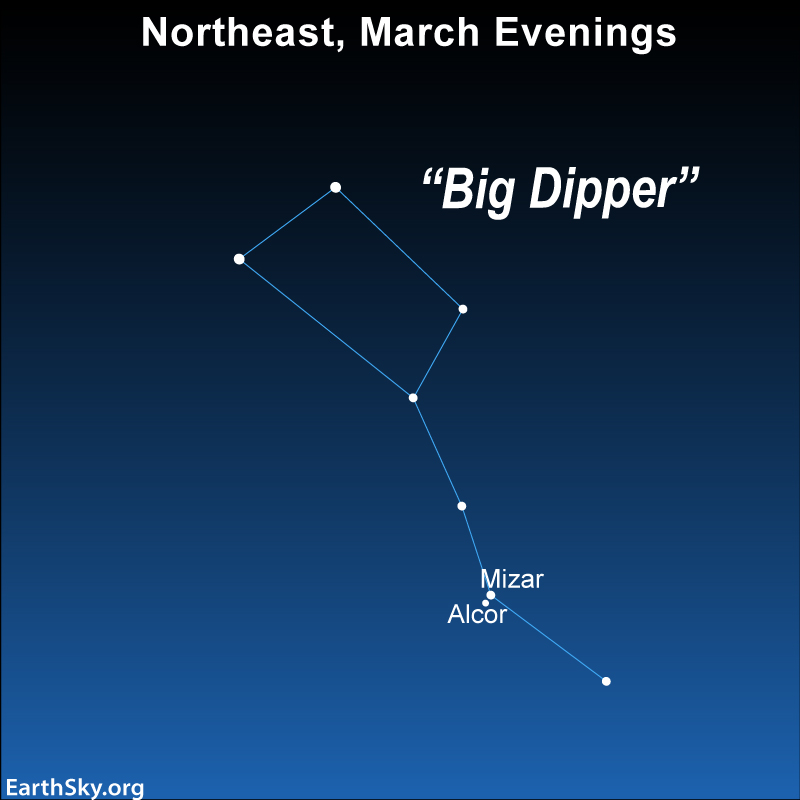
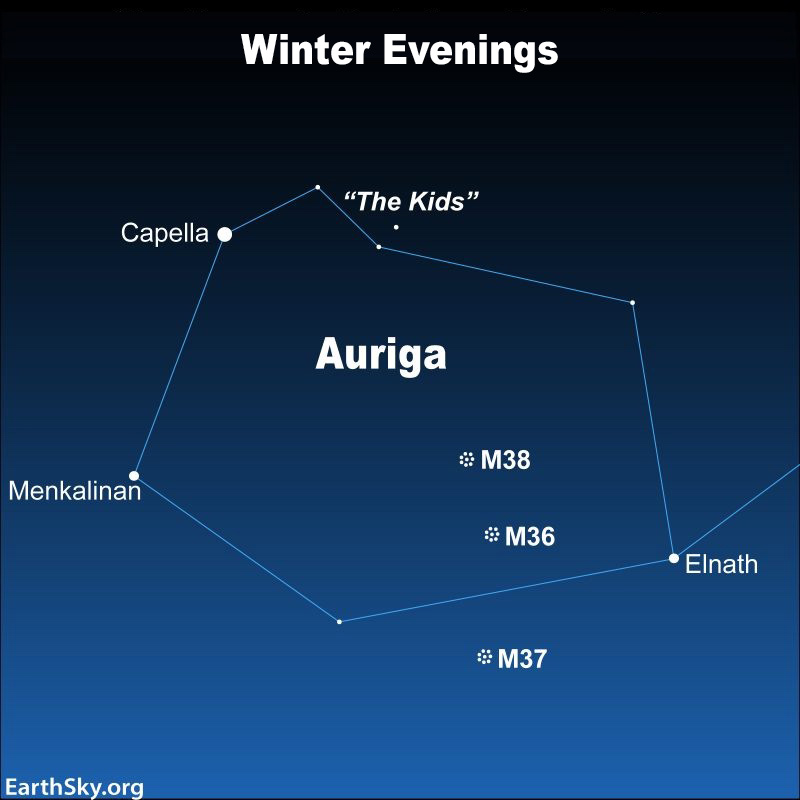
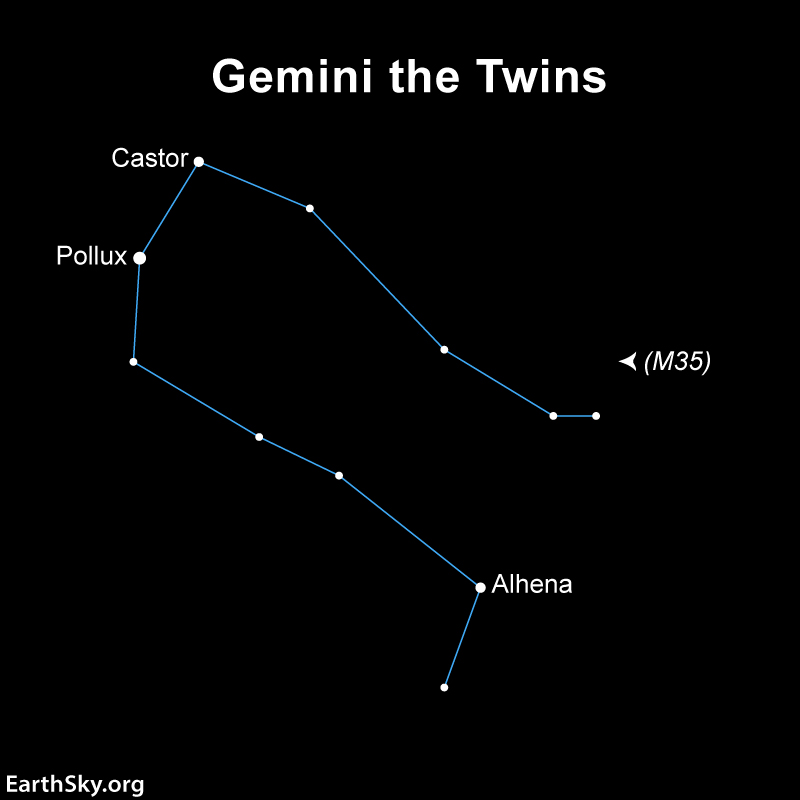
Our charts are mostly set for the northern half of Earth. To see a precise view – and time – from your location, try Stellarium Online.
March morning planet
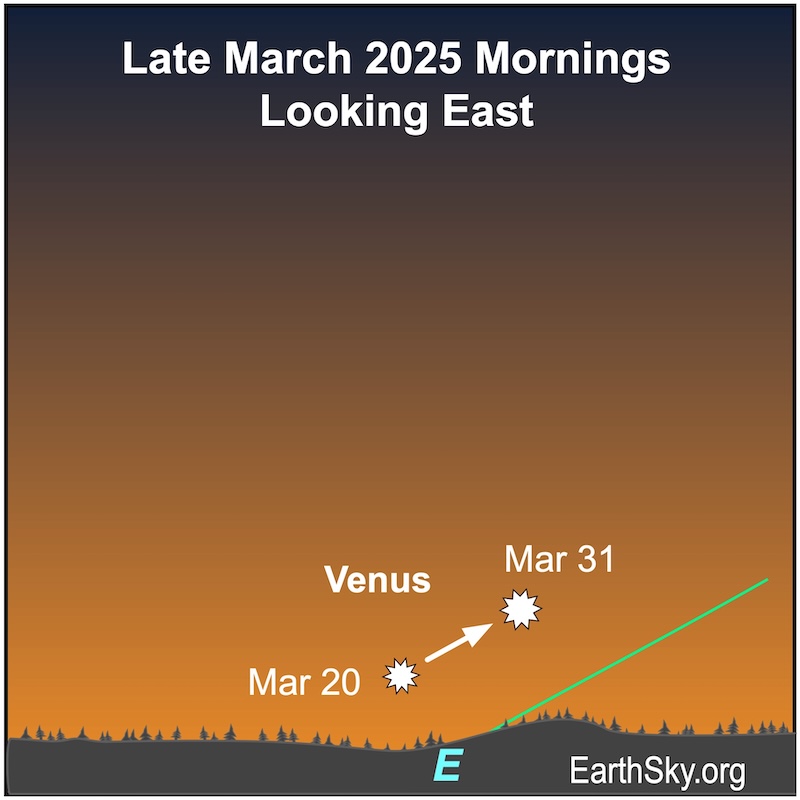
March evening planets


Where’s Saturn? It’s too close to the sun to be visible this month. It’s in conjunction with the sun on March 10.
Our charts are mostly set for the northern half of Earth. To see a precise view – and time – from your location, try Stellarium Online.
Sky dome map for visible planets and night sky

Premiere Showing: Harbor Seal Pups Spotted On Shore
In California, March marks the beginning of pupping season for Harbor Seals (Phoca vitulina). Females gather on shore in rookeries and give birth to a single 30-pound pup, which can swim shortly after birth.
Mothers may leave their pups alone on the rocks for briefly while they hunt for fish, squid and other seafood. Each year, well-intentioned, but misinformed people pick up or otherwise interfere with an “orphaned” seal. In turn, the pup (that waits patiently while its mother forages for their food before she returns) gets separated, then unknowingly absconded by an oblivious person.
Look for Harbor Seal rookeries in Bolinas Lagoon (Marin Co.) and Fitzgerald Marine Reserve (San Mateo Co.). Don’t approach too closely to the seals (especially if you are walking a dog) as you may disrupt their nursing or resting schedules.
Native Bees Prowling for Pollen (And Nectar)
Quick: what do you picture when you hear the word “Bee”? You probably think of Apis mellifera, the European Honeybee. But California has more than 1,500 species of its own native bees. Their sizes and colors are as varied as the plants on which they feed.
Native bees have evolved to hatch or come out of hibernation when their preferred food source is available. In spring, metallic green or blue bees in the genus Osmia and black bees of the genus Adrena appear in time to exploit early blooming flowers such as the California Poppy. Native bumblebees (genus Bombus) also make their debut early in the season — and you see them now as the largest bumblebees hovering close to the ground.
As the seasons change, so do the bee species and their preferred pollen and nectar plants. Wish to help native bees thrive? One way is to plant a variety of their favored flowering plants in your garden.
Professor Gordon Frankie and his students at the University of California –Berkeley have created a wonderful website filled with information about urban bee gardens: nature.berkeley.edu/urbanbeegardens/index.html
Seasonal Vernal Pools Shelter Vulnerable Species
Weeks and weeks of rain. Then months and months of dry, sunny weather. That’s California’s Mediterranean climate.
More exact, during the rainy season (typically November through March), where rain collects in grassland depressions (where impermeable layers of hardpan, claypan, or volcanic basalt occur) vernal pools form (i.e., temporary ponds). They may dry up and refill several times each rainy season.
Turns out the borders of these vernal pools host impressive colorful expressions of diverse wildflowers. In so doing, you’ll see rainbow-like concentric circles of vernal pool endemic wildflowers grow on the outer edges of pools. In turn, as water slowly evaporates as spring progresses, other flower species bloom as spring proceeds in relation to slowly-waning soil moisture.
Vernal pool wildflowers have descriptive names — Meadow Foam. Wooly Marbles, Button Celery, Butter and Eggs, to name just five. Joining them, invertebrates in impressive numbers occur in vernal pools. They provide food for birds, lizards, and other animals. These fragile habitats provide home to vulnerable, threatened, and endangered animals including the California Tiger Salamander, the Western Spadefoot Toad, and several species of fairy shrimp.
Habitat loss is one of the biggest threats to native species, and vernal pools are themselves threatened by development. Today, only 13% of California’s vernal pools remain. Most of the best-preserved pools are privately owned by conservation organizations or land trusts.
In Northern California, both Jepson Prairie Preserve in Solano County and Mather Field in Sacramento County offer guided tours of their vernal pools in spring. For more information, visit http://www.vernalpools.org
Baby Time
Which animals give birth this month? A large variety. Watch for baby Western Tree Squirrels, Opossum, and Raccoons. We don’t usually get lucky enough to see newborn mammals because the mother or both parents typically hide their young from any potential predators. But you can sometimes see Western Tree Squirrel mothers transferring their babies from one tree “nest” to another or spot a family of Raccoons at night in your backyard (perhaps easiest accomplished while using an infrared light bulb to cast a glow that Raccoons ignore, but is bright enough for your own viewing pleasure).
For another notable exception, see the entry above about Harbor Seals.
Western Tree Squirrel: Newborns All Around
Even urban areas with sparse tree growth may host Western Tree Squirrel populations. Now’s an ideal time to see males competing for the attention of females. Two to five young are born this month where females have retreated to tree cavities. By June, the newborns are active (though not yet full grown, so you can tell them apart from adults).
They’re Back: Returning Migrants
During most breeding seasons, you can expect this month to feature a variety of migrating birds returning to coastal northern California in good numbers, including the House Wren, Warbling Vireo, Wilson’s Warbler, Pacific-Slope Flycatcher and Cliff Swallow.
Rare Bird Alert Hotline
Do you wish to see rare, accidental or early bird migrants in northern California? Call the “Bird Box” to find out at 415/681-7422. You may also record your own bird sighting reports at the same phone number.
Fluttering By: Butterflies and Moths
Now’s the time to watch for the appearance of various butterflies and moths. One of the most appealing is the Silkmoth (Saturnia mendocino), which wears a striking black-rimmed eyespot on each wing. Look for them most commonly in coastal and mountain chaparral.
Mountain Lookout: Birds Up High
Going to the California mountains this time of year? Be on the lookout for several species of birds: Williamson’s Sapsucker (a woodpecker that feeds on the sap of lodgepole pine during the summer but eats more insects in the winter), Black-backed Woodpecker, Mountain Chickadee (that eats larvae of the lodgepole needleminer during the winter), Pine Grosbeak (less common in winter up high), Red-breasted Nuthatch, and Red Crossbill (also less common). The latter two species are year-round residents in Marin County, but they are never common to see, and are often detected initially by a birder’s ear tuned to the landscape.
Bon Voyage: Winter Resident Migration
Some winter resident birds in the Bay Area and northern California begin to leave now for breeding areas elsewhere, including species such as American Pipit and Cedar Waxwing.
Wake Up Call: Awakening From Hibernation
Which true hibernating mammals are getting closer to “waking up” from their long winter’s sleep? In foothill and mountainous areas of northern California, yellowbelly marmot, least chipmunk, California ground squirrel, and western jumping mice all hibernate. Some of these species may spend seven to eight months in a torpid state, though not all ground squirrel populations hibernate and many individuals in our area remain above ground or are active by January.
The Numbers Are In: Returning Bird Migrants
Migrating birds whose return to northern California typically occurs in higher numbers now (and into the first two weeks of April) include MacGillivray’s Warbler, Black-headed Grosbeak, Yellow Warbler, Olive-sided Flycatcher, Lazuli Bunting, and Swainson’s Thrush. Excellent guides to birding in our area include “Birder’s Guide to Northern California” (Lolo and Jim Westrich, Gulf Publishing Co., 1991) and “Birding Northern Calfornia,” John Kemper, A Falcon Guide, Globe Pequot Press, 2001). You may also wish to find guided birding walks that are pre-scheduled on local Audubon chapter web sites that are accessed through http://www.audubon.org
(Click on the home page’s button titled “states and chapters” to access any local California Audubon chapter among the dozens listed.)
April, 2026
Sky Watch:
(Courtesy of earthsky.com)
Note: To see your area’s rise and set planet times, visit https://www.almanac.com/astronomy/planets-rise-and-set. Then, type in your city, state and zip code to see the results like mine below for 4/15/23 (at Latitude: 38:03:38 N, Longitude: 122:32:27 W, which is Novato, CA, 20 miles north of San Francisco, CA in Marin County):
Visible planets and night sky guide for March and April
April 1-2 all night: Full Pink Moon near Spica

Read more: April full moon is the Pink Moon
Our charts are mostly set for mid-latitudes in the Northern Hemisphere. To see a precise view – and time – from your location, try Stellarium Online.
April moon phases and alignments
From the full Pink Moon on April 1-2, to bright evening planets, find out what the month of April has in store in this new video preview.
April 2 evening: Moon near Spica

Southern Hemisphere: Mercury farthest from sunrise on April 3

April 3 evening: Moon near Spica and Zubenelgenubi

Read more: Zubenelgenubi is the alpha star of Libra the Scales
April evening planets

April 6 and 7 mornings: Moon meets up with Antares and Scorpius

Read more: Scorpius the Scorpion and its legendary stinger
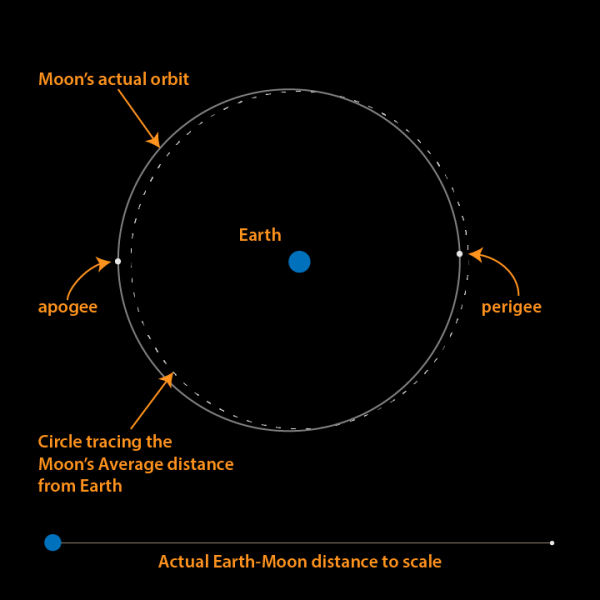
April 7: Moon reaches apogee
April 8 and 9 mornings: Moon and the Teapot

Read more: Sagittarius the Archer and its famous Teapot
April 10: Watch for the 3rd quarter moon

Want more? Here are 4 keys to understanding the moon’s phases.
April 11 and 12 mornings: Moon near Capricornus

Read more: Capricornus the Sea Goat
April 13 and 14 mornings: Slender old crescent moon

Read more: Earthshine is a lovely glow on the unlit portion of the moon
April 15 morning, Southern Hemisphere: Moon near Mercury, Mars and Saturn

The mid-April daytime planet parade

April 17: New supermoon

Want more? Here are 4 keys to understanding the moon’s phases.
April morning planets: Northern Hemisphere

April 18 and 19 after sunset: Moon, Venus, Aldebaran and the Pleiades

Read more: The Pleiades – or 7 Sisters – known around the world
April 19: Moon reaches perigee
April 20 morning, Southern Hemisphere: Tight trio of planets in the morning twilight

April 20 evening: Moon, Venus and the Pleiades

Read more: Orange Aldebaran is the fiery eye of Taurus the Bull
April 21 and 22 evenings: Moon, Jupiter and twin stars

Read more: Meet Gemini the Twins, home to 2 bright stars
Our charts are mostly set for mid-latitudes in the Northern Hemisphere. To see a precise view – and time – from your location, try Stellarium Online.
April 22: Lyrid meteor shower
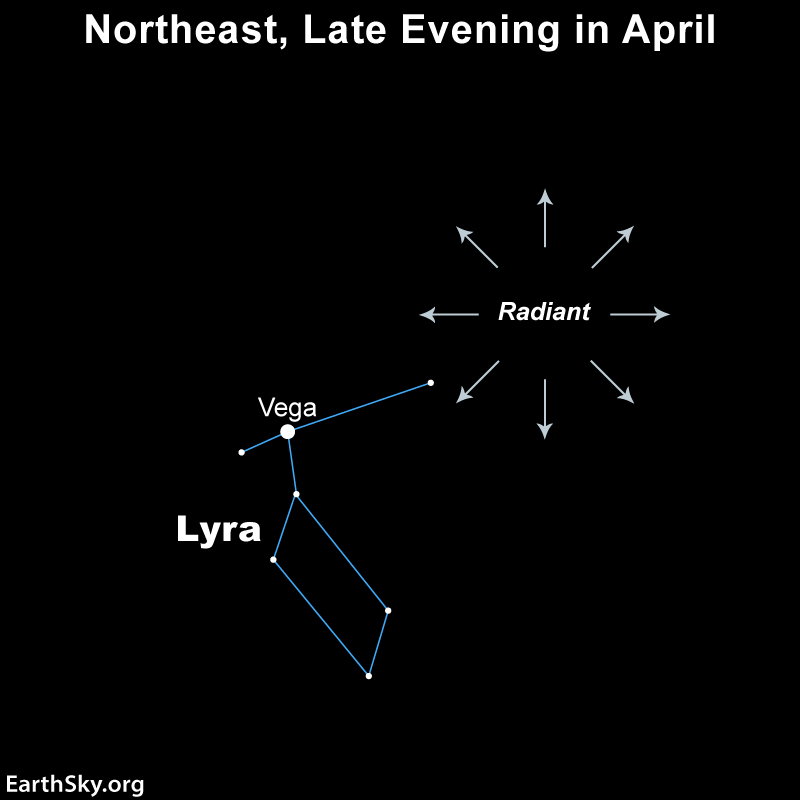
Read more: All you need to know about Lyrid meteors
April 24: 1st quarter moon
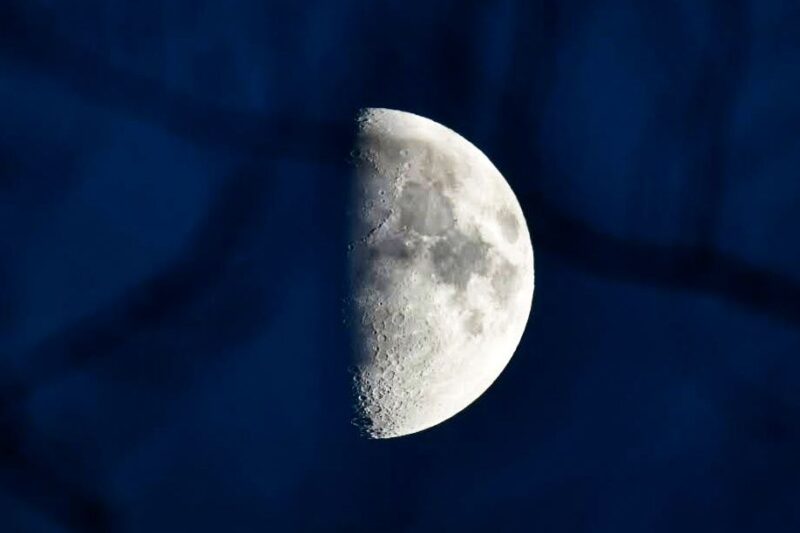
Want more? Here are 4 keys to understanding the moon’s phases.
April 24 and 25 evenings: Moon, Regulus and the Sickle

Read more: Leo the Lion and its easy to see backward question mark
April 28, 29 and 30 evenings: Moon and Spica

Bay Area Bunny (and Hare) Trails
How do you tell a brush rabbit from a Califonia hare (also called California jackrabbit)? Easy. Our common Bay Area rabbit has a powderpuff-like white bunny tail. The hare is much larger and has large, long ears.
You tend to see brush rabbits in dense undergrowth. Their brown pelage and small size provide camouflage as they rest under brush and scrub during the day. At dawn and dusk they emerge to feed on green plants. When threatened, brush rabbits thump their hind legs against the ground to produce a warning sound. If pursued by a predator, a rabbit will race away in a zig-zag pattern.
Unlike a brush rabbit, hares can jump up to 20 feet in a single bound, and it can run up to 35 mph when eluding a predator. Baby hares, called leverets, are born with their eyes open and are ready to run shortly after birth. In the Bay Area, look for brush rabbits at Sunol Regional Wilderness or in many other spots. Hares are commonly spotted along the Albany waterfront and at Mission Peak, among many other Bay Area locations.
The Sniffling Season
Green hills, golden poppies, and sneezing neighbors are three sure signs that Spring has arrived in Northern California. While blooming flowers are obvious visual harbingers that violate our noses, your allergies may be the result of other, more hidden enemies. Before poppies bloom, trees such as alder, ash, oak and juniper initially produce pollen.
On a windy day you can see clouds of golden dust billowing
from these mature trees. Just as trees wind down, a potpourri of grasses and flowers cast their sniffle-inducing spell. Fortunately, for seasonal allergy sufferers, April showers bring temporary relief from suffering, as rain washes pollen out of the air.
Lizards Arising: Western Whiptails
Throughout the state this month, watch for the emergence of reptiles, including Western Whiptails that become active after winter dormancy. At first sighting, don’t mistake the whiptail for a snake, despite their long, 13-inch body that slithers more like a miniature alligator.
As the only common whiptail in the state, you won’t find them easily along the Coast and instead need to explore inland, arid habitats. Here, the juveniles are the initial populations to become active, followed by adult males. The latter compete for females by establishing mating dominance among males that congregate together. Unlike many reptiles that become more difficult to spot as temperatures rise throughout the spring, whiptails remain active throughout much of the day.
Does a whiptail drop its tail as an escape strategy from a predator? Yes, but only in rare cases, and only if it cannot evade the grasp of its pursuer. Growing its tail again takes lots of energy and time, so a whiptail will typically instead bolt from a predator in the blink of an eye to prevent capture.
Butterfly Sightings?
If you’ve recently seen a butterfly species and wish to know if other people have witnessed the same kind or others, then visit a Web site link that is devoted to tracking the appearance of butterfly species throughout North America: http://www.naba.org/sightings/sightings.html
Mountain Beavers: A Family Of One
Have you ever seen a Mountain Beaver? Not many people have been lucky enough to observe these solitary rodents that are in a different family than the more common American Beaver that lives throughout North America. To find a Mountain Beaver, you have to search in moist habitats along the Pacific coast from northern California through Washington and into southern British Columbia, Canada. Little is known about mountain beaver behavior during the breeding season. Breeding activity occurs mainly from January to March with gestation lasting about 30 days. Young are born blind and hairless, weighing about 3/4 ounce (20 g). They develop incisors at about 30 days and are weaned at about 8 weeks. Young animals are often active in May. Females apparently do not bear young until they are two years of age.
As the only member of its family (Aplodontidae) and genus (Aplodontia) in North America, a Mountain Beaver leaves evidence of its presence in the form of packed ground that forms a trail next to its burrow within a forest canopy and/or thick understory. Mountain Beavers are active year-round, but a rare sight, perhaps primarily because their habitat is usually inaccessible and off-trail from where most hikers prefer to explore.
Skinks Underfoot
Look under a flat board or log now for the Western Skink, a common, yet secretive reptile that lives throughout northern California from sea level to 7,000 feet. Males wear a distinctive blue belly and join females in a variety of habitats, most commonly in open areas or places undergoing early regrowth of vegetation after logging. Mating occurs in spring soon after emerging from winter slumber.
Big Time: CA Giant Salamanders
CA Giant Salamander individuals are entering their peak breeding time in northern California. At lengths ranging from six inches to, rarely, 10-12 inches, this salamander is the largest in our area. They are year-round residents of north-central California (from southern Santa Cruz County to extreme southern Mendocino and Lake counties) that live up to 6,500 feet, primarily in humid coastal forests, and especially in Douglas-fir, redwood, red fir, and montane and valley-foothill riparian habitats. Look for aquatic adults and larvae in cool, rocky streams and occasionally in lakes and ponds.
Where do I go in Marin County, CA where I live to see this majestic, air-craft carrier-sized salamander? Bear Valley Creek in Pt. Reyes National Seashore is a fine spot to peruse for California Giant Salamander presence. Cascade Canyon in Fairfax is another place for seeing California Giant Salamander.
Roadside Mammal Sightings
Roadside mammal sightings now may seem more common for a good reason: Mothers are giving birth to babies, including those born to opossums. As the only pouched mammal (marsupial) in the USA, opossums often give birth to 14 embryos that have large hands to quickly crawl and attach to their mother’s 13 teats. Of course, in a tongue-and-cheek kind of way, this means the oversupply of babies for available teats makes opossums players of “musical chairs,” a game they have been playing for millions of years prior to the first appearance of evolved primates such as humans.
Everywhere and Omnipresent: Western Fence Lizards
Probably the most common reptile in California, the Western Fence Lizard is now more easily seen. This abundant, plainly-marked species begins courtship as early as March (and more commonly April), with copulations also occurring in May and June. Egg-laying after copulation typically occurs in two to four weeks (May through mid-July is the peak of egg-laying), and the incubation period is around 60 days. Found throughout California except in deserts (where it is confined to riparian areas), Western Fence Lizards live from sea level to 10,000 feet. Of course, like any common animal, populations of Western Fence Lizard may be locally rare if suitable habitat is removed as a consequence of development.
Aerial Acrobats: Swifts in Northern California
Although you can now see two species of swifts (Vaux’s and White-throated) that nest in northern California (including Marin County), the White-throated is more common until it begins to disperse and migrate by the end of July and early August, after which they become a more rare sight throughout autumn and into winter. According to studies, all species of swifts obtain their food exclusively while aloft. Copulation also occurs in the air. Such aerial feats make sense, as seeing a swift perched is an uncommon sight, given their underdeveloped feet and leg muscles that are weak in comparison to those designed for perching birds such as songbirds.
Wakeup Call: Emerging Marmots
Detecting obvious signs of global warming’s presence is indicated by changing hibernation dynamics in some mammal species. Consider that yellowbelly marmots (close relatives of woodchucks), which usually hibernate for eight months during the long winter at high altitudes, are emerging from hibernation earlier (38 days earlier over the past 23 years) and may risk starvation as they wait longer for snow to melt before they can feed.
May, 2026
Sky Watch:
1. Moon and planet watching:
Type in your location to learn moon and planet rise & set times at:
https://www.timeanddate.com/astronomy/night/
2. Sky events:
May 27 and 28 evenings: Young moon challenge and Jupiter

May 27: New moon
The moment of new moon will fall at 3:02 UTC on May 27, 2025. That’s 10:02 p.m. CDT on May 26. New moons rise and set with the sun. It’s the 4th of 5 new supermoons in a row for 2025. Nights around the new moon are perfect for stargazing. See EarthSky’s best places to stargaze.
See the moon phases from new to full in this EarthSky community photo.
Read more: What is a supermoon? Supermoons in 2025
May 28 and 29: Manhattanhenge in NYC
Twice a year – in late May and just before mid-July – people in New York City look for Manhattanhenge. It’s a phenomenon where the sunset aligns perfectly with the city’s cross streets, to illuminate the “canyons” created by the tall city buildings. In 2025, the first set of Manhattanhenge dates will fall on May 28 (half sun) and May 29 (full sun). Hear all about the science and history behind Manhattanhenge from Jackie Faherty, Senior Research Scientist at the American Museum of Natural History in New York. She spoke to EarthSky’s Deborah Byrd on May 23. Watch in the player above or on YouTube. Prefer to read? Read about Manhattanhenge here.
May 29 evening: Moon and twin stars

Our charts are mostly set for the northern half of Earth. To see a precise view – and time – from your location, try Stellarium Online.
Two planets in the May evening sky

We all see the same sky. But our orientation to the sky shifts from place to place on Earth. EarthSky charts are mostly set for the northern half of Earth. To see a precise view – and time – from your location, try Stellarium Online.
Three planets in the May morning sky

We all see the same sky. But our orientation to the sky shifts from place to place on Earth. EarthSky charts are mostly set for the northern half of Earth. To see a precise view – and time – from your location, try Stellarium Online.
May 30: Mercury in superior conjunction

May 30 and 31 evenings: Moon, Mars and twin stars

Communal Housing: Heron and Egret Nest Choices
Why do Great Blue Heron, Snowy Egret, and Great Egret nest so close to their neighbors? Predator evasion may be one reason: many eyes are more likely to spot marauding hawks, crows, and other threats. Another possibility is that herons and egrets prefer to next close to their food source and nearby sturdy, tall trees may be in short supply. After birds find a choice piece of real estate, they remain loyal owners, as some colonies have been in use for more than 70 years!
Large nesting colonies (called rookeries) are sure to be host newborns this month. Some late arriving pairs of egrets and herons may still be courting.Their elaborate displays include flashing long, plume-like feathers that once were harvested for women’s hats — a practice that is now banned. Other egrets in the same rookerie tree may be incubating eggs. By the end of the month, some will be caring for newly-hatched chicks. In Bolinas (Marin County), Audubon Canyon Ranch is a great place to see dozens of Great and Snowy Egrets nest together, with the occasional Great Blue Heron also sometimes present.
Newborn & Nearby Elk Calves
From most spots in the Bay Area, did you know that you’re only an hour or two from seeing Tule Elk newborns? A visit to Point Reyes National Seashore is a great place to seem them. Within the park, take Pierce Point Road (instead of remaining on Sir Francis Drake Road that goes to the lighthouse) to its end. At the parking lot, follow the main trail where dozens of Tule Elk are soon often present.
When you see the spotted, spindly-legged newborn calves this time of the year, they weigh only 20-25 pounds at birth. Growing quickly, they run within a few weeks of birth, but still nurse for four months. In the fall, adult males weighing up to 700 pounds shed their antlers. Females are about three-quarters that size.
The Point Reyes population is introduced after unting and habitat loss once pushed California’s native elk to the brink of extinction. The Point Reyes populations and a few others throughout the state remain stable, thanks to land management and the establishment of wildlife preserves.
Return of the Terns
How many species of terns nest in the Bay Area? Two. Forster’s nest in the South Bay. Least, North America’s smallest tern, nests on Alameda Island in the Bay Area and in a few other Bay Area locations.
Annually, they migrate from California to Southern Mexico and back. By late April, adults arrive at their nesting sites. They prefer open, vegetation-free areas, above the tide line where their eggs will remain dry. But predators, such as raccoons and foxes, find some of the eggs. Habitat loss of prime nesting beach sites is another problem that has resulted in large population drops statewide. In fact, only 25-30 nesting sites remain in California.
The Least Terns you see now may have traveled as far as 2,000 miles. Males and females bond during a 2-3 week courtship. In California, the first eggs appear around May 15 and are incubated for 19-25 days. Chicks leave the nest when they are only two days old, but they aren’t fully independent for several months. By mid-July, the Bay Area’s Least Terns begin to depart for Mexico.
Migrating Swainson’s Thrushes
Northern California’s greatest abundance of Swainson’s Thrush arrive this month on their breeding grounds, joining April’s initial vanguard that returns from non-breeding areas in Mexico, Central America, and, even, perhaps, from as far south as mid-South America. Northern California’s populations have been studied less rigorously than eastern populations that complete a 3,000 mile from Panama to Canada. In an amazing effort spanning 34 years of tracking migrating thrushes in spring, W.W. Cochran’s discoveries inspired Martin Wikelski, a biologist at Princeton University in 1999, to measure how much energy thrushes expended in migratory flight.
Wikelski’s results were counter-intuitive to what common sense would suggest: the thrushes traveling north in spring spent less energy in flight than they did while resting and foraging during daytime layover episodes. In total, Wikelski and his collaborators found a typical thrush completed its long migration journey over 42 nights while averaging 4.6 hours per night flight of approximately 158 miles. Losing 0.3 calories per mile on average, each thrush’s heart beat about 840 times per minute while flying — a hyper-aerobic workout that failed to be as caloric intensive as the seemingly more loitering, casual effort required when merely perched or foraging.
Watching Radar To Follow Migrating Birds
Anyone with an Internet connection to the World Wide Web can use radar images to see whether migrant birds are aloft and how large their flocks are in abundance while heading your way. Visit the fascinating and well-respected Clemson University Radar Ornithology Laboratory Web site at http://virtual.clemson.edu/groups/birdrad. These radar images are forecasts for East Coast viewers wishing to track spring migrants, but, nonetheless, it’s probably also fascinating for West Coast Web surfers to interpret how an evening’s weather pattern influences the movement of migrating birds.
An equally interesting source of migration information available through radar maps is operated by the College of DuPage in Illinois. The ideal time to look at its radar maps is two to four hours after sunset at http://weather.cod.edu/analysis/analysis.radar.html. At this time, you’ll be able to interpret the magnitude of migration and the direction and speed traveled by birds en masse by the different concentrations of colors appearing on each radar map.
Born Free: Northern Alligator Lizards
Northern Alligator Lizards are commonly seen now in a variety of forested habitats and montane chaparral from northwestern California, in the Coast Ranges south to San Luis Obispo Co. and in the Sierra Nevada Mountains south to the Kern River in southern California. Although mating probably occurs as early as mid-April, live alligator lizard young (in litters of 3-8) are typically born in August and September. As long as temperatures remain above freezing into November, these reptiles will roam free and usually disperse no more than five to seven miles from an original birthing area.
Rare Find: California Red-Legged Frogs
The federally threatened California Red-legged Frog breeds from March to July in northern parts of California and from January to July (peak in February) in the southern part of the state. It inhabits quiet pools of streams, marshes, and occasionally ponds where emergent vegetation provides hiding places. Look for this species west of the Sierra-Cascade crest and along the Coast Ranges the entire length of the state usually below 4,000 feet.
Wash First: Newborn Raccoons
Newborn raccoons born this time of year may number 2-7 in a litter. Do they and their parents truly wash their food? Sometimes, but dipping their meal is merely thought to be a tactic that helps them tell edible objects from non-edible items. There is no evidence from field observations to suggest raccoons attempt to clean off their prey by washing them with water before feasting. An excellent tactic to see raccoons closeup is to attract them to your backyard with a bowl of dogfood or graham crackers while shining the glare of an infrared bulb from above on the food attractant. Then, retreating to your residence and watching from a distance of at least 50 feet, wait patiently to see if raccoons arrive to take your bait.
Water Magnets: Attracting Birds To Your Yard
What’s one technique that may attract more birds to your yard? Try installing a backyard in-ground pond or above-ground water source. A perpetual spray or fountain that recycles water can attract birds drawn in by the sound of running water, especially passerines such as American Robin, Chestnut-backed Chickadee, Oak Titmouse, House Finch, American Goldfinch and many others.
Better Late Than Never: Western Wood-Pewees Arrive
Western Wood-Pewees, one of our latest returning neotropical migrants, are now settling into breeding habitats such as woodlands, pine-oak forests, and river groves.
Got Skunks?
What is the strange scent in the air along roadsides? Perhaps you’re smelling night-active skunks whose home range may extend beyond 10 acres, within which a portion is used more often, including sheltering areas such as abandoned burrows of other animals. Skunks sometimes also dig their own burrow or use protected cavities underneath buildings. Some naturalists suggest mothballs work to repel skunks from habitually entering a shelter under, for example, a house or patio.
Care Package: Feeding Thirsty Hummingbirds Correctly
Changing sweet mixtures regularly every 2-3 days in hummingbird feeders becomes important as days grow warmer. Washing the feeder in hot water is also an important preventive measure to care for the health of hummers. A four to five parts water to one part sugar combination usually works best, though you may experiment (fun!) to judge which mixture is most often visited by hummingbirds. Bee and ant guards are a good idea to prevent potential problems. If you’re hanging more than one feeder, the best strategy (if possible) is to space them apart by at least 30-40 feet. This action may help prevent the guarding of two feeders by an overaggressive male hummer that defends the territory in between both feeders.
June, 2026
1. Moon and planet watching in June, 2025:
Type in your location to learn moon and planet rise & set times at:
https://www.timeanddate.com/astronomy/night/
2) June Night Sky (courtesy of EarthSky.org)
June 1: Venus greatest elongation from the sun

Read more: Venus greatest distance from the morning sun on May 31-June 1
June 1 evening: Moon near Mars and Regulus
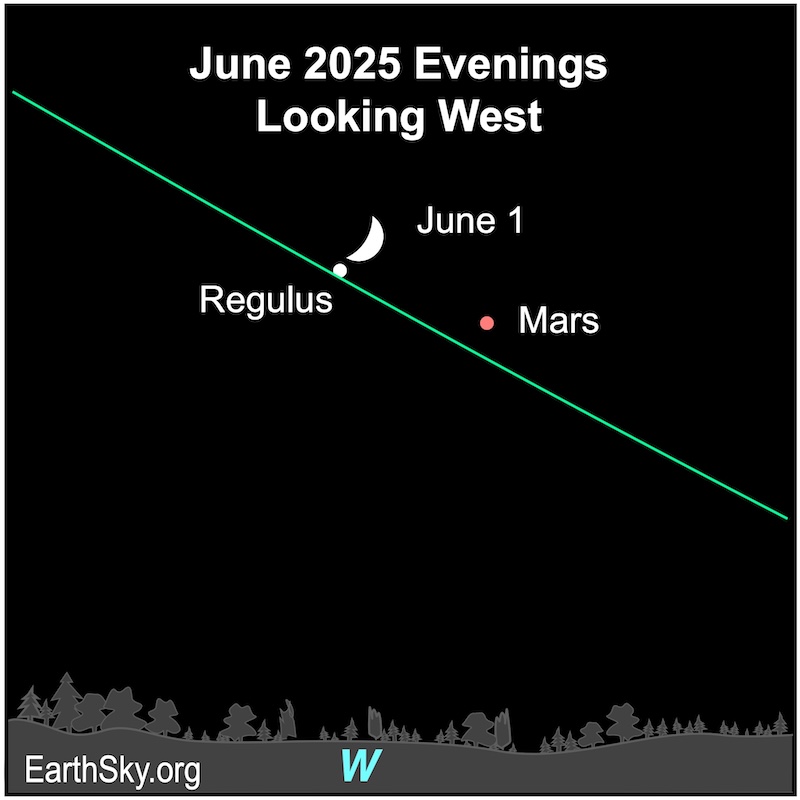
Read more: Leo the Lion and its backward question mark
Catch Jupiter in early June before it disappears

Our charts are mostly set for the northern half of Earth. To see a precise view – and time – from your location, try Stellarium Online.
June 3: 1st quarter moon
The moment of 1st quarter moon will fall at 3:41 UTC on June 3, 2025. That’s 10:41 p.m. CDT on June 2. A 1st quarter moon rises around noon your local time and sets around midnight. Watch for a 1st quarter moon high in the sky at sundown.
Want more? Here are 4 keys to understanding the moon’s phases.
June 5 and 6 evenings: Moon and Spica
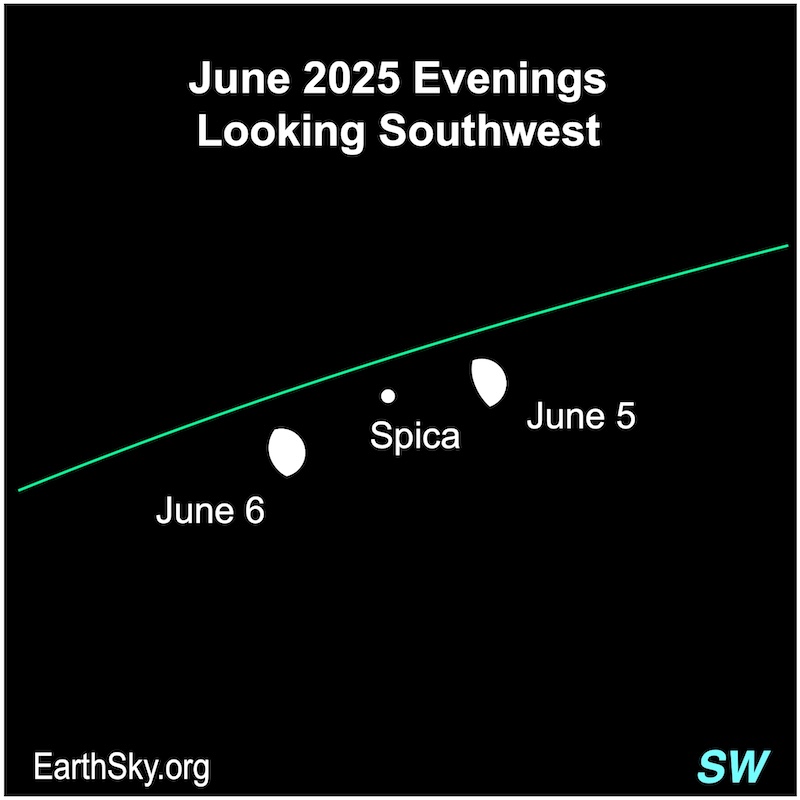
Read more: Virgo the Maiden represents a harvest goddess
Our charts are mostly set for the northern half of Earth. To see a precise view – and time – from your location, try Stellarium Online.
A pair of planets in the June morning sky: Northern Hemisphere

June morning planets: Southern Hemisphere

June 7 before dawn: Daytime Arietid meteor shower
Every year, we have meteor showers that are easy to observe. Just find a dark sky and look up! But what about meteor showers that happen in the daytime, when the sun is up? The Arietids are the most active daytime meteor shower. In 2025, their predicted peak is around the morning of June 7. You might catch some Arietids in the dark hours before dawn, shooting up from the horizon. A 1st quarter moon will not interfere. Read more about the daytime Arietid meteor shower.
June 7: Moon reaches apogee
The moon will reach apogee – its farthest distance from Earth in its elliptical orbit– at 11 UTC on June 7, 2025, when it’s 251,998 miles (405,553 km) away.
June 9 and 10 evenings: Moon pairs up with Antares

Read more: Massive ruby red Antares is the Scorpion’s Heart
Our charts are mostly set for the northern half of Earth. To see a precise view – and time – from your location, try Stellarium Online.
June 10-11 overnight: Full Strawberry Moon near Antares
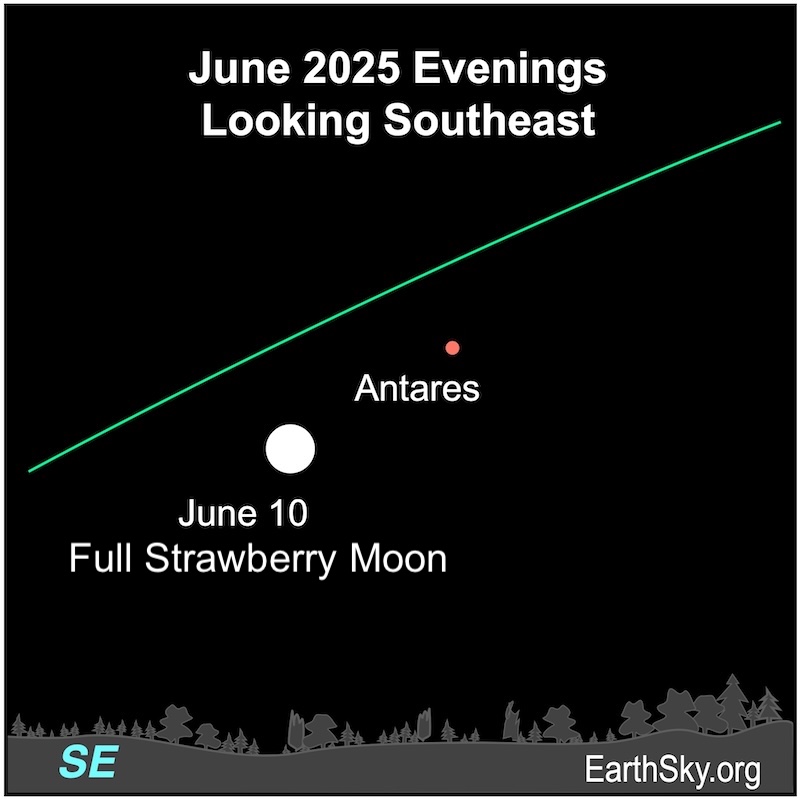
June 11 and 12 late evenings: Moon visits the Teapot

Read more: Teapot of Sagittarius points to Milky Way Center
A pair of planets in the evening sky
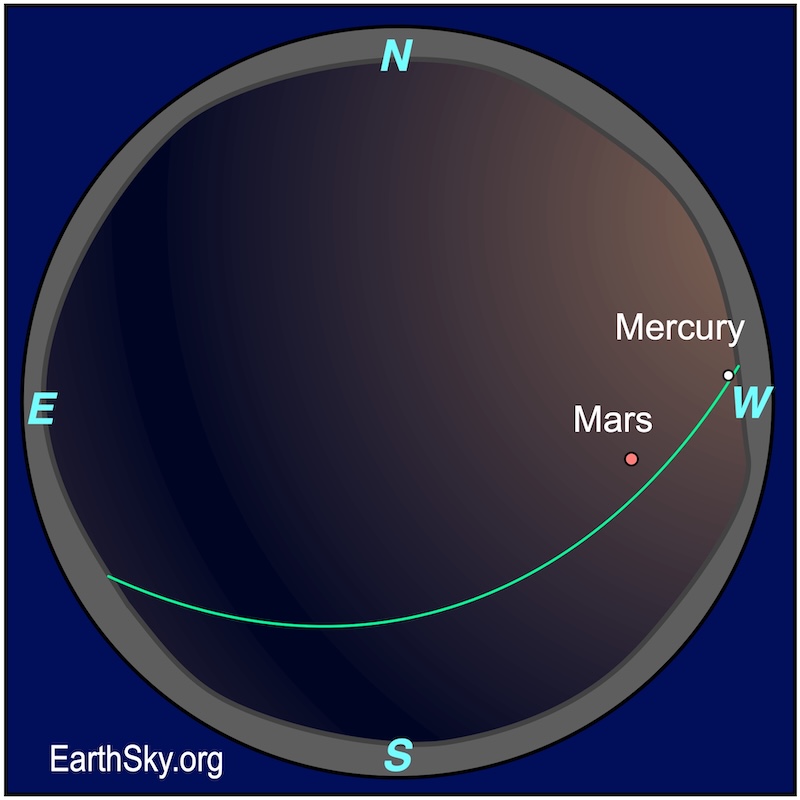
Regulus and Mars closest in the evening sky

June 18: Watch for the last quarter moon
The moment of last quarter moon will fall at 19:19 UTC on June 18, 2025. That’s 2:19 p.m. CDT. It’ll rise after midnight your local time and set around noon. Look for it high in the sky before dawn.
Want more? Here are 4 keys to understanding the moon’s phases.
June 18 and 19 mornings: Moon and Saturn

Our charts are mostly set for the northern half of Earth. To see a precise view – and time – from your location, try Stellarium Online.
June solstice in 2025
June 21 and 22 mornings: Moon and Venus

Read more: Venus reached its greatest distance from the morning sun on May 31-June 1. It’ll remain visible in the morning sky through October.
June 23: Moon reaches perigee
The moon will reach perigee – its closest point to us in its elliptical orbit around Earth – at 5 UTC on June 23, 2025, when it’s 225,668 miles (363,178 km) away.
June morning planets challenge

June 24: Jupiter in conjunction with the sun

June 24 evenings: Mercury, Pollux and Castor form a line


Read more: Mercury farthest from sunset on July 4
Our charts are mostly set for the northern half of Earth. To see a precise view – and time – from your location, try Stellarium Online.
June 25: New moon
The moment of new moon will fall at 10:32 UTC on June 25, 2025. That’s 5:32 a.m. CDT. New moons rise and set with the sun. It’s the last of 5 new supermoons in a row for 2025. Nights around the new moon are perfect for stargazing. See EarthSky’s best places to stargaze.
See the moon phases from new to full in this EarthSky community photo.
Read more: What is a supermoon? Supermoons in 2025
June 26 and 27 evenings: Moon, Mercury and twin stars

Our charts are mostly set for the northern half of Earth. To see a precise view – and time – from your location, try Stellarium Online.
June 28 and 29: Moon, Mercury, Mars and Regulus


June stars
If you’re out stargazing on any June evening, look for these stars and constellations overhead in the evening sky.
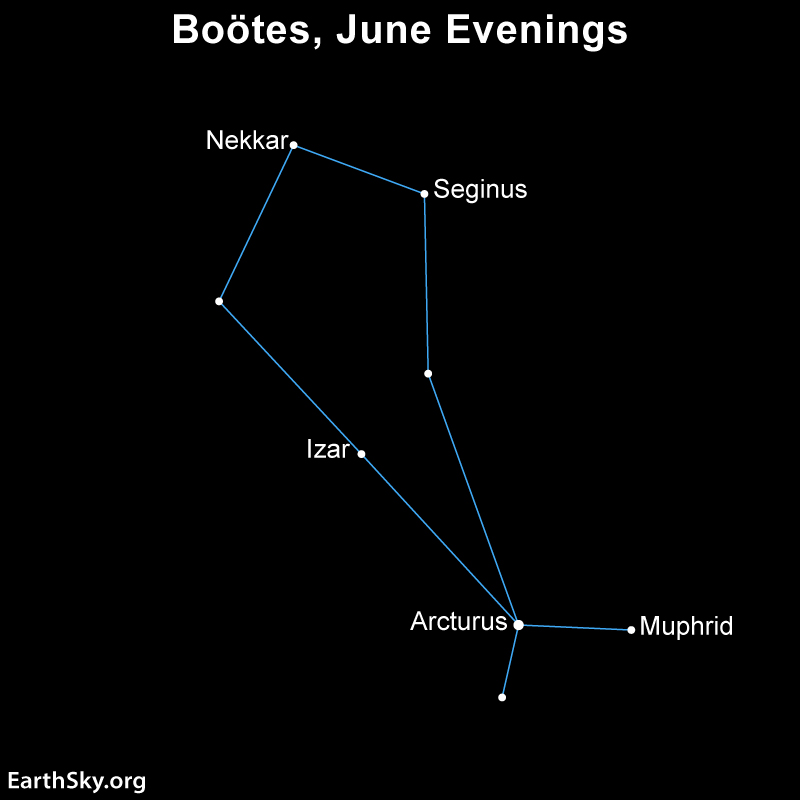

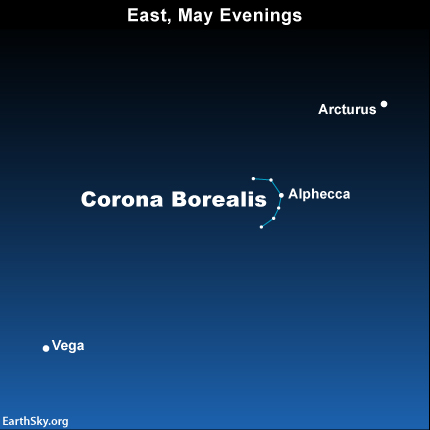
Our charts are mostly set for the northern half of Earth. To see a precise view – and time – from your location, try Stellarium Online.
June evening planets


Our charts are mostly set for the northern half of Earth. To see a precise view – and time – from your location, try Stellarium Online.
June morning planets


Sky dome map for visible planets and night sky

Read more: Guy Ottewell explains sky dome maps.
Heliocentric solar system visible planets and more


Bird Quiz
Pop bird quiz: How many species of warblers nest in northern California along and near the coast (e.g., Marin County)? During most breeding seasons, at least eight species breed annually in suitable habitat (Orange-Crowned, Yellow, Yellow-Rumped, Black-throated-gray, Hermit, MacGillivray’s, Common Yellowthroat, and Wilson’s). Irregular to rare annual breeders in n. CA may include Northern Parula, American Redstart (annual in far n.w. CA along the coast) and Yellow-breasted Chat. All eight in the initial list, above, may be seen during the non-breeding season, with the Common Yellowthroat and Yellow-rumped considered resident in Marin County.
Note, however, that some Yellow-Rumped populations may arrive from the north during the non-breeding season to displace Marin County’s higher altitude breeding populations of the same species. These individuals likely migrate south and don’t remain during the non-breeding season.
In our area, Orange-crowned is uncommon, yet not rare to see during the non-breeding season, while Hermit is often also seen, especially during the County’s annual Christmas Bird Count surveys conducted by volunteers. The least common species to see during the non-breeding season (December through March) from the list above (in descending order of abundance) are Yellow, Black-throated gray, Wilson’s, and MacGillivray’s). Nashville Warbler is sometimes seen as a transient migrant through the Bay Area, including occasional sightings during the West Marin Christmas Bird Count (West Marin CBC).
Final Avian Arrivals
In northern California, it’s a good bet that Western Wood Peewee and Common Nighthawk are the latest arriving avian migrants among species that do not overwinter in the state. According to the Point Reyes Bird Observatory Biologist Dave Shuford’s chart (Marin County Breeding Bird Atlas, Dave Shuford, Bushtit Books, Bolinas, CA 1993) that highlights the arrival of avian migrants in northern California (see http://www.warblerwatch.com and click on the “Bird Arrival Times” button), Western Wood Peewee may arrive in May and as late as early June during some years. Common Nighthawk is usually a June arrival, probably because their primary food resource — aerial insects of various species — do not bloom in abundance until this time.
What’s That Sound? Could It Be A Chipmunk?
Unlike the Sierra mountains where many species of chipmunks may be seen, the Sonoma Chipmunks is the only species of chipmunk you’ll see in coastal areas of northern California, including the San Francisco Bay area. Breeding from February through July, one litter is born per year consisting of three to seven young. Gestation occurs for 30 days in a pregnant chipmunk and individuals mature at around one year. Not surprisingly, people often mistake the soft chirping of the Sonoma chipmunk for a bird.
Blinded By The Light
On warm nights now and the rest of the summer, it’s wonderful to linger outdoors and gaze at the stars. There’s only one problem. It’s increasingly more difficult to see the stars through the glare discarded by people and their surroundings. Do you care about the increasing problem of light pollution that makes it more difficult to clearly spot celestial objects? If so, you might consider joining the International Dark-Sky Association. Call 520/293-3198 for more information or look at its Web site: http://www.darksky.org
Spotting Spotted Deer?
Will you still see young deer this late in the spring? Yes, it seems the normal range of births for deer extends into late June and beyond. I’ve seen white-spotted fawns well into July and, even, occasionally as late as August and September in our area, the burgeoning population due in part to the plentiful forage and ideal habitat that continues to expand as more suburban landscapes and their associated gardens displace forests, forest borders, and meadows.
Gray Fox: Dog Family Member All Around Us
On trails near urban areas throughout the Bay Area, you can often find the scat or tracks of gray foxes. (Many people may automatically assume these signs are from domestic dogs. Telltale signs of gray fox include the presence of hair and a sharp, tapered point at least one end of the scat.) More common than ever in our region, these solitary mammals may be active both day and night. Unlike other dog family members, the gray fox is able to climb trees where they may hang out during the day.
Coastal Nester: Western Gull
Which gull in California is the only species nesting along the coast (e.g., Marin County)? The Western Gull, which nests from southern Baja to Washington. Distinguishing this species from other gull species is not too difficult. Three field marks often give away their identity: pink legs, large bill, extremely dark gray backside/mantle. Note the lower portion of the bill has a small crook or angle near its end, a field mark that is called the “gonydeal angle.”
Attracting Mammals
Do you want to attract mammals into view in your backyard? One fun technique for doing so is to place a Q-tip (that has been dipped into musk oil or other animal-attracting oil potion) into the ground. Place a small circle of sand under the Q-tip so that you can see the tracks of the animals you attract. (You can order a large variety of animal attractant oil and vocal call devices from M & M Fur Co., 1-800-658-5554.)
July, 2026
1) Night Sky For July, 2026
To see planet rising times and which ones are present from your location, visit:
https://www.timeanddate.com/astronomy/night/
and
https://www.timeanddate.com/astronomy/
2) EarthSky.org July, 2026 Night Sky Highlights:
(courtesy of earthsky.org)

Early July mornings: Venus and Saturn

Our charts are mostly set for the northern half of Earth. To see a precise view – and time – from your location, try Stellarium Online.
July 15 and 16 mornings: Moon and Saturn

Our charts are mostly set for the northern half of Earth. To see a precise view – and time – from your location, try Stellarium Online.
July 18: Watch for the last quarter moon
The moment of last quarter moon will fall at 00:38 UTC on July 18, 2025. That’s 7:38 p.m. CDT on July 17. It’ll rise after midnight your local time and set around noon. Look for it high in the sky before dawn.
Want more? Here are 4 keys to understanding the moon’s phases.
July moon phases and visible planets
Watch EarthSky’s Marcy Curran tell about the moon phases – and the morning and evening planets – for the month of July 2025. Check it out!
July 19 morning: Moon, Venus and Pleiades

July 20 and 21 mornings: Moon blots out Pleiades with Venus nearby

July 20 morning: Binocular view of moon passing through Pleiades

Our charts are mostly set for the northern half of Earth. To see a precise view – and time – from your location, try Stellarium Online.
Read more: The Pleiades – or 7 Sisters – known around the world
And now there’s just 1 planet in the July evening sky

July 20: Moon reaches perigee
The moon will reach perigee – its closest point to us in its elliptical orbit around Earth – at 14 UTC on July 20, 2025, when it’s 228,690 miles (368,041 km) away.
Late July morning planets

Late July morning planets challenge

Our charts are mostly set for the northern half of Earth. To see a precise view – and time – from your location, try Stellarium Online.
July 22 and 23 mornings: Moon between Venus and Jupiter

July 24: New moon
The moment of new moon will fall at 19:11 UTC on July 24, 2025. That’s 2:11 p.m. CDT. New moons rise and set with the sun. Nights around the new moon are perfect for stargazing. See EarthSky’s best places to stargaze.
See the moon phases from new to full in this EarthSky community photo.
July 26 and 27 evenings: Moon, Mars and Regulus

Our charts are mostly set for the northern half of Earth. To see a precise view – and time – from your location, try Stellarium Online.
Late July: Delta Aquariid meteor shower
The peak of the Delta Aquariid meteor shower is late July. But the shower rambles along steadily in late July and August, intermingling with the Perseids. The radiant – the point from which the meteors seem to originate – rises mid-evening and is highest in the sky around 2 a.m. So in 2025, watch in the moon-free evenings – after midnight – of late July to avoid moonlight. The first quarter moon falls on August 1st.
July 28 evening: Moon joins Mars

Read more: What is earthshine?
July 30 and 31 evenings: Moon and Spica

August 1: Mercury in inferior conjunction

Join EarthSky’s Marcy Curran in a video preview of the stars and constellations visible in the night sky during the month of July 2025. Check it out!
July stars
If you’re out stargazing on any July evening, look for these stars and constellations overhead in the evening sky.
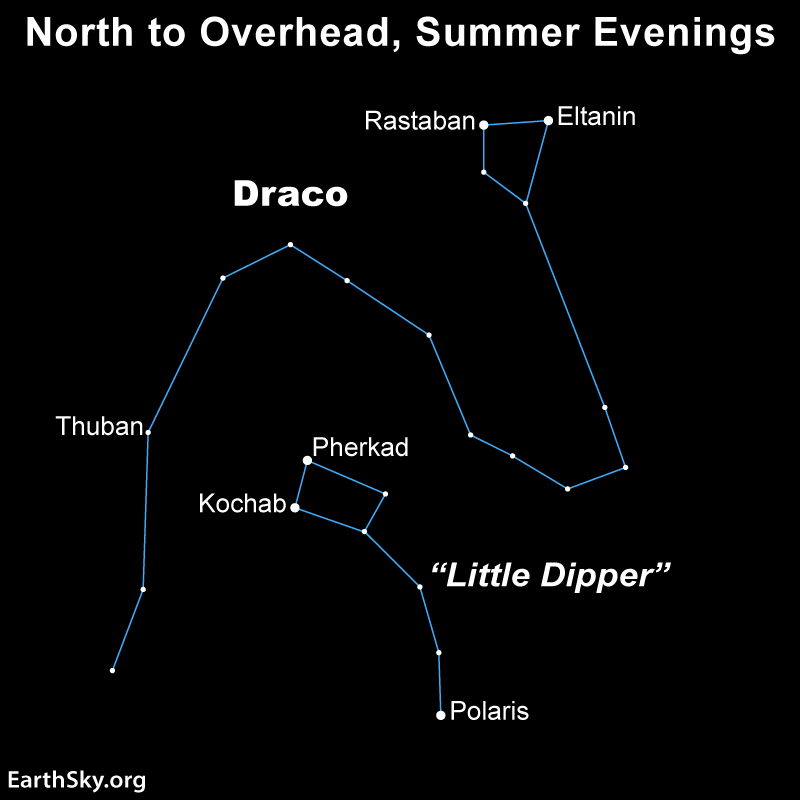
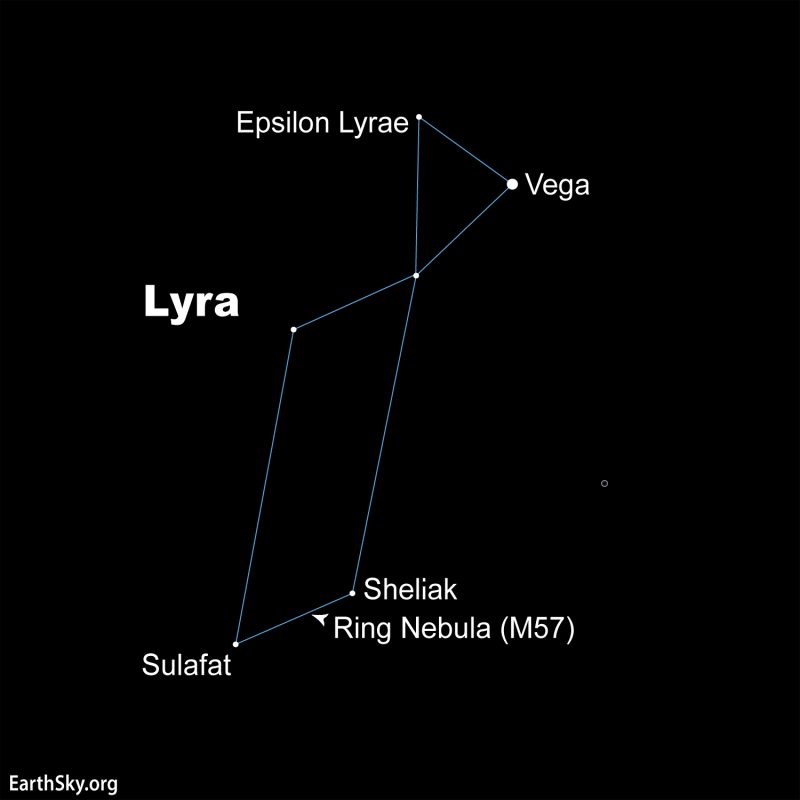
Our charts are mostly set for the northern half of Earth. To see a precise view – and time – from your location, try Stellarium Online.
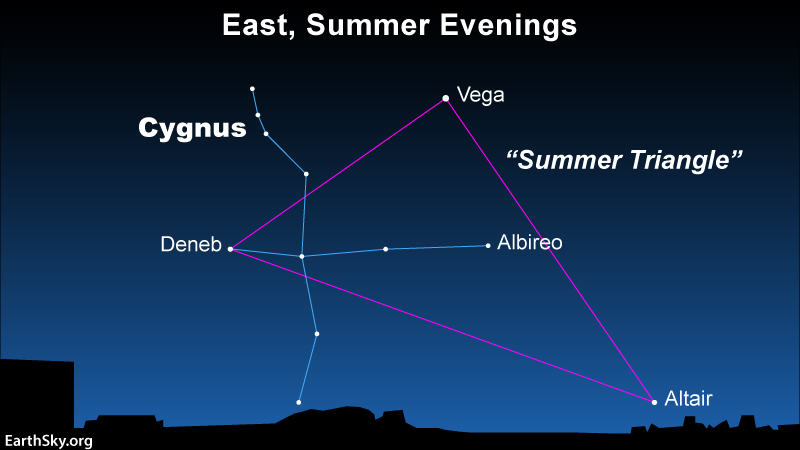
July evening planets

Our charts are mostly set for the northern half of Earth. To see a precise view – and time – from your location, try Stellarium Online.
July morning planets


Returning Migrant Birds In July? Yes, Correct:
Visit San Francisco Bay shorelines this month to note the arrival of Arctic and Alaskan populations of Western and Least Sandpiper, northern California’s initial returning migrants that will spend the non-breeding season here or at points farther south. An interesting fact relates to how some tardy northward migrating Western and Least Sandpiper populations in June may actually pass early southward migrating male individuals belonging to the same species. Imagine this phenomenon happening infrequently, but when it does, it’s likely to happen in Washington or British Columbia coastal areas — and not as typical in the San Francisco Bay Area where the initial returning shorebirds/peeps usually return as early as the last week of June and in greater numbers during the initial two weeks of July.
Trailside Nest? It’s Probably A Wood Rat
The Dusky-Footed Wood Rat is a common small mammal that is often overlooked when people walk in woodlands. Active only at night, its presence is easily noticed by its often elaborate and conspicuous conical nest of twigs and branches that can grow two to three feet tall (as more twigs accumulate each year). The wood rat occupying a nest is solitary except for during the breeding season.
Hopping Around: Brush Rabbits
By now, you may see first-year brush rabbits on the landscape. Born from January through August in our area (with greater activity from March through June), young rabbits remain in their nest for two weeks. Females produce 2-4 litters per year, of 1-6 young (average 3-4).
Beating The Heat: California Ground Squirrel
Another common northern California mammal, the California ground squirrel (or Beecheyi’s ground squirrel), is more difficult to spot now because the dry, warm weather reduces vegetation as a food source and therefore induces estivation (“summer slumber”) in some individuals during this time of the year. From now through mid-winter, these 9-11 inch mammals may retire to a burrow until more green growth appears with the first rains and in mid-winter. At higher elevations, these squirrels hibernate from late October through May.
Wood-Warblers Leaving Already?
Do some warblers actually begin dispersing from their breeding areas already? Yes, and this movement includes populations of California-nesting Orange-Crowned Warblers that first disperse to higher altitudes in the foothill and the Sierra Madre Mountains (to the east and northeast of Marin County) where they feed and molt for a period before eventually migrating south in late summer and early autumn.
More Babies? Western Tree Squirrel
Tree squirrels may be having their second “hatch” of babies by now. Using tree cavities as birthing sites, the adults occasionally move the babies from one locale to another in the canopy.
Autumnal Exit: Migrating Birds
Be on the lookout for south migrating shorebirds and sandpipers as they begin their early treks back to wintering grounds from northern breeding areas. Likely first candidates to spot along ocean beaches and in esteros include Western and Least Sandpipers, Greater Yellowlegs, Lesser Yellowlegs (less common than Greater), Willet, Marbled Godwit, Black Turnstone, and, by the end of September, Dunlin. Curiously, it’s actually possible to see both north and southbound migrating birds this month. Go to Limantour Beach at Point Reyes National Seashore, for example, and it would be plausible to see late-migrating northbound Least Sandpipers passing by the first southbound migrating birds of the same species that have already bred to the north.
Hatching Butterflies
The hatching times of butterflies vary throughout the spring and summer. One excellent online resource for the butterfly breeding biology in the McLaughlin Reserve (in Napa and Lake Counties, northwest of Davis by two hours) is accessed at http://nrs.ucop.edu/reserves/mclaughlin/species/butterflypheno.htm. An excellent butterfly field guide that reveals hatching range times is “Butterflies Through Binoculars: A Field Guide to the Butterflies of Western North America,” by Jeffrey Glassberg.
August, 2025
Sky Watch:
1) Planet Highlights:
See planet rise and set times for your location by clicking here.
Or visiting:
https://www.timeanddate.com/astronomy/night/
2) Night Sky Highlights For August, 2025 (courtesy earthsky.org):
August 2 and 3 evenings: Moon pairs up with Antares
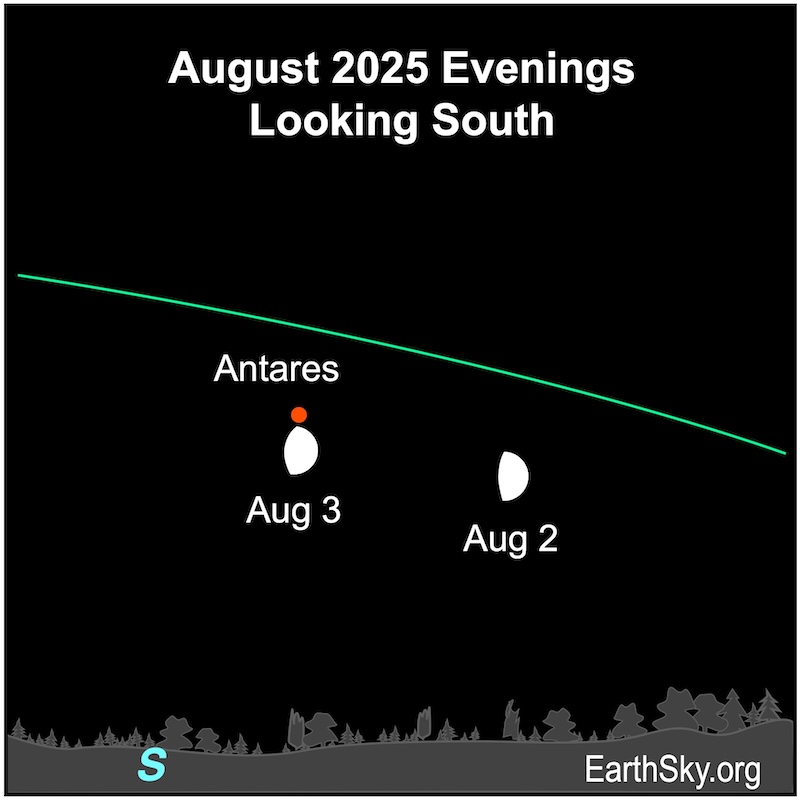
Read more: Massive ruby red Antares is the Scorpion’s Heart
Start watching Venus and Jupiter now
Our charts are mostly set for the northern half of Earth. To see a precise view – and time – from your location, try Stellarium Online.
Watch for the return of Orion, ghost of the summer dawn
Look east in early August to see Orion the Hunter, one of the sky’s easiest-to-spot constellations, as darkness gives way to morning dawn. EarthSky’s Deborah Byrd shows you how to spot Orion and introduces Orion’s brightest stars. Watch in the player above or on YouTube. Prefer to read? Click here.
August 4 and 5 evenings: Moon visits the Teapot and direction of the galactic center
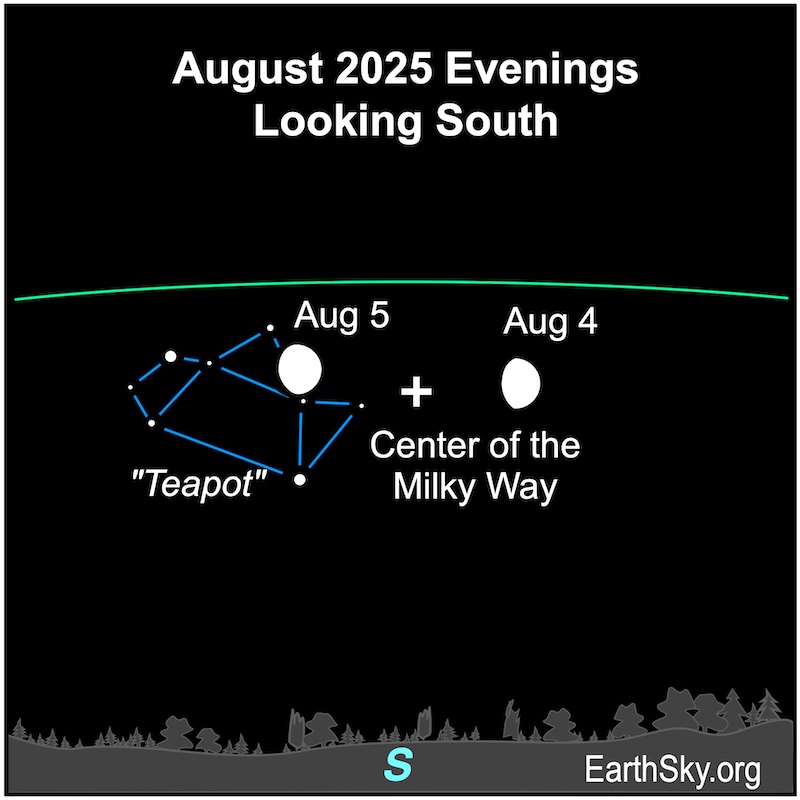
Read more: Teapot of Sagittarius points to Milky Way Center
August 6 evening: Moon visits the Teapot
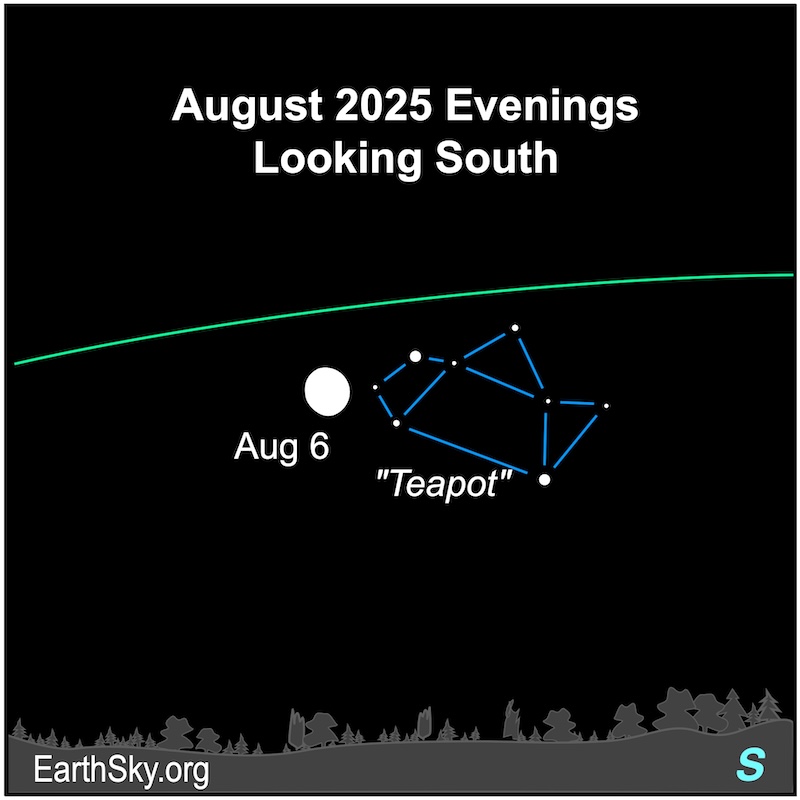
Overnight August 8-9: Full Sturgeon Moon
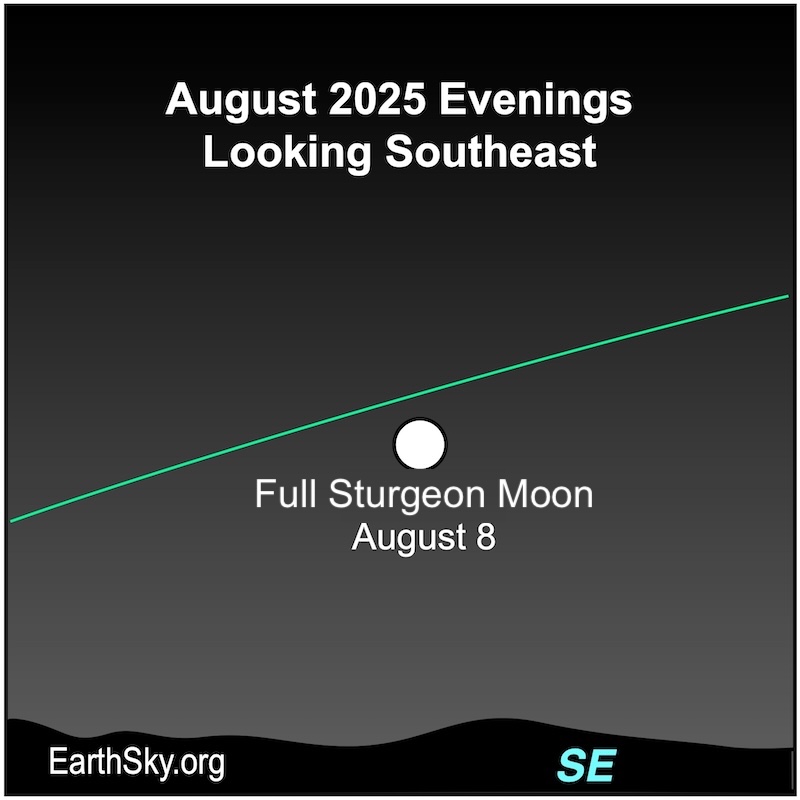
Read more about the August full Sturgeon Moon
August 11 and 12 mornings: Moon and Saturn
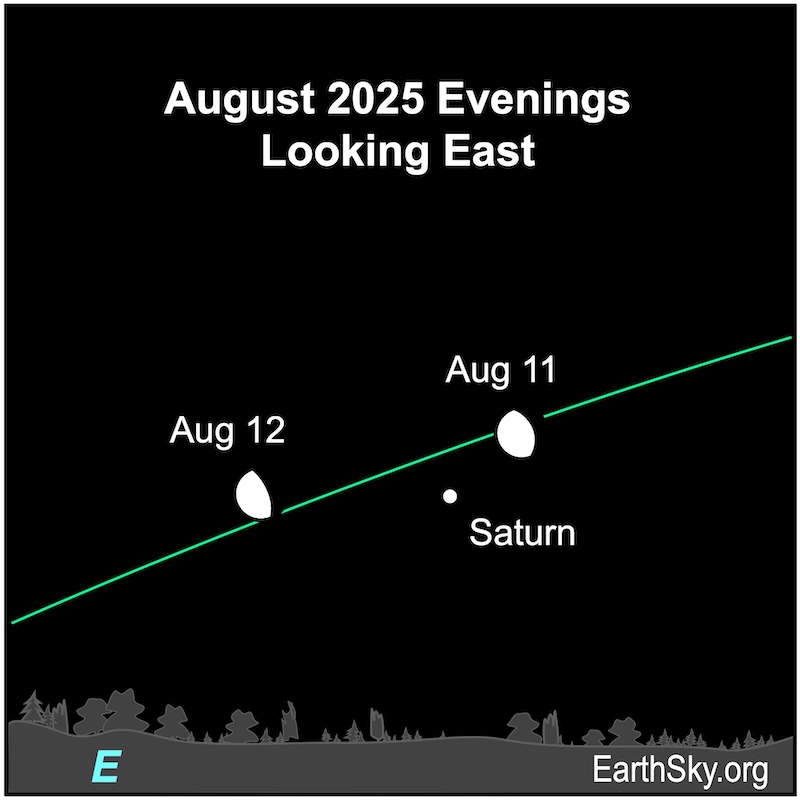
Our charts are mostly set for the northern half of Earth. To see a precise view – and time – from your location, try Stellarium Online.
August 12 morning: The Venus and Jupiter Spectacular Conjnction!
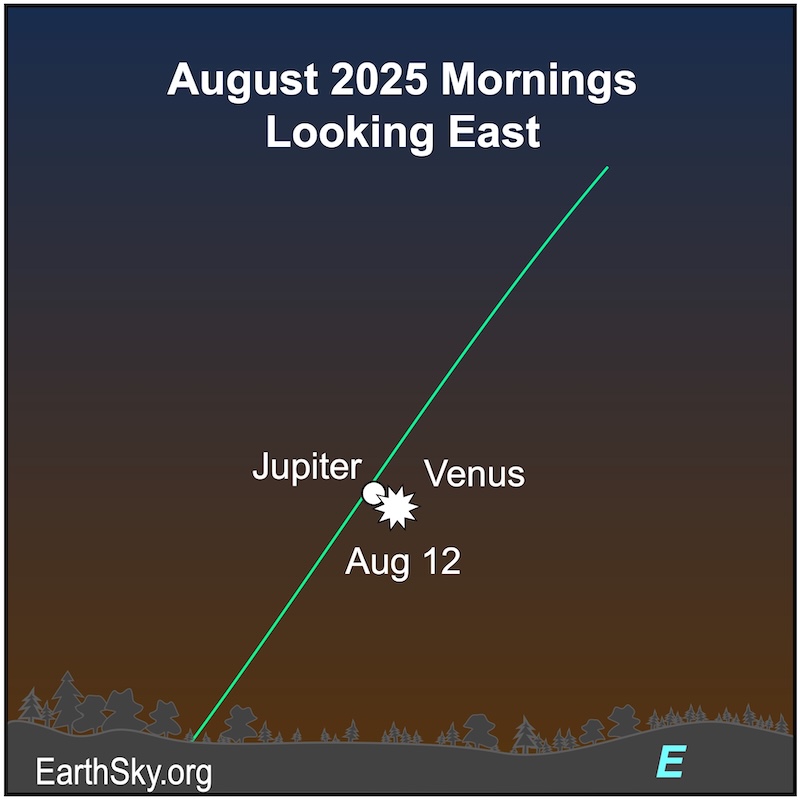
Mornings of August 11, 12 and 13: Perseids peak in moonlight
The peak mornings of the 2025 Perseid meteor shower are August 11, 12 and 13. In 2025, a bright waning gibbous moon will hinder meteor viewing. Stand with your back to the moon for better meteor viewing. Or stand in the shadow of a barn or mountain. The Perseids typically produce some 60 meteors per hour. But most of those will be washed out by bright moonlight in 2025. You might see about a dozen meteors per hour. Just remember, it’s not about the count! It’s about enjoying the sights and sounds and smells of nature at night in a rural location, and even one bright meteor can make it all worthwhile.
Read more: Perseid meteor shower: All you need to know in 2025
Read about watching meteors in moonlight: 6 tips for when the moon is out
August 14: Moon reaches perigee
The moon will reach perigee – its closest point to us in its elliptical orbit around Earth – at 18 UTC on August 14, 2025, when it’s 229,464 miles (369,288 km) away.
August 15 and 16 mornings: Moon and Pleiades
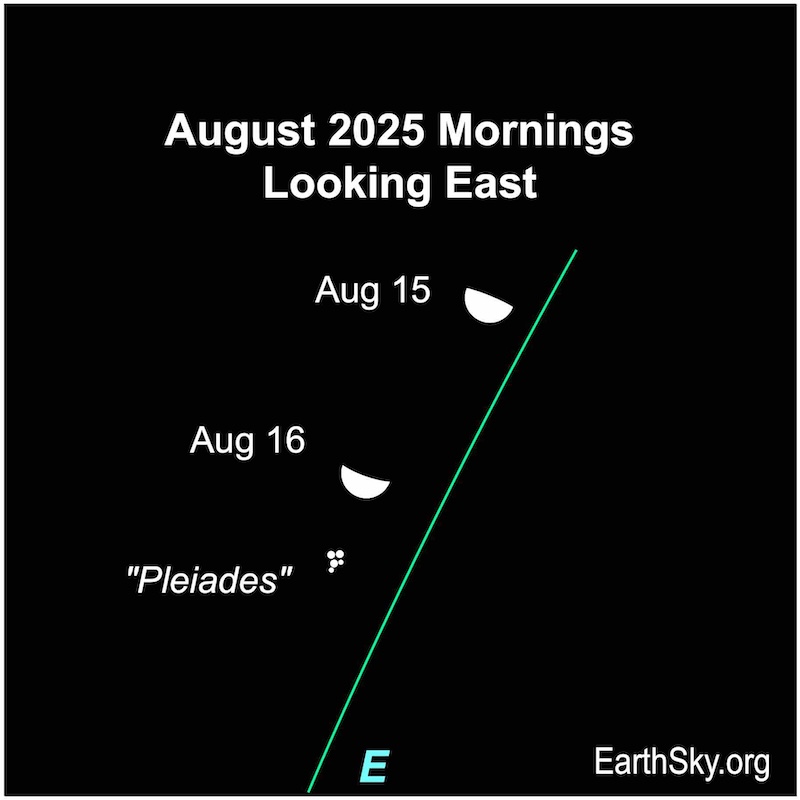
Read more: The Pleiades – or 7 Sisters – known around the world
August 16: Watch for the last quarter moon
The moment of last quarter moon will fall at 5:12 UTC on August 16, 2025. That’s 12:12 a.m. CDT. It’ll rise after midnight your local time and set around noon. Look for it high in the sky before dawn.
Want more? Here are 4 keys to understanding the moon’s phases.
August 17 and 18 mornings: Moon and 3 bright stars
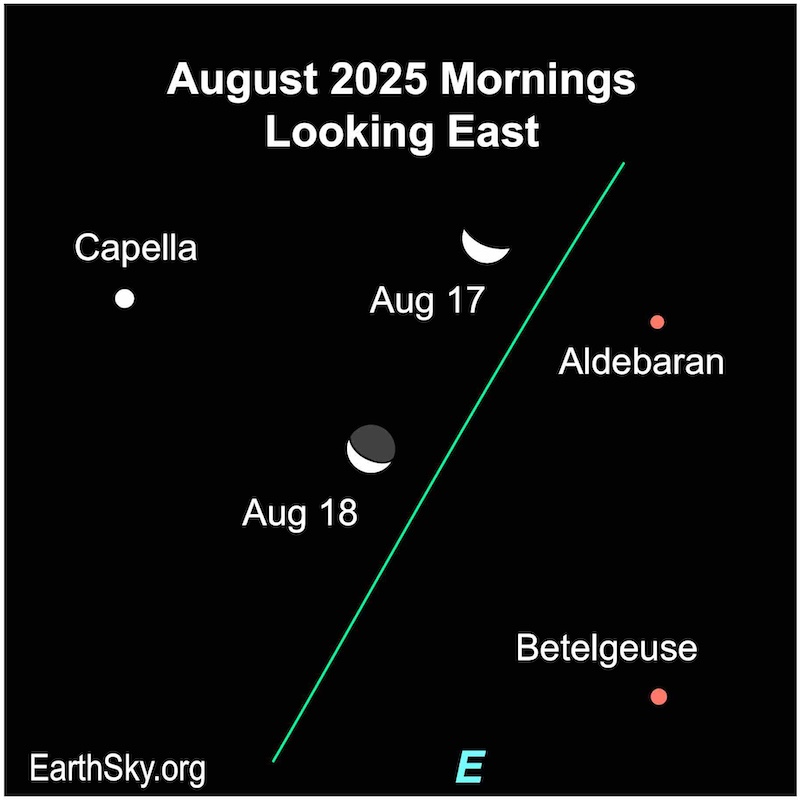
Our charts are mostly set for the northern half of Earth. To see a precise view – and time – from your location, try Stellarium Online.
Late August mornings: 4 visible planets
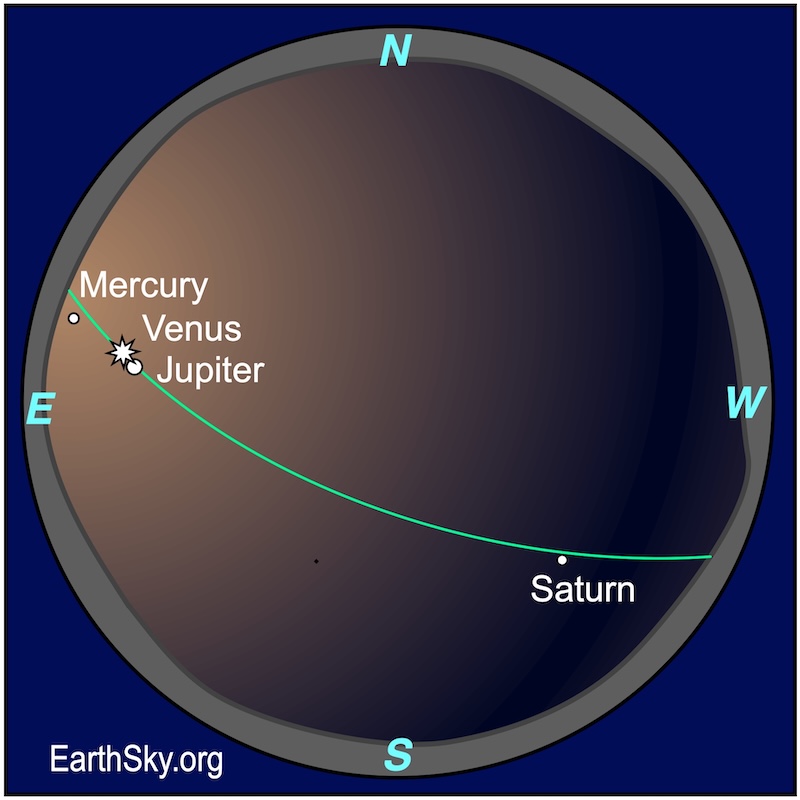
Late August mornings: Planet parade challenge
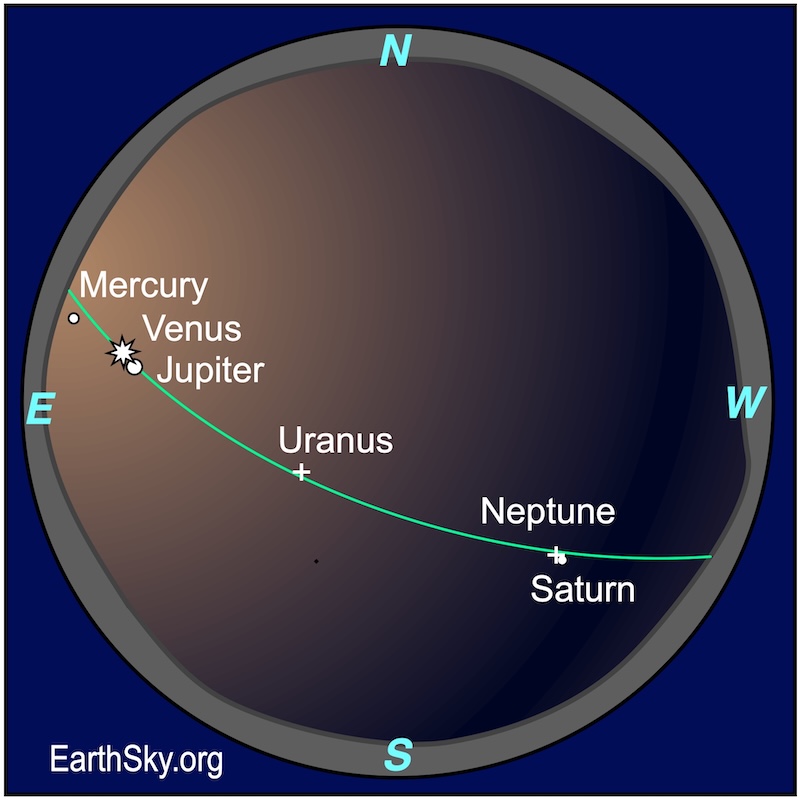
Our charts are mostly set for the northern half of Earth. To see a precise view – and time – from your location, try Stellarium Online.
August 19: Mercury farthest from the morning sun
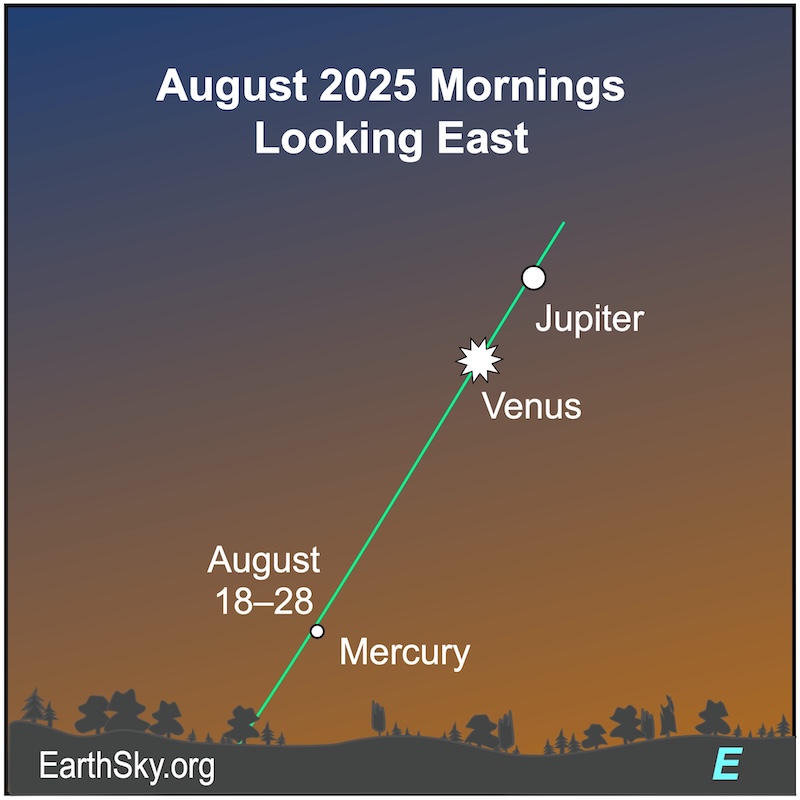
Read more: Mercury farthest from the morning sun on August 19
August 19 and 20 mornings: Moon, Venus, Jupiter and stars
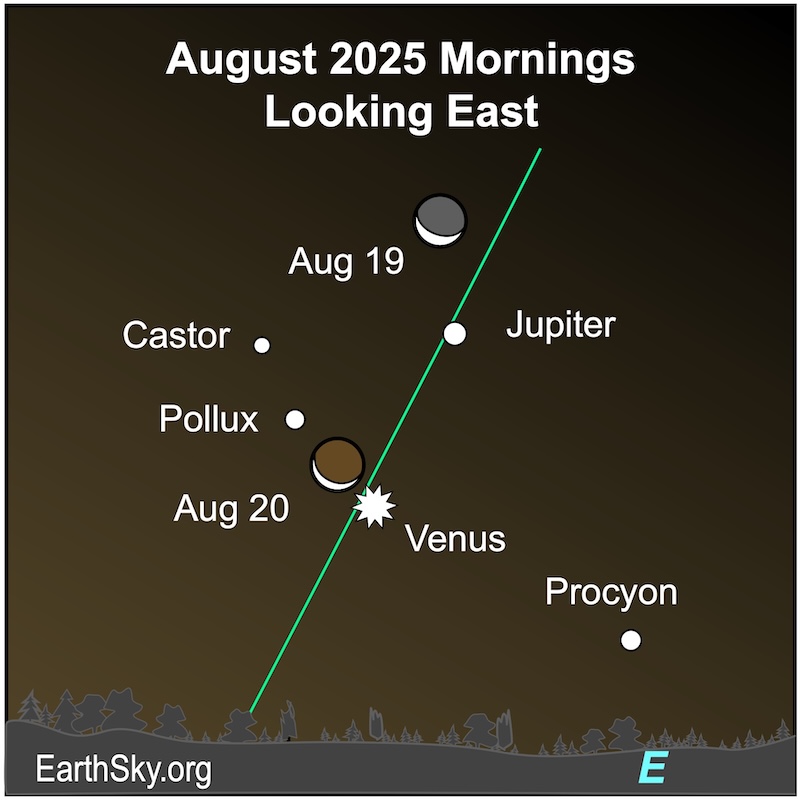
August 21 morning: Moon, Venus, Jupiter, Mercury and stars
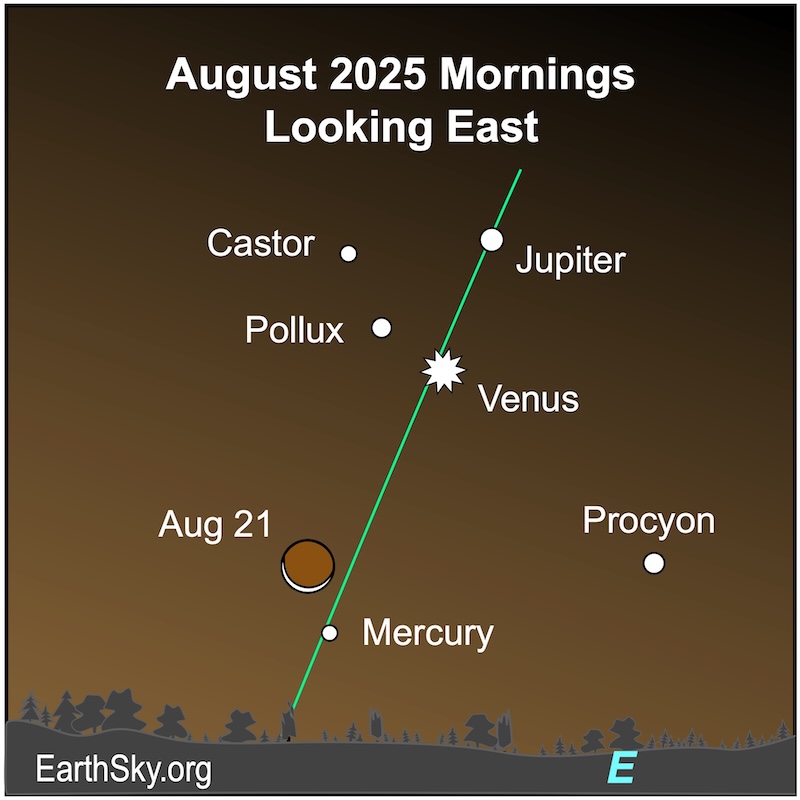
August 23: New moon
The moment of new moon will fall at 6:06 UTC on August 23, 2025. That’s 1:06 a.m. CDT. New moons rise and set with the sun. Nights around the new moon are perfect for stargazing. See EarthSky’s best places to stargaze.
See the moon phases from new to full in this EarthSky community photo.
August 25 and 26 evenings: Moon, Mars and Spica
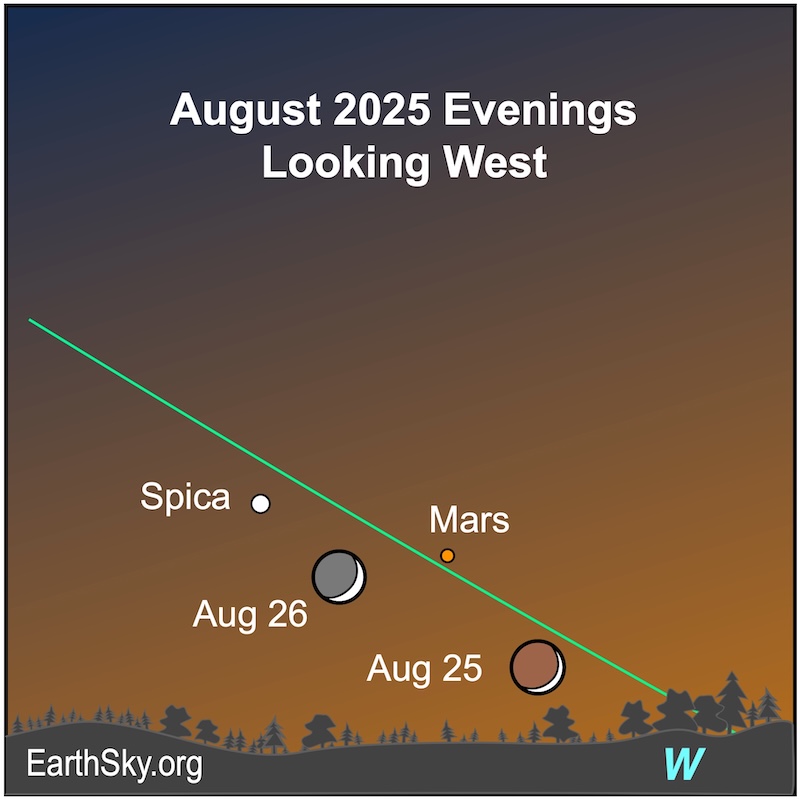
Read more: What is earthshine?
Our charts are mostly set for the northern half of Earth. To see a precise view – and time – from your location, try Stellarium Online.
August 27 evening: Moon and Spica
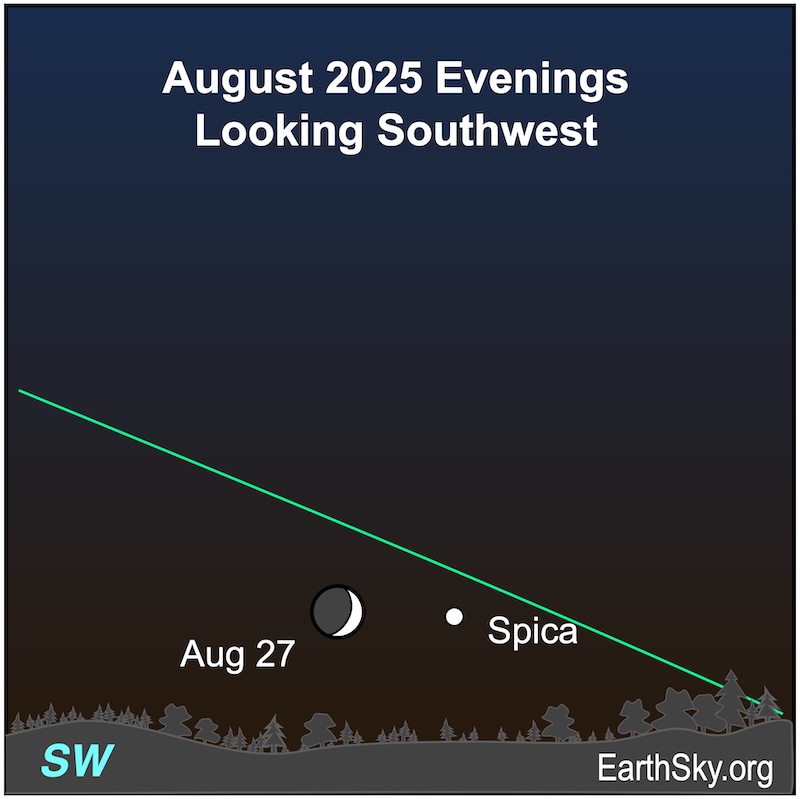
August 29: Moon reaches apogee
The moon will reach apogee – its farthest distance from Earth for the second time this month in its elliptical orbit – at 16 UTC on August 29, 2025, when it’s 251,374 miles (404,548 km) away.
August 28 and 29 evenings: Moon near Zubenelgenubi
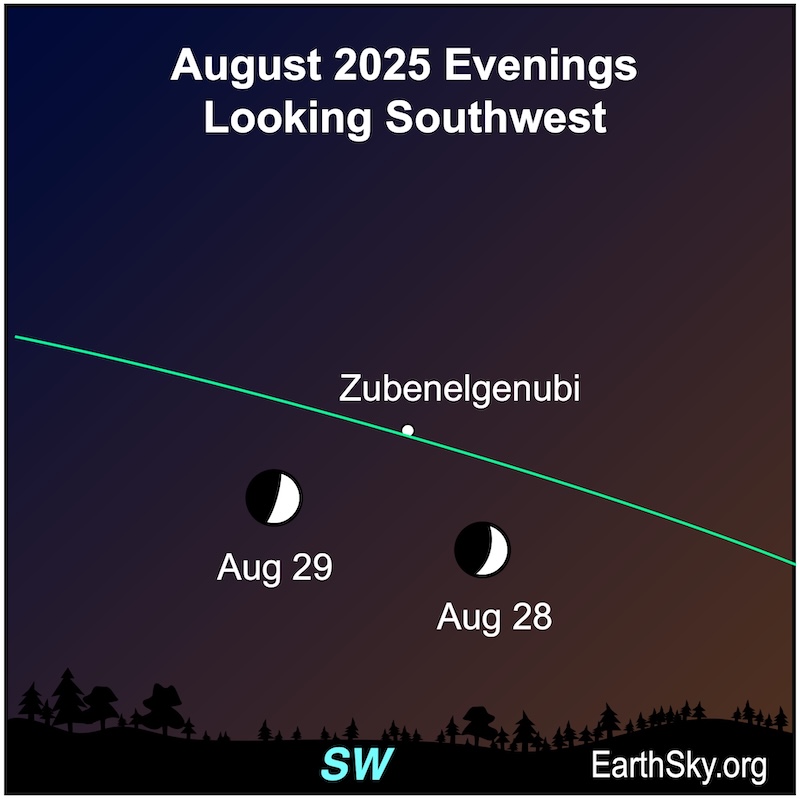
August 30 and 31 evenings: Moon pairs up with Antares
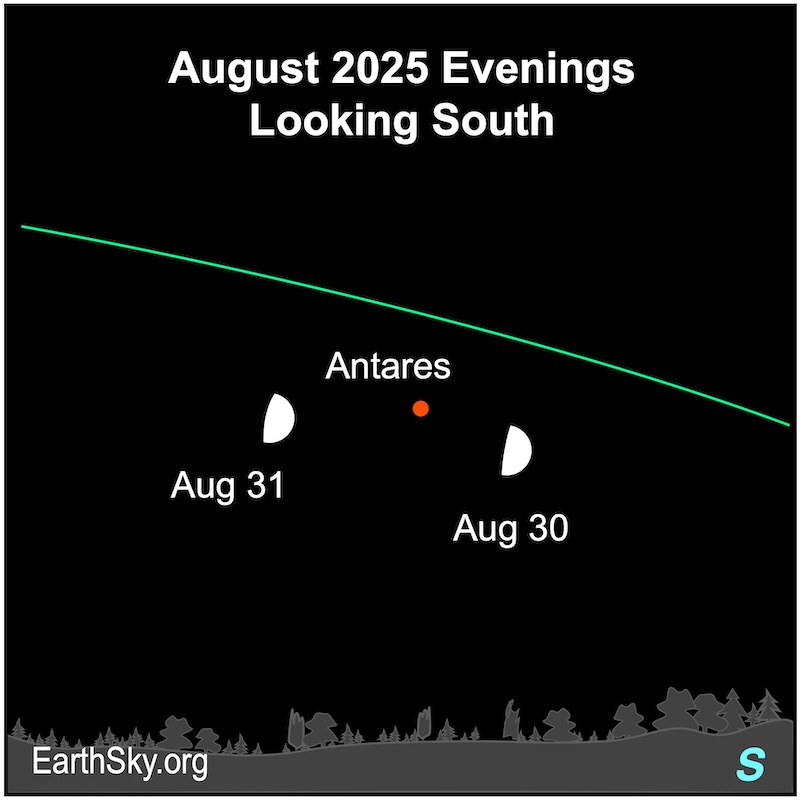
Read more: Massive ruby red Antares is the Scorpion’s Heart
Our charts are mostly set for the northern half of Earth. To see a precise view – and time – from your location, try Stellarium Online.
August 31: 1st quarter moon
The moment of 1st quarter moon will fall at 6:25 UTC on August 31, 2025. That’s 1:25 a.m. CDT. Did you know you can see an X and V on the 1st quarter moon? Here’s how to see them. A 1st quarter moon rises around noon your local time and sets around midnight. Watch for a 1st quarter moon high in the sky at sundown.
Want more? Here are 4 keys to understanding the moon’s phases.
August stars and constellations
If you’re out stargazing on any August evening, look for these stars and constellations overhead in the evening sky.
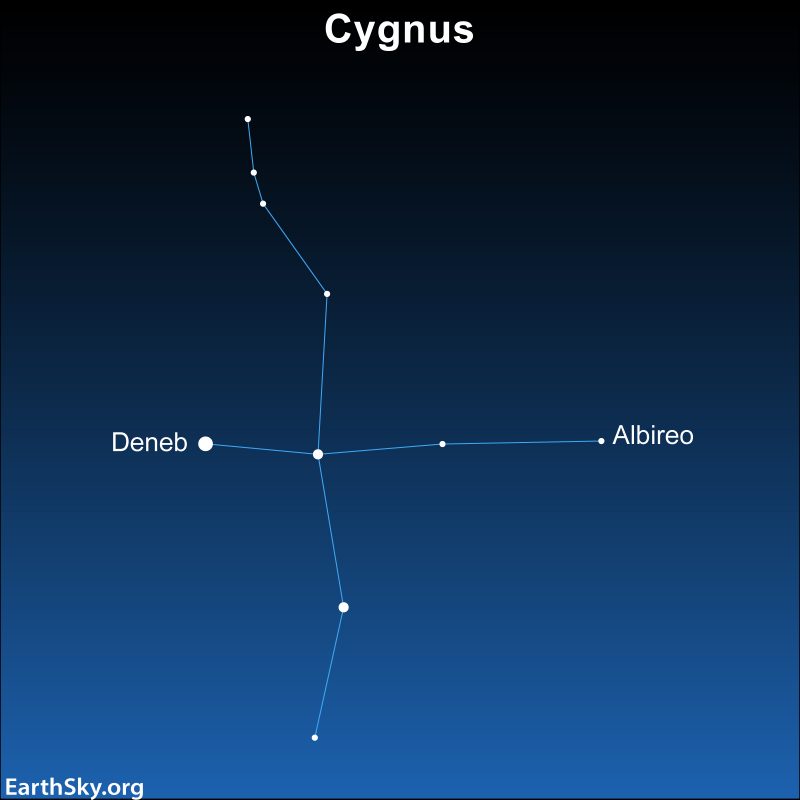
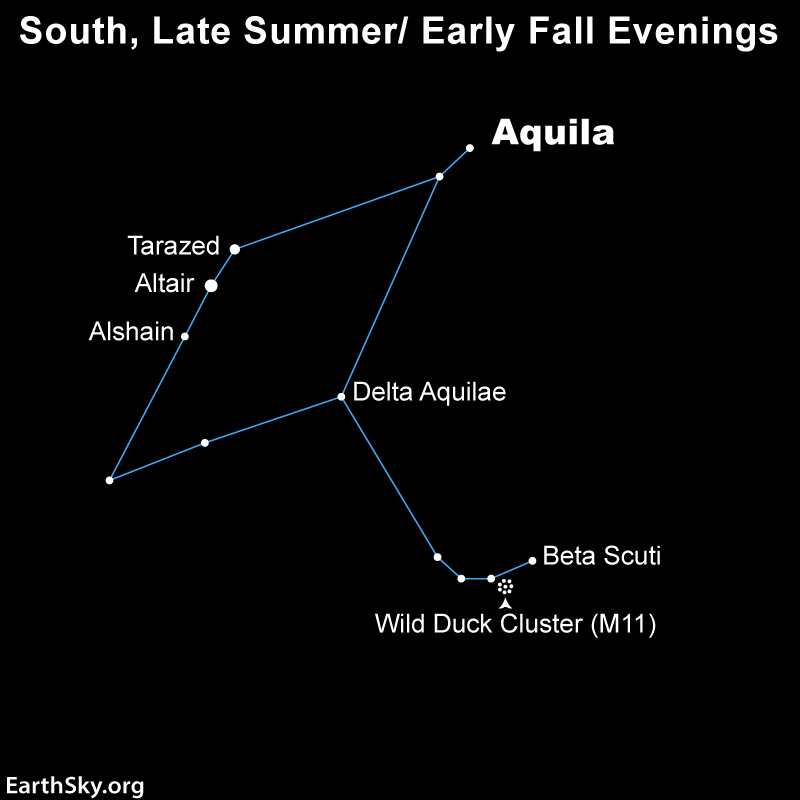
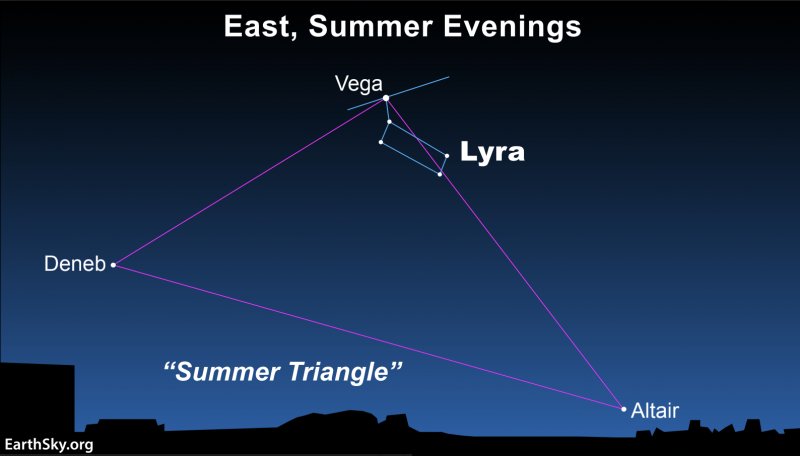
Our charts are mostly set for the northern half of Earth. To see a precise view – and time – from your location, try Stellarium Online.
Read more about the Summer Triangle
August morning planets
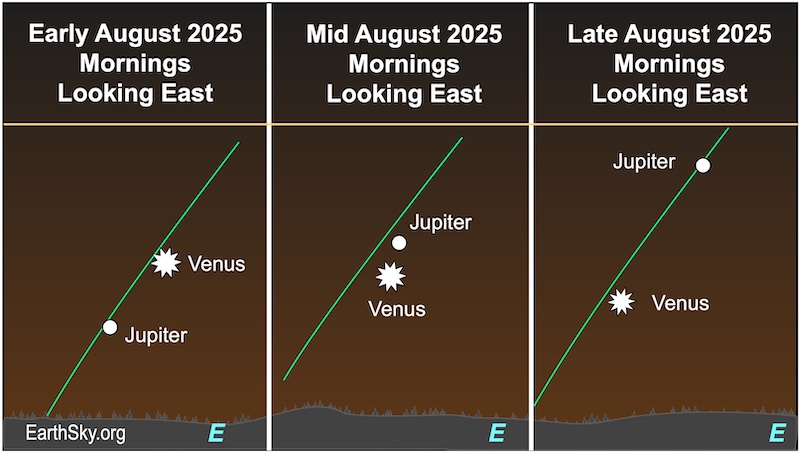
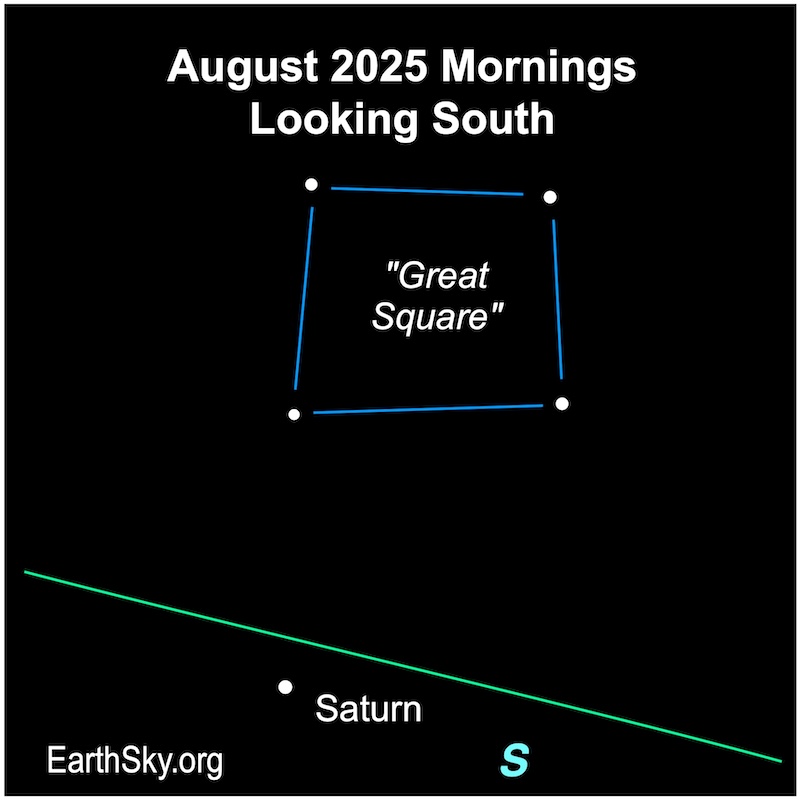
Sky dome map for visible planets and night sky
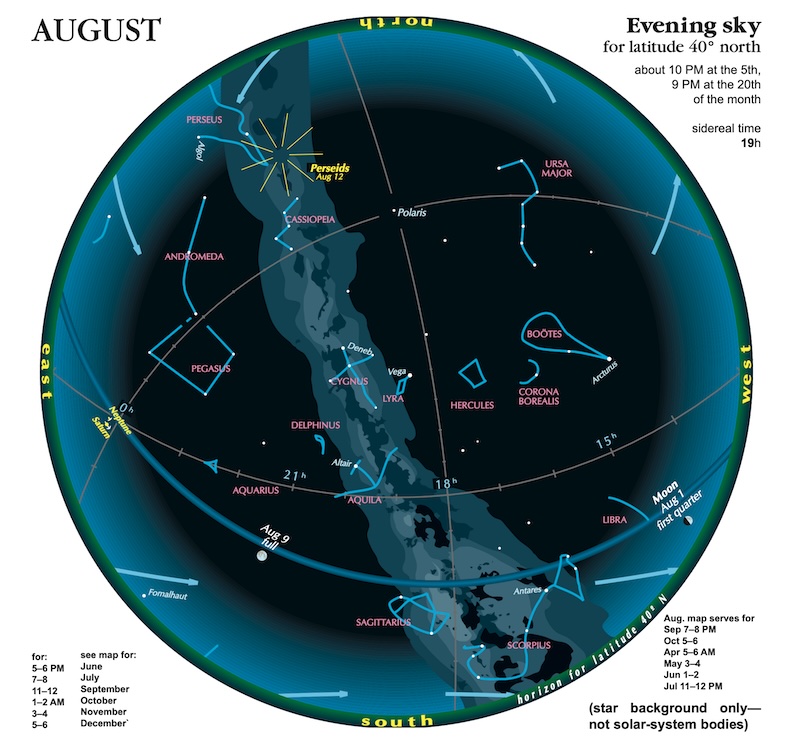
September, 2025
Please check back after September 1, 2025 for accurate information.
September 5 morning: Mercury greatest distance from sunrise
Mercury reaches its greatest elongation – greatest distance from the sunrise – at 3 UTC on September 5, 2024. Look east at dawn. It’ll brighten through most of September before disappearing from the morning sky before the end of the month. This will be the best morning apparition of Mercury for the Northern Hemisphere this year. Southern viewers can see it too.
September 8: Saturn at opposition
Earth will fly between the sun and Saturn on September 8, 2024, placing the ringed planet at opposition – opposite the sun – in our sky. And that’s the best time to watch Saturn. Saturn is rising in the east at sunset and is visible all night. Then, for the rest of 2024, Saturn will remain visible in the evening sky. It’ll finally disappear in the sunset glare in February 2025.
Watch a video of Saturn at its brightest.
September 8 to 10 mornings: Mercury and Regulus pair up
Mercury will pass the much dimmer star Regulus from September 8 to September 10, 2024. Look low in the eastern morning twilight about 40 minutes before sunrise. Here’s a binocular view for September 8 to 10. They will be 0.5 degrees apart – the width of a full moon – on September 9.
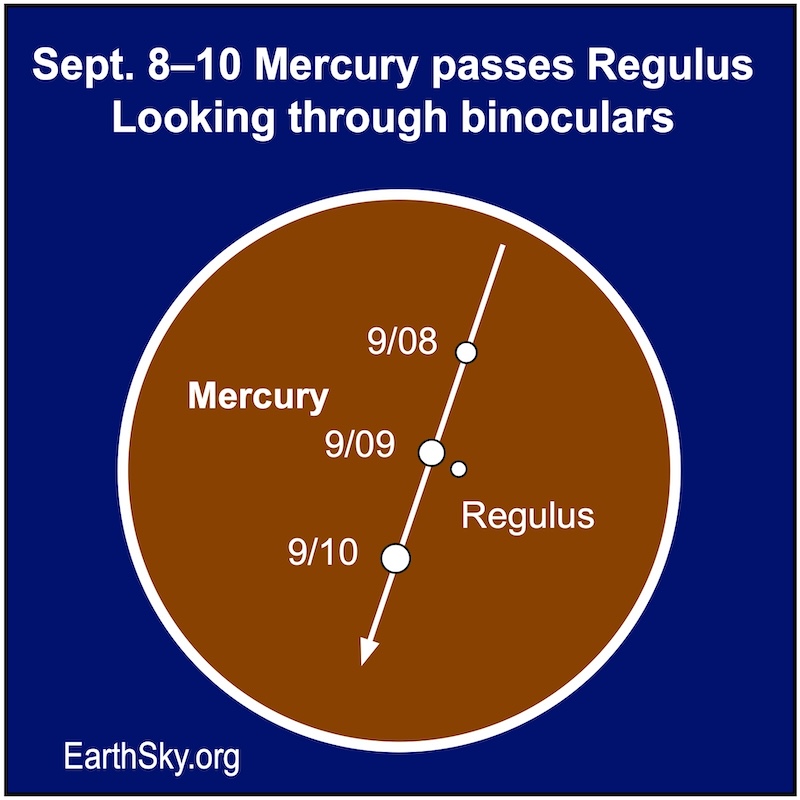
September 9 and 10 evenings: Moon near Antares
As the waxing crescent moon nears 1st quarter, it will move through Scorpius the Scorpion on the nights of September 9 and 10, 2024. It will lie closest to the bright red star Antares on September 10. Observers in parts of Africa, Madagascar, Kerguelen Island, Australia and Indonesia will see the moon occult Antares at 13 UTC on September 10. They’ll be visible until a little after 10 p.m. your local time.
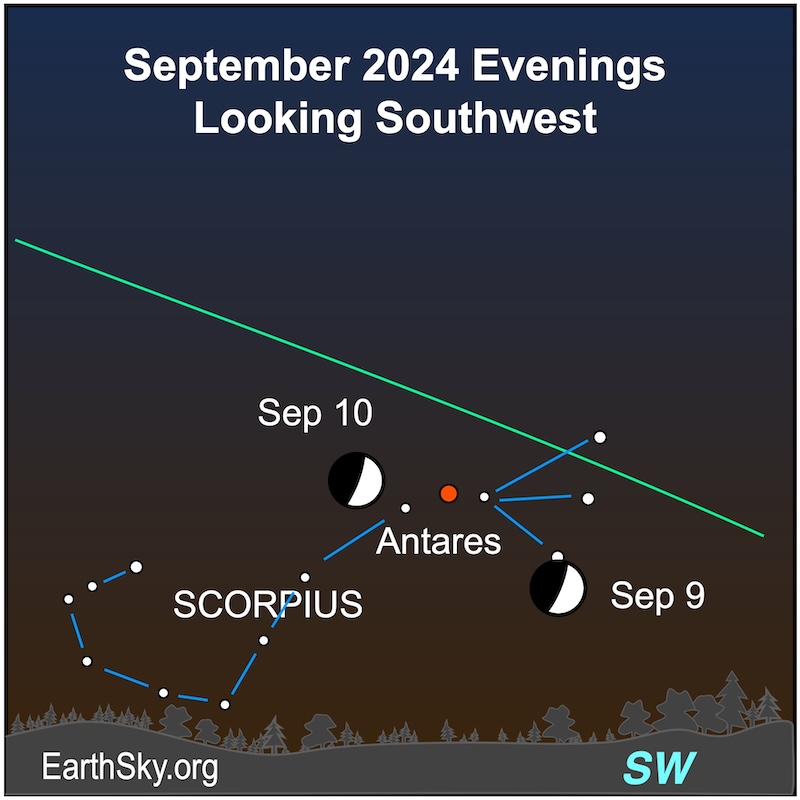
September 11: 1st quarter moon
The moment of 1st quarter moon will fall at 6:06 UTC (1:06 a.m. CDT) on September 11, 2024. A 1st quarter moon rises around noon your local time and sets around midnight. Watch for it high in the sky at sundown.
September 11 and 12 evenings: Moon near Teapot
On September 11 and 12, 2024, the waxing gibbous moon will glow low in the south as it moves through the Teapot, an asterism in Sagittarius the Archer. The moon’s glow may make spotting the Teapot difficult. They’ll be visible until around midnight your local time.
Our charts are mostly set for the northern half of Earth. To see a precise view – and time – from your location, try Stellarium Online.
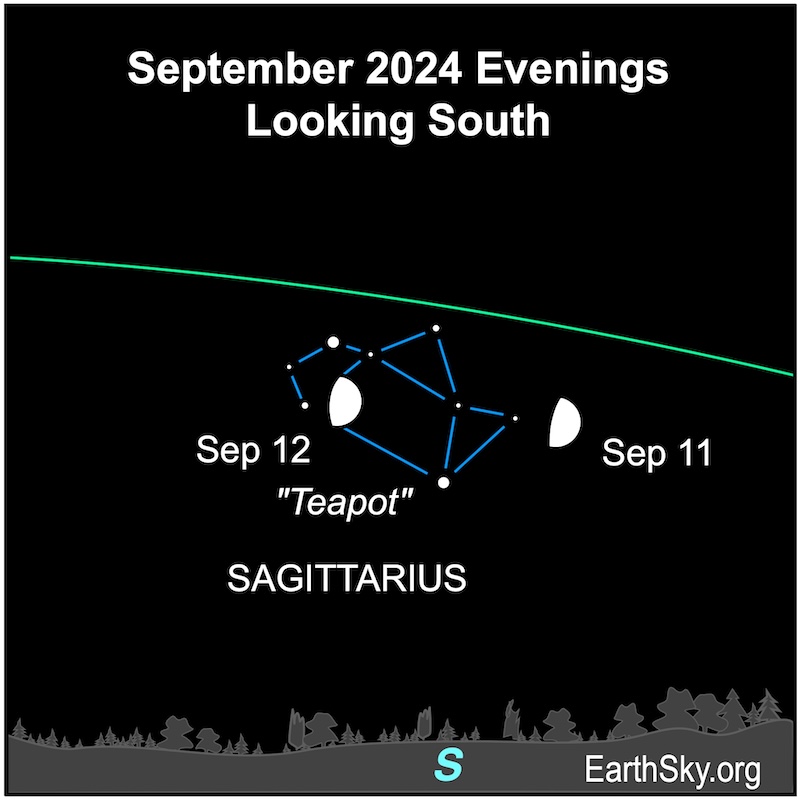
September 15 and 16 evenings: Moon near Saturn
The bright waxing gibbous moon will hang near Saturn in the east after sunset on September 15 and 16, 2024. Observers in the western United States, Australia, western Canada and northwestern Mexico will see the moon occult Saturn at 10 UTC on September 17. They’ll set a few hours before dawn.
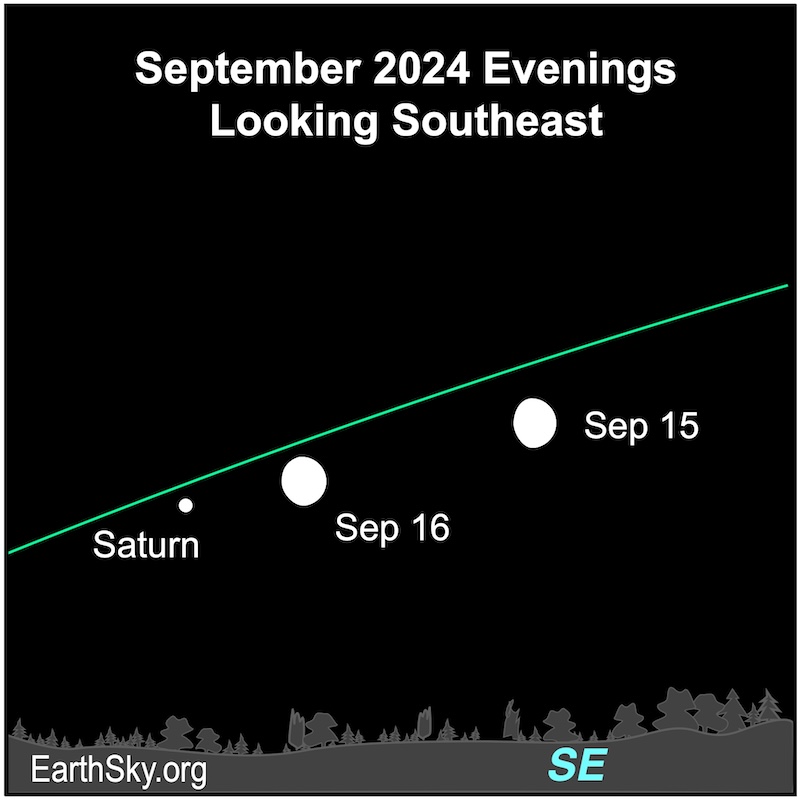
September 17 overnight: Super Harvest Moon and partial lunar eclipse
The moment of full moon will fall at 2:34 UTC on September 18, 2024 (9:34 p.m. CDT on September 17). A full moon rises opposite the sunset, is highest in the sky at midnight and lies low on the western horizon opposite the sunrise. This is the second of four supermoons in a row. And it’s the Harvest Moon, plus there’s a partial lunar eclipse. The moon will be partly eclipsed from 9:12 p.m. CDT to 10:16 p.m. Only 8% of the moon’s disk lies in the dark umbral shadow at mid-eclipse, which happens at 9:44.
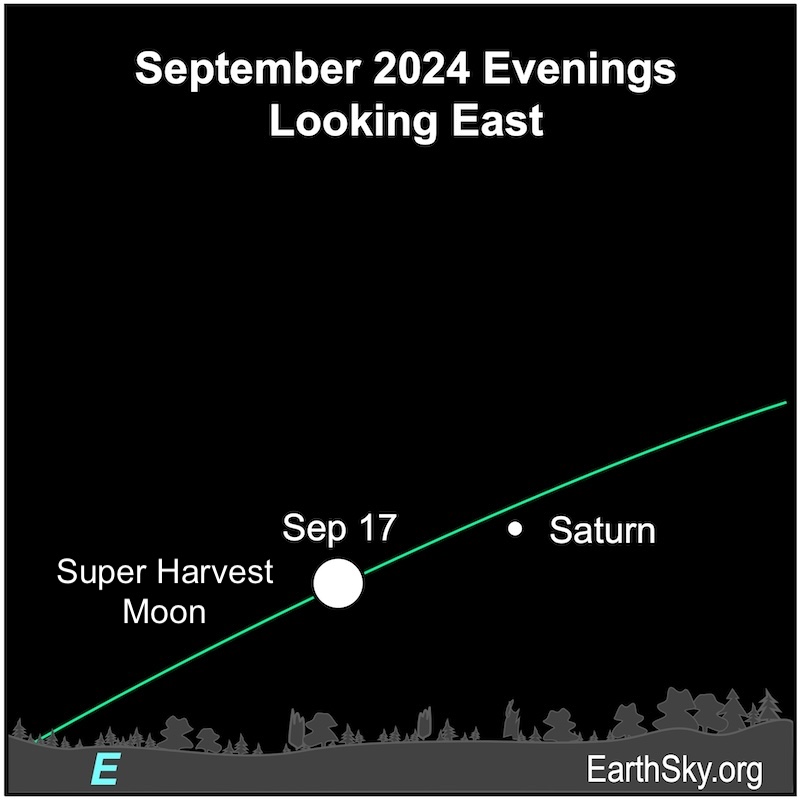
September 18: Moon reaches perigee
The moon will reach perigee – its closest point in its elliptical orbit around Earth – at 13 UTC (8 a.m. CDT) on September 18, 2024, when it’s 222,007 miles (357,286 km) away. High tides possible.
September 20 overnight: Neptune at opposition
Neptune, visible only in telescopes, will be at its closest point to Earth on the overnight of September 20, 2024.
September equinox: September 22
The September equinox will arrive at 12:44 UTC today. The sun will be exactly above Earth’s equator, moving from north to south. It’s autumn for the Northern Hemisphere and spring for the Southern Hemisphere.
September 22 morning: Moon near Jupiter, Aldebaran and the Pleiades
On the morning of September 22, 2024, the waning gibbous moon will lie close to the bright planet Jupiter. The 3rd quarter moon will pass the Pleiades. Plus the fiery red star Aldebaran, the Eye of Taurus the Bull, will shine nearby. They’ll rise before midnight and be visible through dawn.
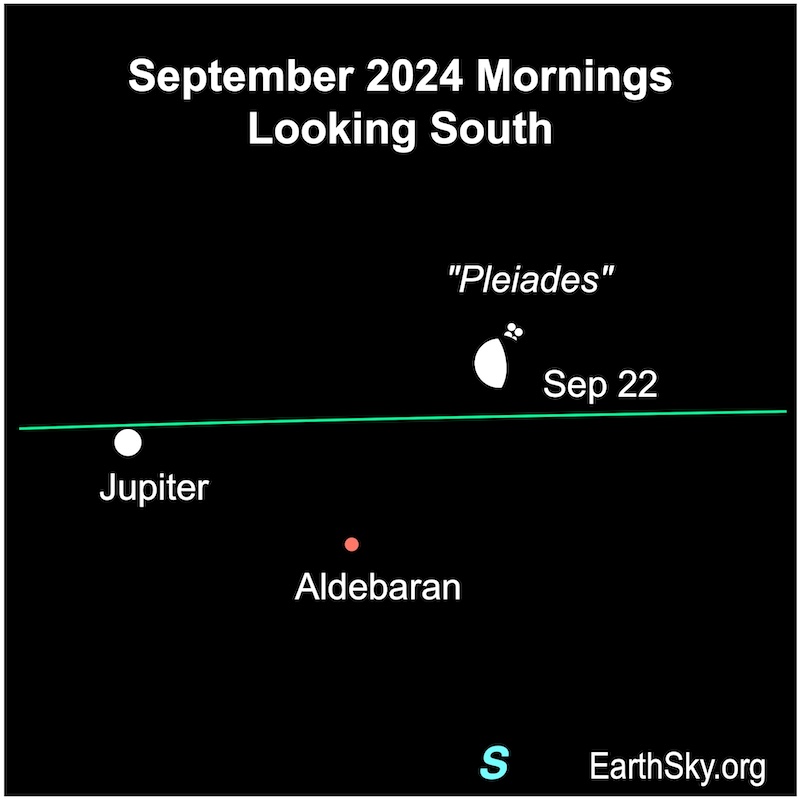
September 23 and 24 mornings: Moon near Jupiter, Mars and 3 bright stars
The 3rd quarter moon on the mornings of September 23 and 24, 2024, will slide by bright Jupiter. Red Mars will lie nearby. Also, look for the bright stars Capella, Aldebaran and Betelgeuse. Plus the shimmering glow of the Pleiades star cluster is nearby. They’ll rise before midnight and be visible through dawn.
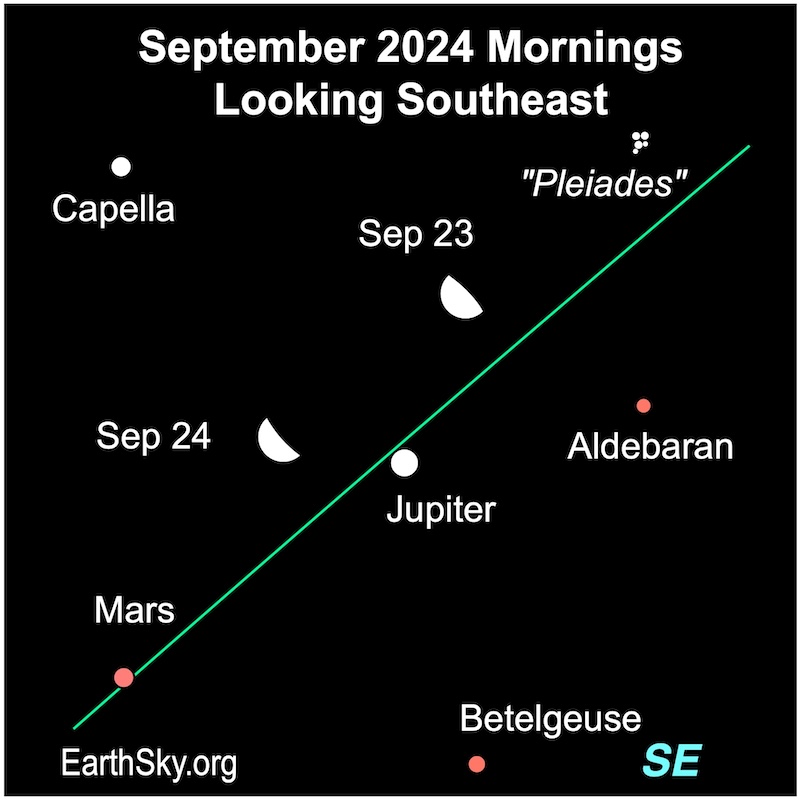
September 24: Last quarter moon
The moment of last quarter moon will fall at 18:50 UTC (1:50 p.m. CDT) on September 24, 2024. It’ll rise after midnight your local time and will set around noon. Look for it high in the sky before dawn.
September 25 and 26 mornings: Moon near Mars, Castor, Pollux and Procyon
On the mornings of September 25 and 26, 2024, the waning crescent moon will lie near Mars and pass the twin stars of Gemini, Castor and Pollux. The bright star Procyon in Canis Minor the Lesser Dog will shine nearby. They’ll rise after midnight and be visible through dawn.
Our charts are mostly set for the northern half of Earth. To see a precise view – and time – from your location, try Stellarium Online.
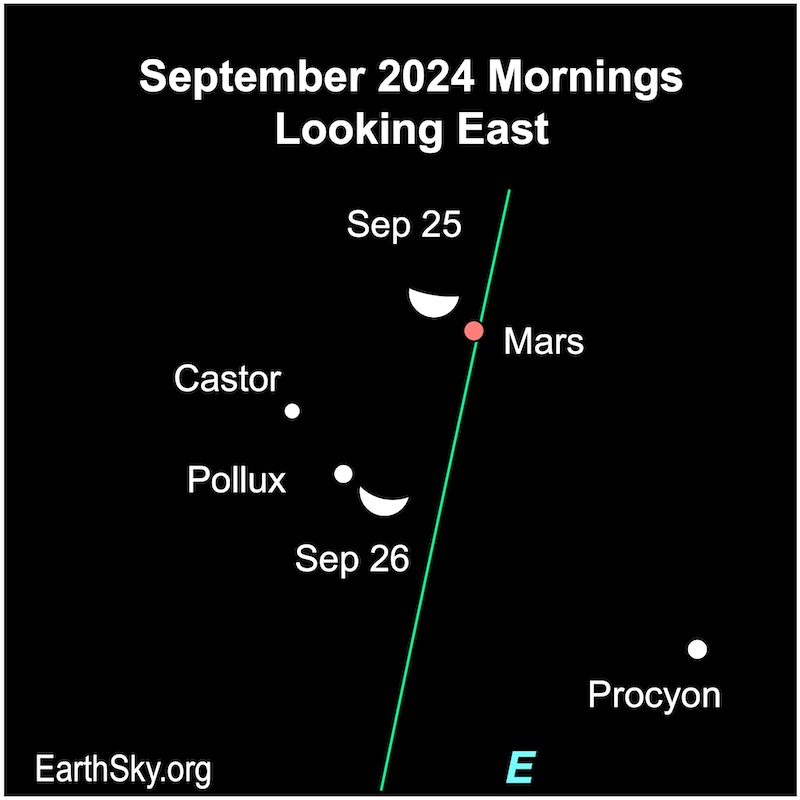
September 27 and 28 mornings: Moon buzzes the Beehive
As eastern twilight begins to brighten on September 27, 2024, the waning crescent moon will move close to the faint Beehive star cluster. In a dark sky, the Beehive is an easy target with binoculars. On the morning of September 28, the moon will hang between the Beehive and Leo the Lion’s brightest star Regulus. They will lie low on the horizon. They’ll rise a few hours after midnight.
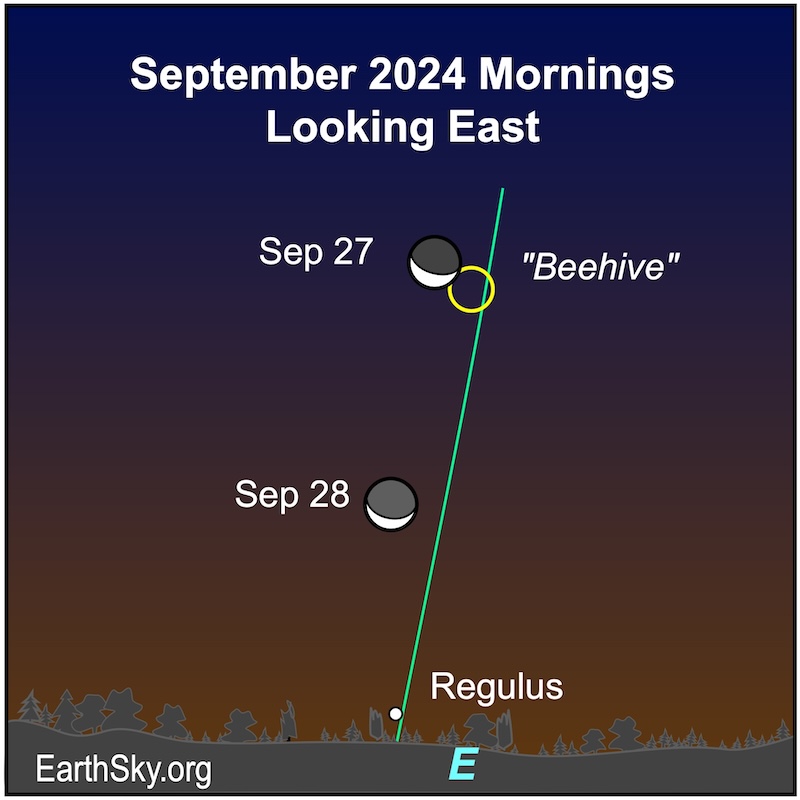
September 27 morning: Moon and Beehive binocular view
Binoculars will help show the Beehive star cluster next to the waning crescent moon on the morning of September 27, 2024.
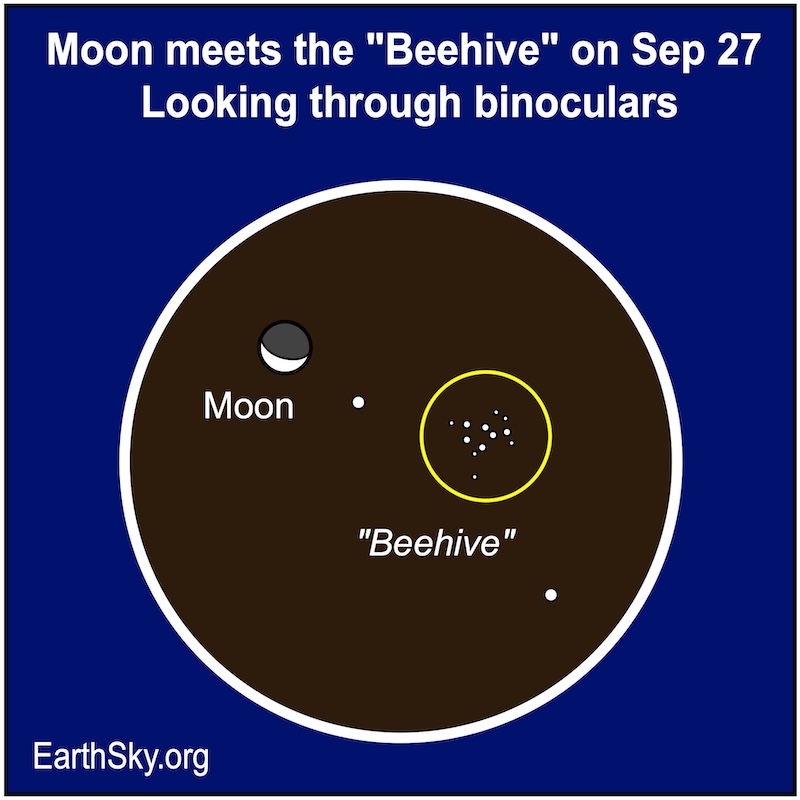
September 29 and 30 mornings: Moon and Regulus
On the final two mornings of September 2024, the waning crescent moon will float in the eastern morning sky. On September 29, 2024, it will lie next to the star Regulus, the brightest star in Leo the Lion. And on September 30, the moon will hang low the eastern horizon. The dark portion of the moon will be glowing with earthshine. That’s reflected light from the Earth. Look for them about 75 minutes before sunrise.
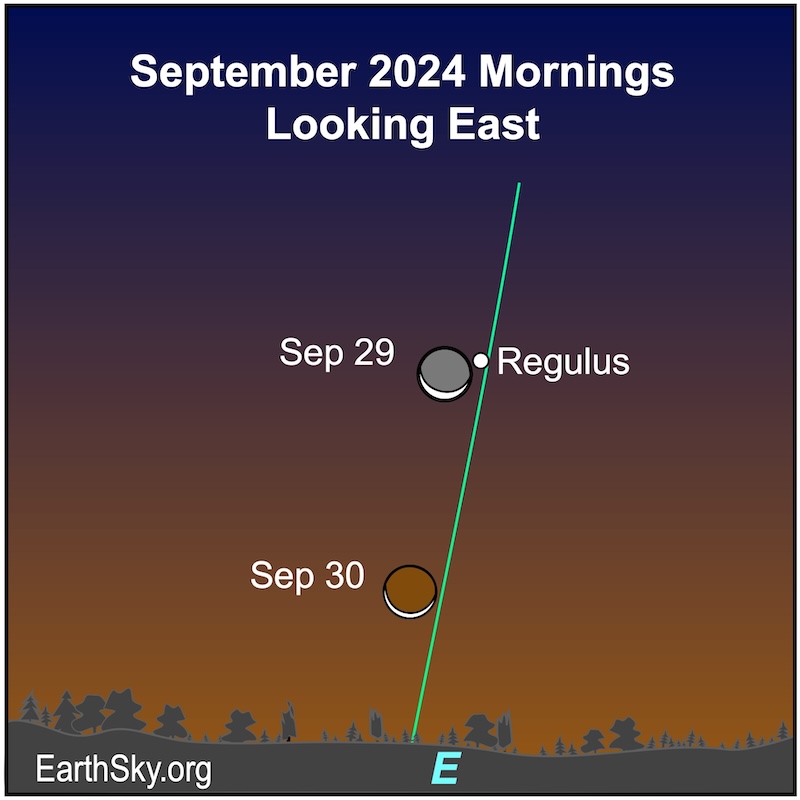
September 30: Mercury at superior conjunction
Mercury will move along the far side of its orbit, and will reach superior conjunction – on the opposite side of the sun – on September 30, 2024.
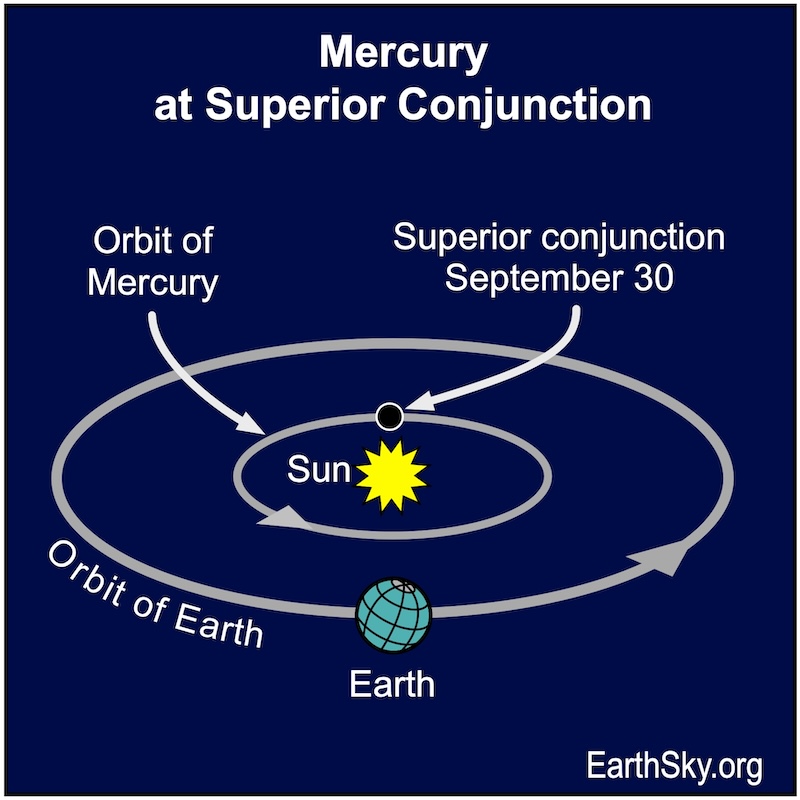
Stars and constellations high in the sky during September
If you’re out stargazing on any September evening, look for these stars and constellations overhead in the sky.
Cassiopeia
You can find Cassiopeia the Queen in the northeast around the month of September. It is composed of five moderately bright stars that form a distinctive M or W. If you have a dark sky, look below Cassiopeia for a famous binocular object. This object is called the Double Cluster in Perseus.
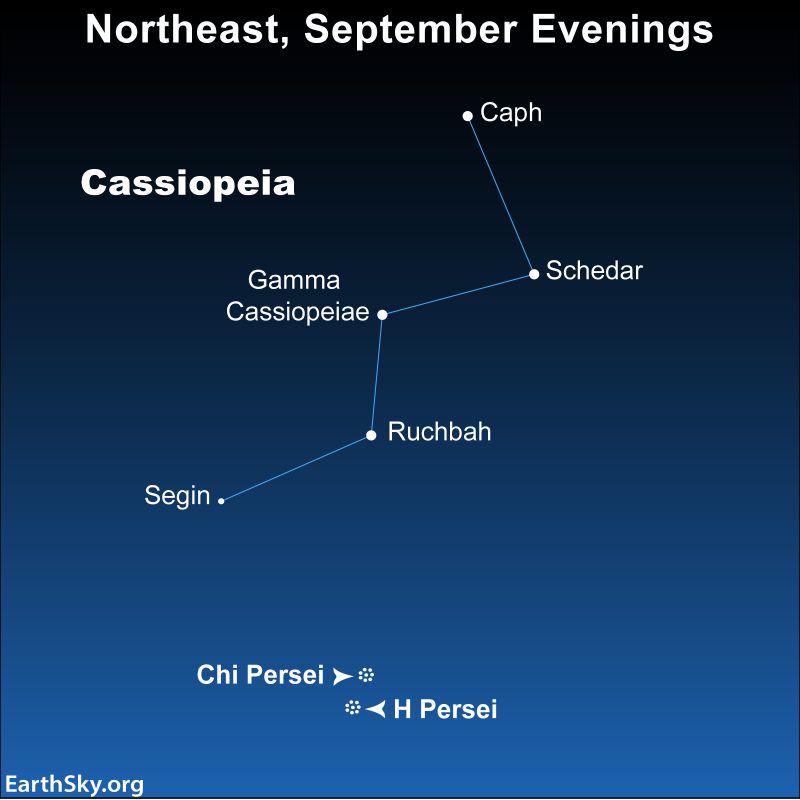
Cepheus
On September evenings, the house-shaped constellation Cepheus lies upside down in the northern sky. It’s between the W shape of Cassiopeia and the Little Dipper.
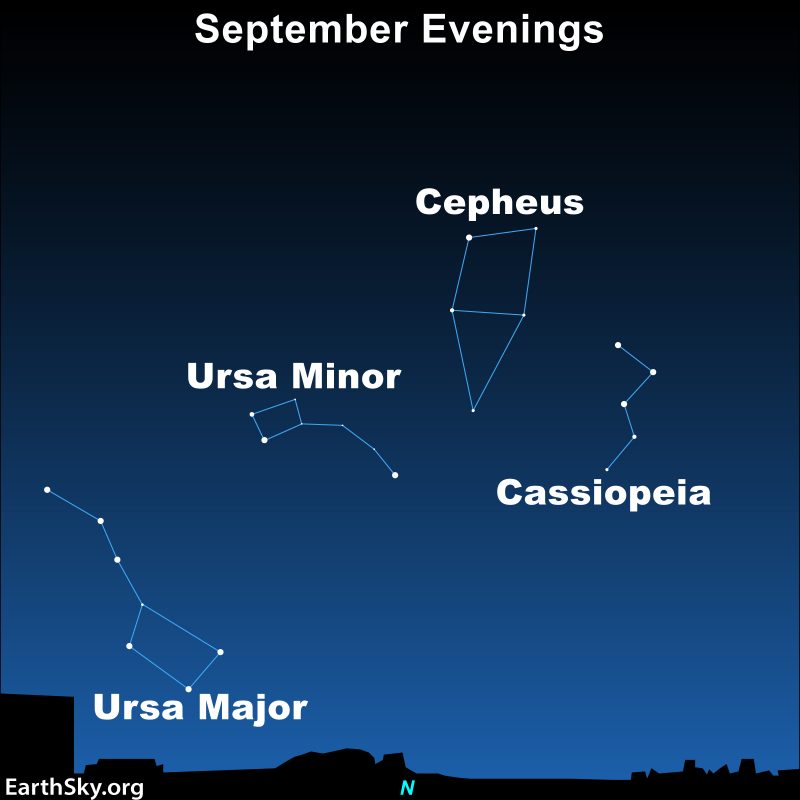
Lyra
Here’s the constellation Lyra the Harp. It’s made of a triangle and a parallelogram. Its brightest star is Vega. And next to it you’ll find Epsilon Lyrae, the famous Double Double star. Through a telescope you can see a famous planetary nebula: M57, the Ring Nebula.
Our charts are mostly set for the northern half of Earth. To see a precise view – and time – from your location, try Stellarium Online.
September morning planets
In September 2024, Jupiter will shine brightly at the center of a triangle formed by the bright stars Capella, Aldebaran and Betelgeuse. Mars and the shimmering glow of the Pleiades star cluster are nearby. Jupiter rises before midnight local time and is prominent through dawn. Jupiter will be closest and brightest for 2024 in December.
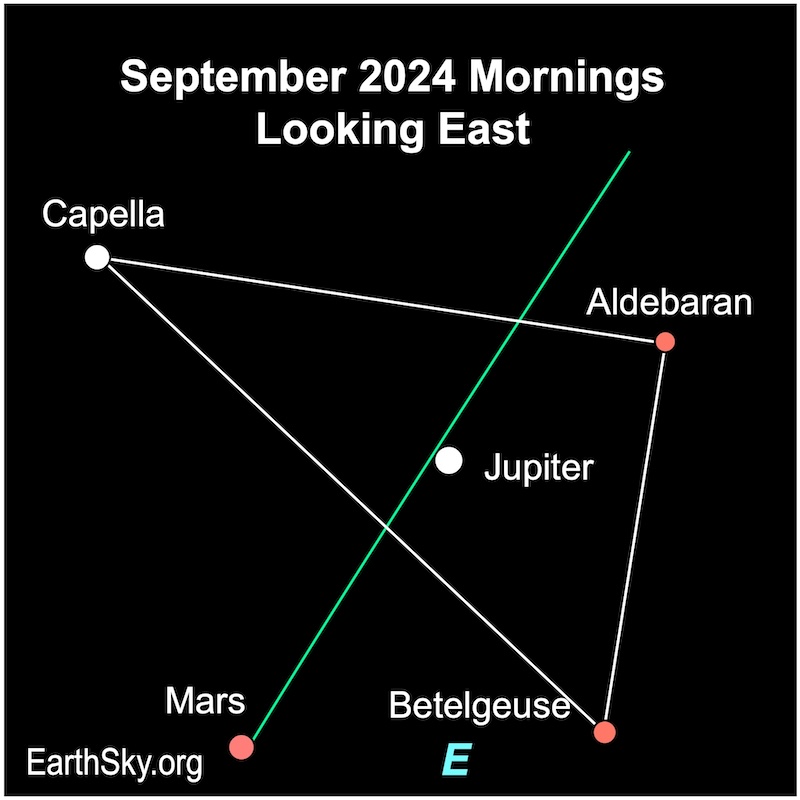
In September 2024, red Mars will continue moving away from Jupiter and it will slide toward the twin stars of Gemini, Castor and Pollux. Also nearby is the ruddy star Betelgeuse. It’ll rise after midnight and is more obvious in the sky before dawn. It’ll be at its closest and brightest again in January 2025.
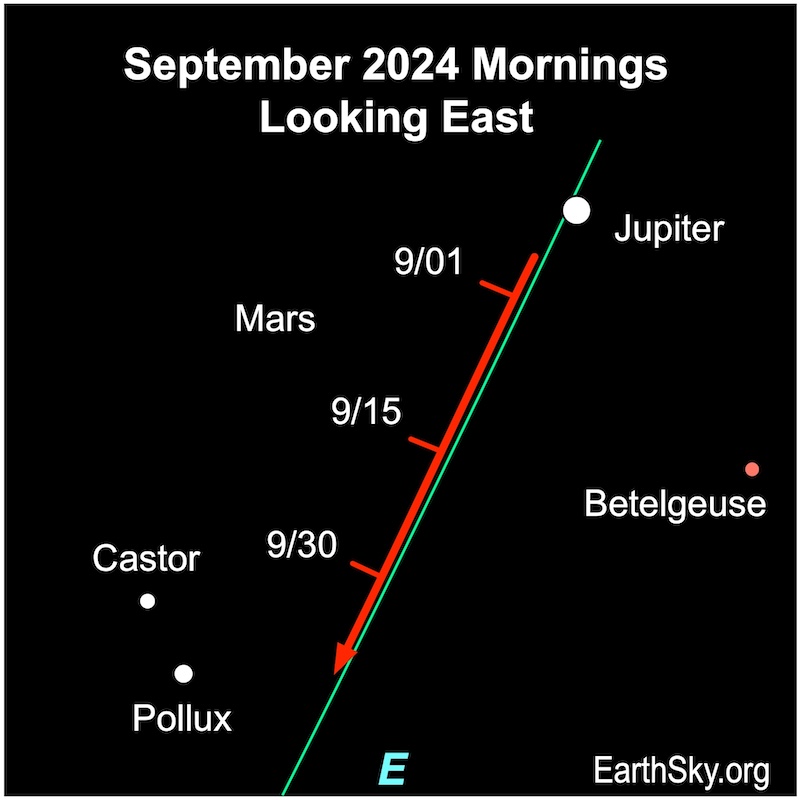
In September 2024, Mercury will lie low in the bright eastern twilight about 40 minutes before sunrise. It will reach its greatest elongation – greatest distance from the sunrise – on September 5, 2024. It will float closest to the star Regulus on September 9, and will slip out of view after mid-September. It’ll brighten through September before disappearing from the morning sky near the end of the month. This will be the best morning apparition of Mercury for the Northern Hemisphere this year. Southern viewers can see it too.
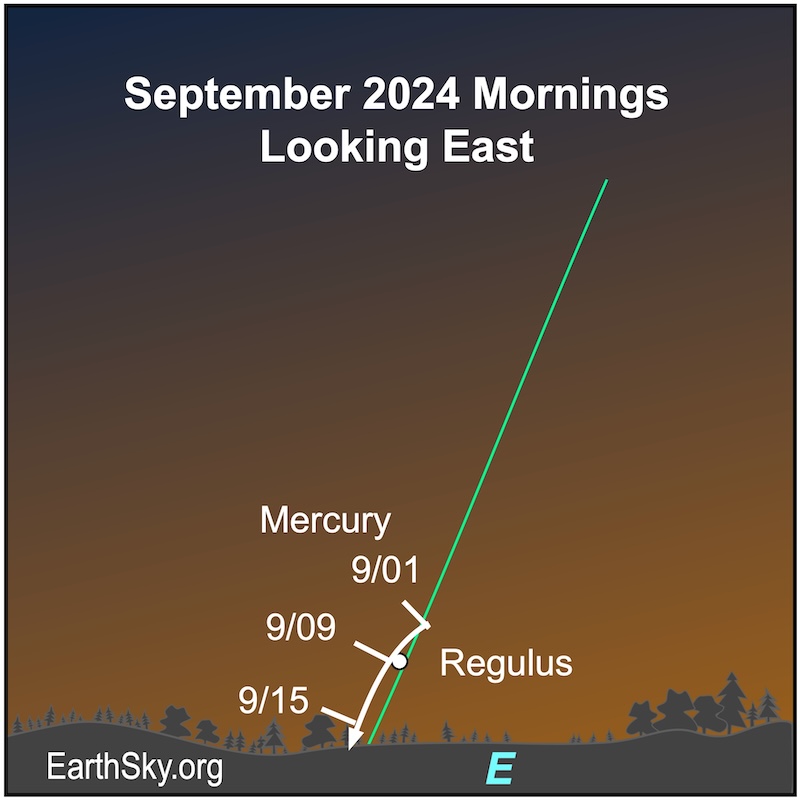
September all night planet: Saturn
In September 2024, Saturn will lie low in the east shortly after sunset and be visible all night until dawn. It will reach its closest point to Earth on September 8 when it will lie directly opposite the sun from Earth. The best time to watch Saturn is around its opposition. Saturn is rising in the east at sunset and is visible all night. Afterward, for the rest of 2024, Saturn will remain visible in the evening sky. It’ll finally disappear in the sunset glare in February 2025.
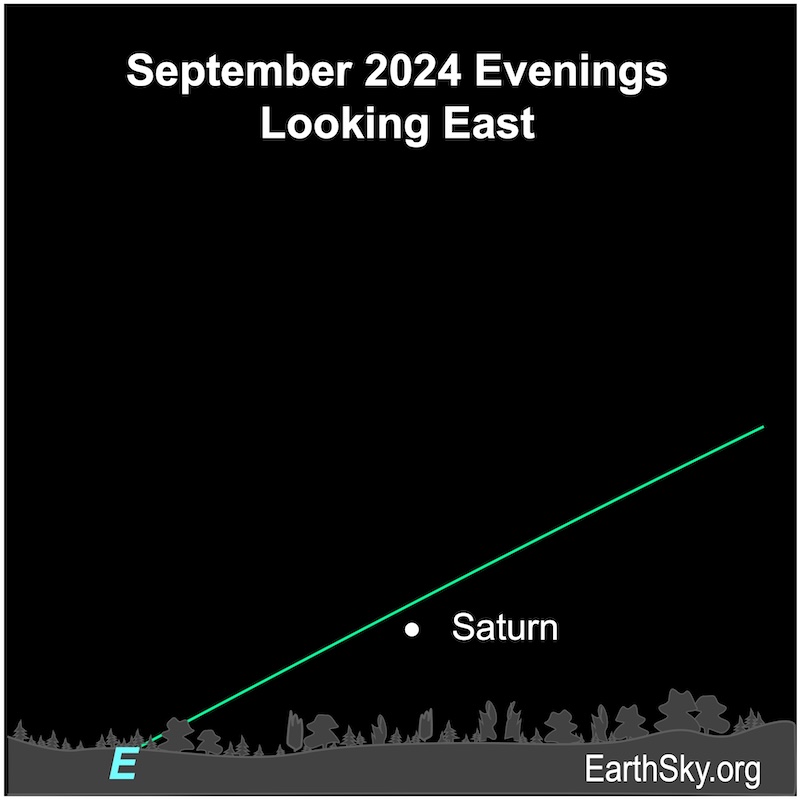
September evening planet: Venus
In September 2024, Venus will lie low along the western horizon shortly after sunset. On September 4 and 5, the thin waxing crescent moon will float near Venus. In the middle of the month, Venus will lie near Spica, the brightest star in Virgo the Maiden. They are at their closest on the evening of September 17. During the rest of the month, bright Venus will shine low in the southwest shortly after sunset. Venus will continue to ascend and become a dazzling evening star through the end of the year. It’ll reach its greatest distance from the sun in January 2025.
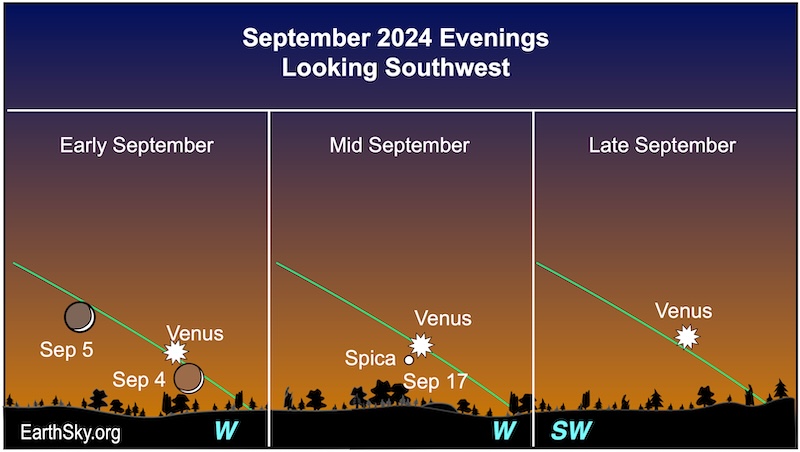
. . .And The First Hibernating Mammal Is?:
You were correct if you said Yellowbelly Marmot (Marmota flaviventris), an inhabitant of high altitudes that turn cool early in southeastern, eastern, and northeastern California. Some individuals of this species may begin hibernation in August, prior to which they begin estivation as early as June (!). A mammal that begins hibernation in September is the Western Jumping Mouse (Zapus princeps), which has a breeding range that extends from New Mexico north to Alaska and the Northwest Territories. The northernmost populations probably enter hibernation prior to southern individuals, with northern California populations possibly entering their winter “sleep” phase in mid- to late-October.
Given this mammal’s breeding range does not include Marin County, it’s likely that our only hibernating mammals could be the Little Brown Bat (Myotis lucifugus) and some localized populations of California Ground Squirrel (Spermophilus beecheyi). Least Chipmunks (Eutamias minimus) in far eastern and northeastern California also hibernate, as do some Whitetail Antelope Squirrel (Ammospermophilus leucurus) populations in northeastern California.
Secret Code: Fireflies In California? Elsewhere?
Does California host fireflies like much of the rest of the USA? Yes, but our species do not have the ability to create bioluminescent light patterns. Elsewhere in the USA (especially in the Midwest/East), watch for the pulsing light show of fireflies in meadows, fields and forest borders. The aerial flights of flashing light are made by male fireflies only. Females may respond in kind from their perches on the ground. Males checkout the light pattern emitted from females by flying closer, then mating if the flashing pattern is acceptable. If you see a different pattern of flashing light from a firefly, it may be another species. You can attempt to distinguish species from one another by noticing the number, duration and time lapse between flashes.
Bats: Lucky 13 In The Bay Area
How many species of different bats can be found in California? Twenty-one, according to a checklist compiled by Daniel F. Williams (Dept. of Biological Sciences, California State University, Stanislaus, Turlock, CA 95382; see http://arnica.csustan.edu/esrpp/calilist.htm). Approximately 13 of these species can be seen in the San Francisco Bay Area. At least 40 species of bats occur in N. America, some of which are threatened or endangered.
Migrating Butterflies I Have Known
Besides monarchs, who are the other migrating butterflies? Two of them are the painted lady and red admiral. High ridges are especially good vantage points to spot monarchs moving south. Butterfly watchers in the East and Midwest will see monarchs on their trips south to where they will remain throughout the winter in the Transvolcanic Mountain range of central Mexico. Western populations of migrating monarchs often congregate together in huge colonies along the central California coast (e.g., Pacific Grove near Monterey, CA).
We’re Outta Here: En Masse Exit
Now is the time to notice “staging” behavior of some birds. Swallows and nighthawks, for example, congregate in large groups on telephone lines and in trees before migrating south together en masse. Unlike most passerine birds, many swallows and nighthawks migrate during the day — as do Lesser, Lawrence’s, and American Goldfinch, in addition American Robin and Northern Flicker.
Introducing The Names Of Introduced Mammals
Thirteen species of mammals living in California are introduced non-natives, including the Virginia opossum, eastern gray tree squirrel, fox squirrel, wild burro, wild horse, axis deer, fallow deer, nutria (probable), feral goat, and Himalayan tahr (a kind of bovid).
Are Hummingbirds Around During Winter?
Where do hummingbirds go for the winter? Most species depart from the United States, though several populations of the Anna’s hummingbirds are year-round residents. During many years, this species may begin courtship in December (before Winter begins!) in some parts of its range. Ruby-throated hummingbirds east of the Mississippi River begin migrating south around now through October. Many spend the winter in southern Mexico, though a few live on Florida Key islands and in Cuba (95 miles from Key West).
A curious phenomenon in recent years is the increasing diversity of hummingbirds appearing during the winter in the eastern USA. Rufous Hummingbirds appear to be the most common “newly-discovered” hummingbird species seen in the southeast, while two Calliope Hummingbirds spent much of the 2001-2002 winter at feeders near New York City. Some researchers and bird banders believe the Rufous may either be more commonly noticed in the East because it has recently changed its migration/dispersal behavior (due to global warming?) and/or it is more accurately observed now because of recently-increased banding and monitoring.
Rare Bird Sightings
One of the best West Coast places to spot vagrant songbirds is in western Marin Co. in Point Reyes National Seashore. At the point near the lighthouse and amidst nearby groves of Monterey Cypress trees, diverse species of wayward eastern wood-warblers are best spotted in September and October. If you go, don’t be surprised to see American
Redstart, Blackpolls, Blackburnian, Black-and-White, and Prairie Warblers. Note: American Redstart and Black-and-White are not considered vagrant species in California by some theorists because the state sometimes hosts nesting individuals annually or irregularly. Other songbirds that may make cameo appearances here include Rose-breasted Grosbeak and Baltimore Oriole.
October, 2025
Moon & Planet Rise & Set Times For October, 2025
For your area’s moon & planet rise & set times, go to: https://www.timeanddate.com/astronomy/night/
Type in your location’s city and state. Then note the results (below in the table) similar to the ones for my location at latitude: 38:03:38 N, longitude: 122:32:27 W, which is Novato, CA, 20 miles north of San Francisco, CA in Marin County.
Sky Watch:(courtesy of earthsky.org)
October evening planets
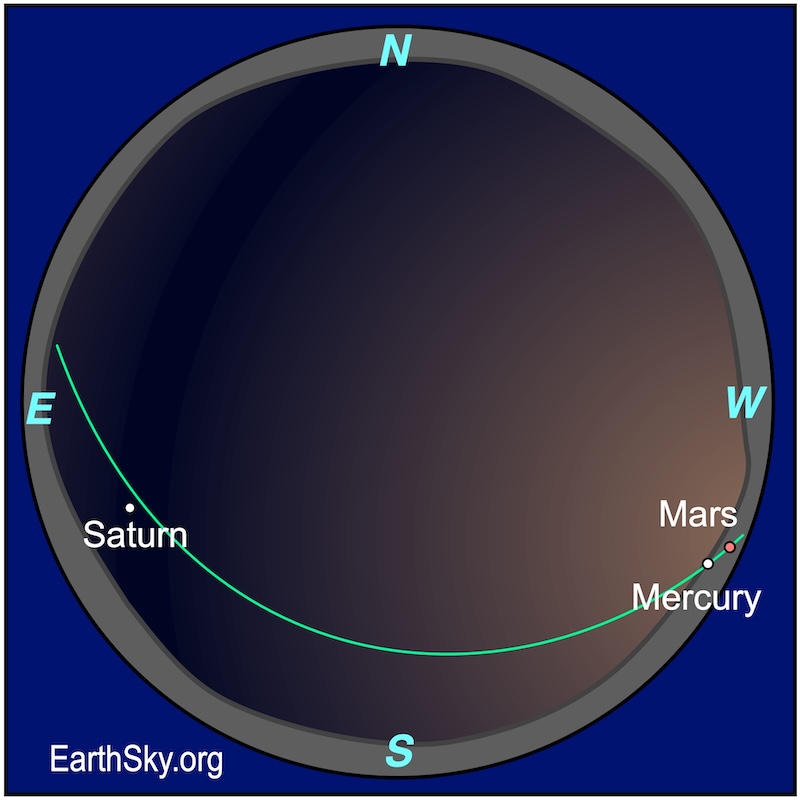
October morning planets
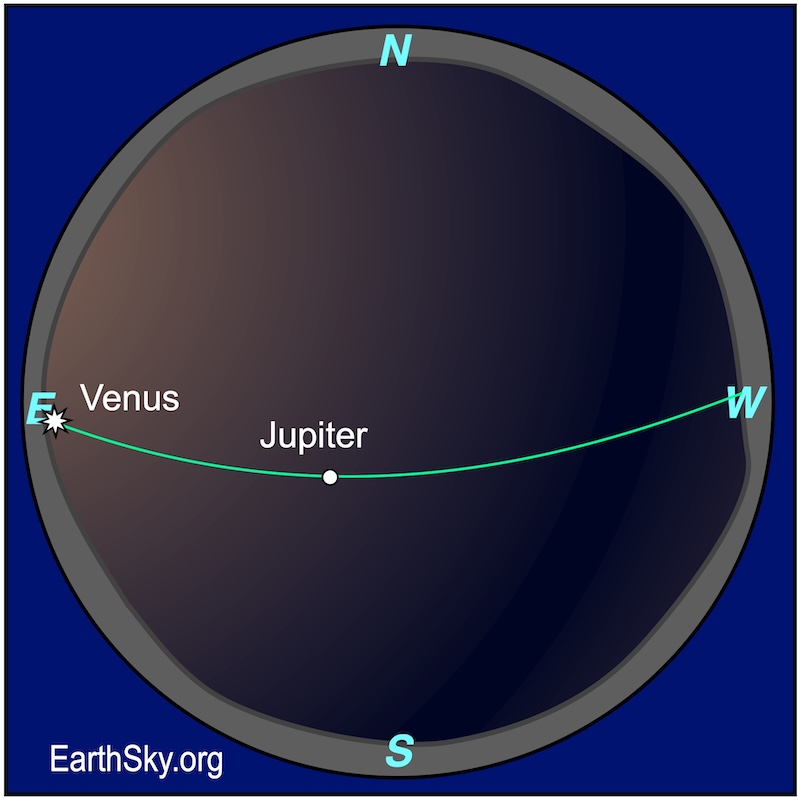
Early October meteors … the Draconids
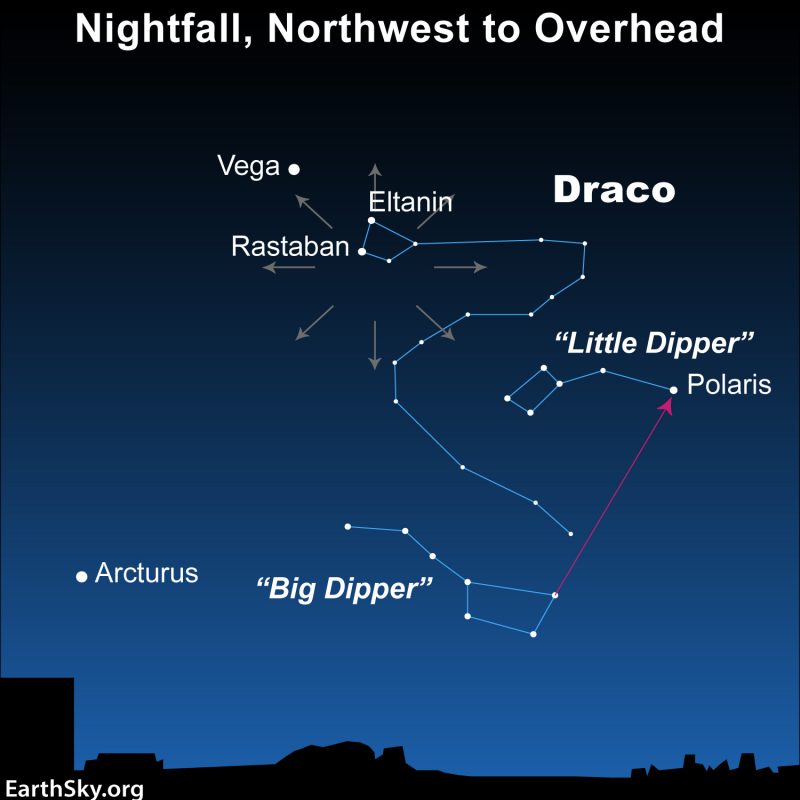
Read more: All you need to know about Draconid meteors
October meteors are here for 2025! The Draconids start it off, followed by the Orionids. And then the South and North Taurids ramble across the sky from late October through early November. Learn when the meteors may be their best and what to expect.
October 8: Moon reaches perigee
The moon will reach perigee – its closest point to us in its elliptical orbit around Earth – at 13 UTC on October 8, 2025, when it’s 223,581 miles (359,819 km) away.
October 8 and 9 evenings: Moon and Pleiades

Read more: The Pleiades – or 7 Sisters – known around the world
October 9 evening: Moon blots out some Pleiades
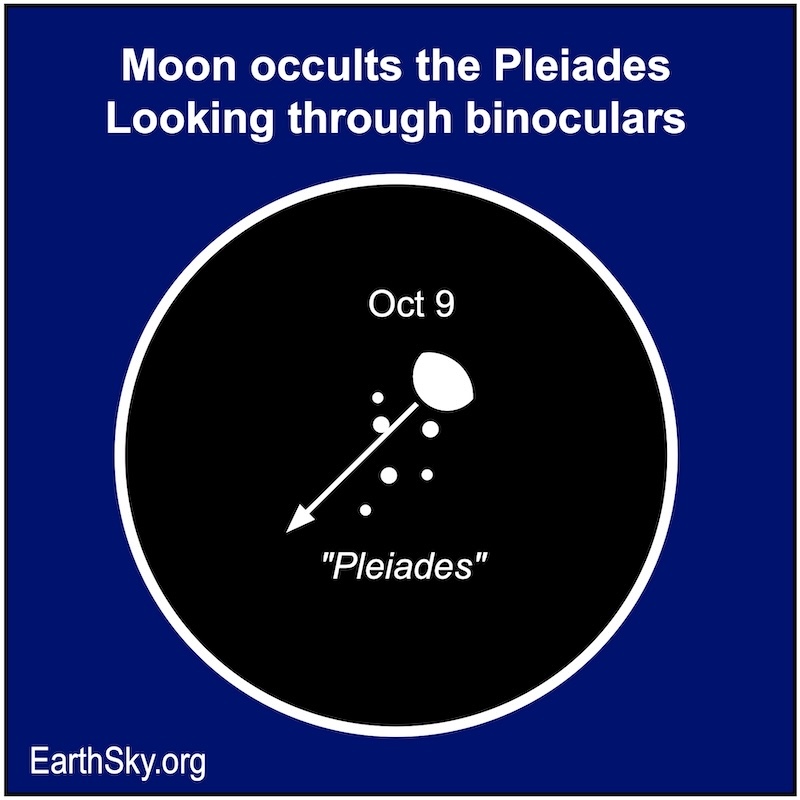
October 10 evening: Moon, Pleiades and 2 bright stars

Read more: Capella is sometimes called the Goat Star
October 12 morning: Moon, Capella, Betelgeuse and Aldebaran
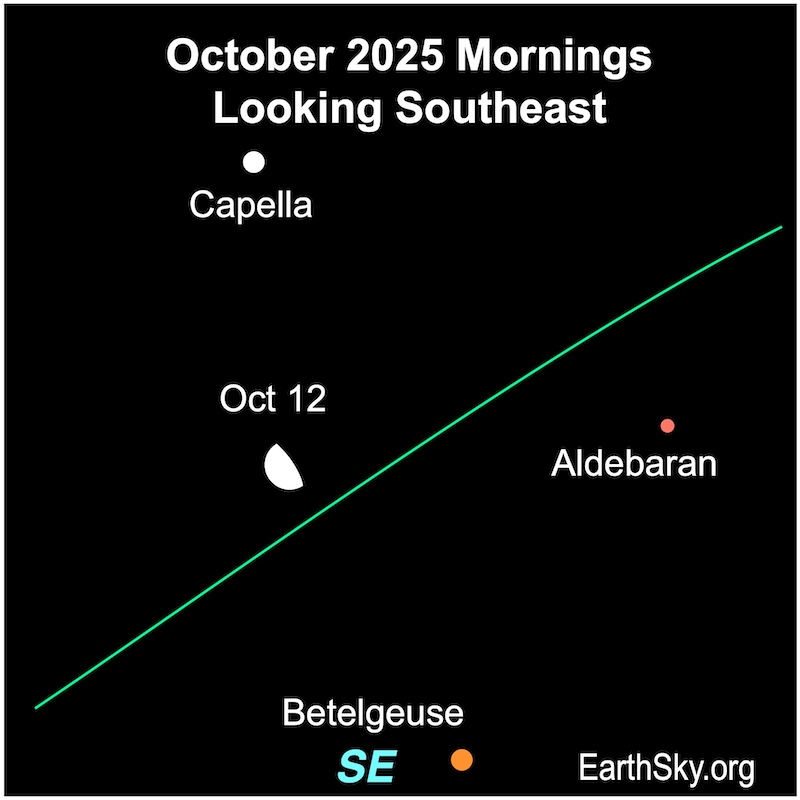
Read more: Companion for Betelgeuse confirmed! Beloved red star has a blue-white buddy
Our charts are mostly set for the northern half of Earth. To see a precise view – and time – from your location, try Stellarium Online.
October 13: Watch for the 3rd quarter moon
The moment of last quarter moon will fall at 18:13 UTC on October 14, 2025. That’s 1:13 p.m. CDT. It’ll rise after midnight your local time and set around noon. Look for it high in the sky before dawn.
Want more? Here are 4 keys to understanding the moon’s phases.
October 13 and 14 mornings: Moon, Jupiter and twin stars

October 15 and 16 mornings: Moon, Regulus and the Beehive

Read more: The Beehive cluster: A swarm of 1,000 stars
October 17 and 18 mornings: Moon and Regulus

Read more: Meet Regulus, Leo the Lion’s Heart and brightest star
October 19 and 20 mornings: Moon and Venus

October 21: New moon and perfect timing for Orionid meteor shower
The moment of new moon will fall at 12:25 UTC on October 21, 2025. That’s 7:25 a.m. CDT. New moons rise and set with the sun. Nights around the new moon are perfect for stargazing, and this one coincides with the peak of the Oroinid meteor shower. See EarthSky’s best places to stargaze.
Want more? Here are 4 keys to understanding the moon’s phases.
October 21: Orionid meteor shower
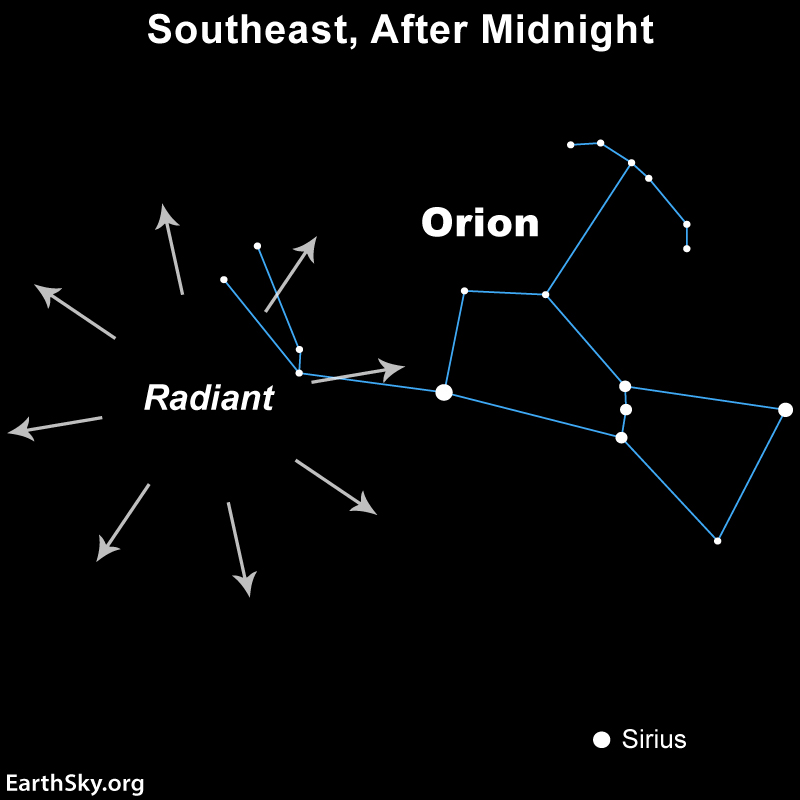
Read more: Everything you need to know Orionid meteors
October 24: Moon reaches apogee
The moon will reach apogee – its farthest distance from Earth in its elliptical orbit – at 0 UTC on October 24, 2025, when it’s 252,552 miles (406,444 km) away.
October 24 and 25 evenings: Moon and Antares
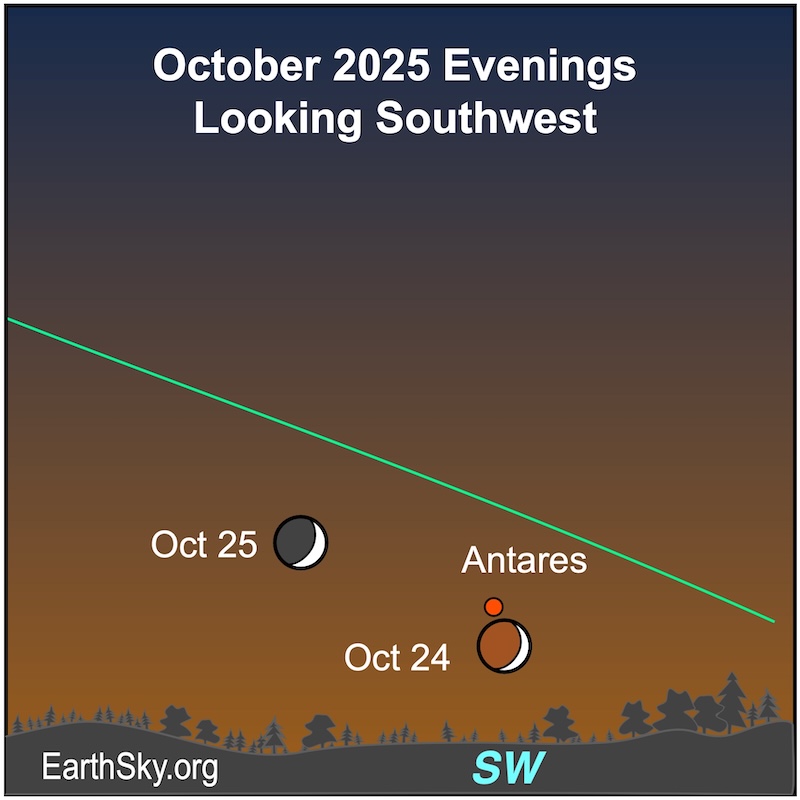
Read more: Massive ruby red Antares is the Scorpion’s Heart
Our charts are mostly set for the northern half of Earth. To see a precise view – and time – from your location, try Stellarium Online.
October 26 and 27 evenings: Moon and Teapot
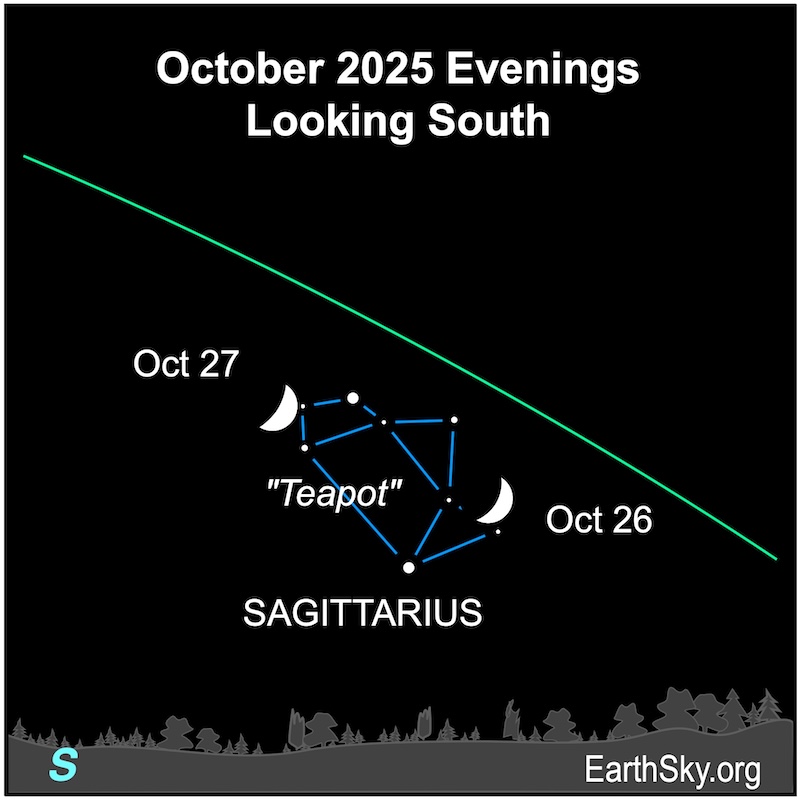
Read more: Teapot of Sagittarius points to Milky Way Center
October 29: 1st quarter moon
The moment of 1st quarter moon will fall at 16:21 UTC on October 29, 2025. That’s 11:21 a.m. CDT. Did you know you can see an X and V on the 1st quarter moon? Here’s how to see them. A 1st quarter moon rises around noon your local time and sets around midnight. Watch for a 1st quarter moon high in the sky at sundown.
Want more? Here are 4 keys to understanding the moon’s phases.
October 29: Mercury reaches greatest elongation from evening sun
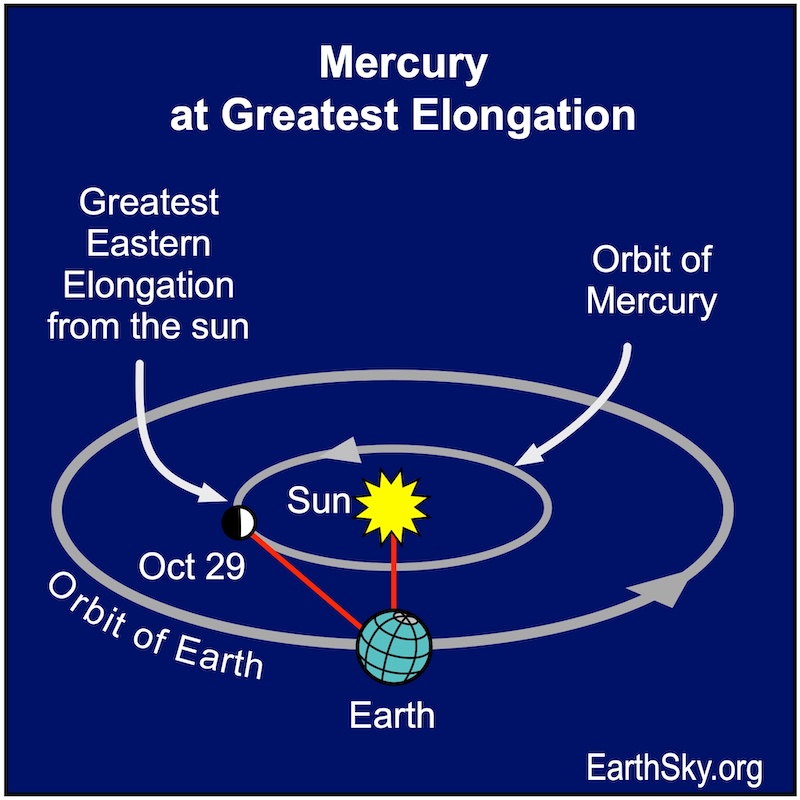
Read more: Mercury is farthest from the sunset on October 29
October 29 and 30 evenings: Moon and Capricornus
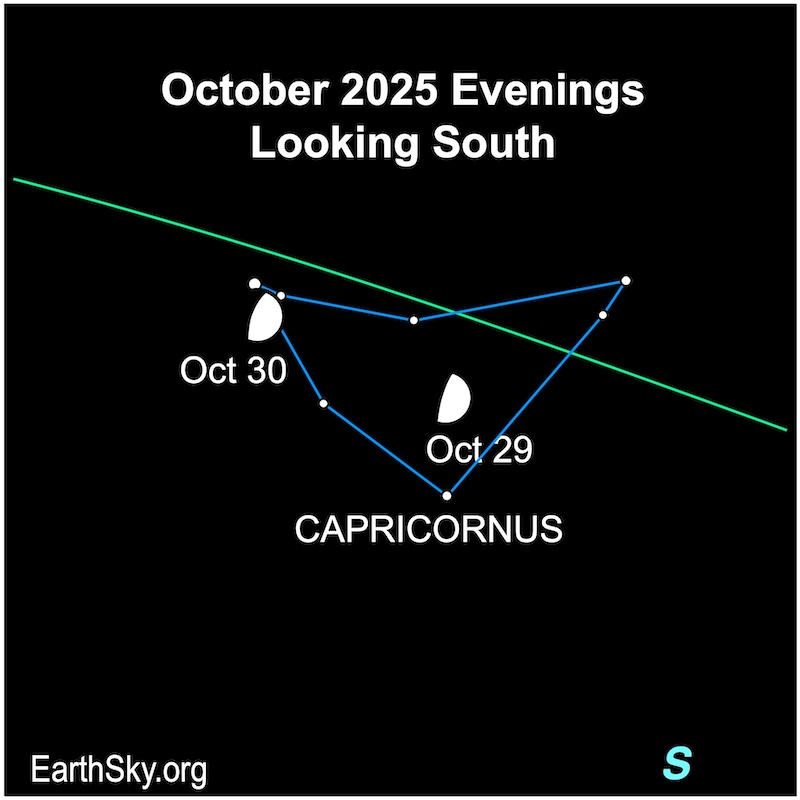
Read more: Capricornus the Sea-goat has an arrowhead shape
October 31 evening: Moon, Saturn and Fomalhaut
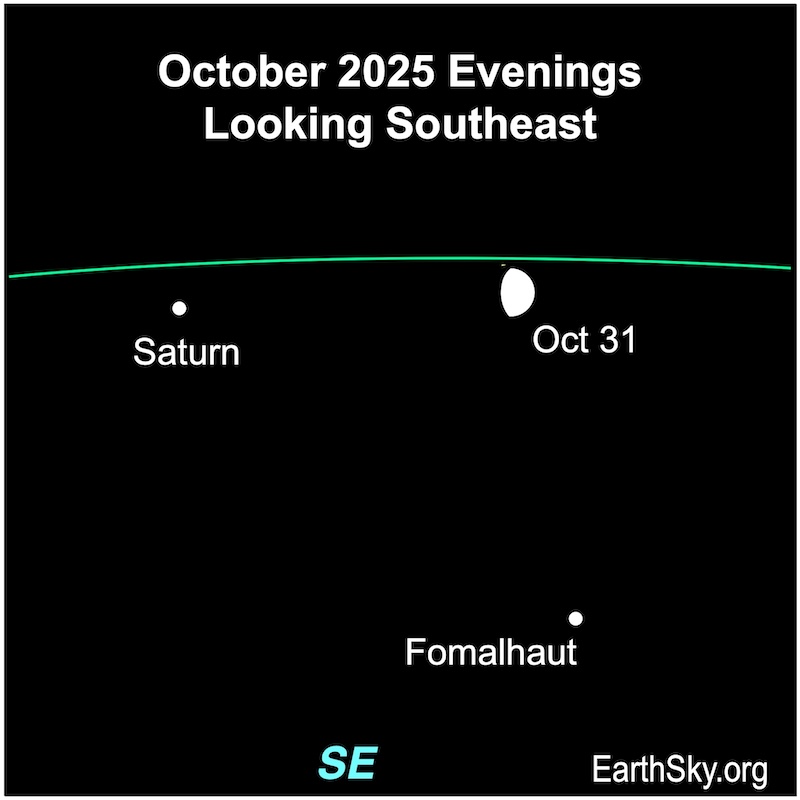
Read more: Fomalhaut is the Loneliest Star … but not in 2025
Our charts are mostly set for the northern half of Earth. To see a precise view – and time – from your location, try Stellarium Online.
October stars and constellations
If you’re out stargazing on any October evening, look for these stars and constellations high in the evening sky while facing north.
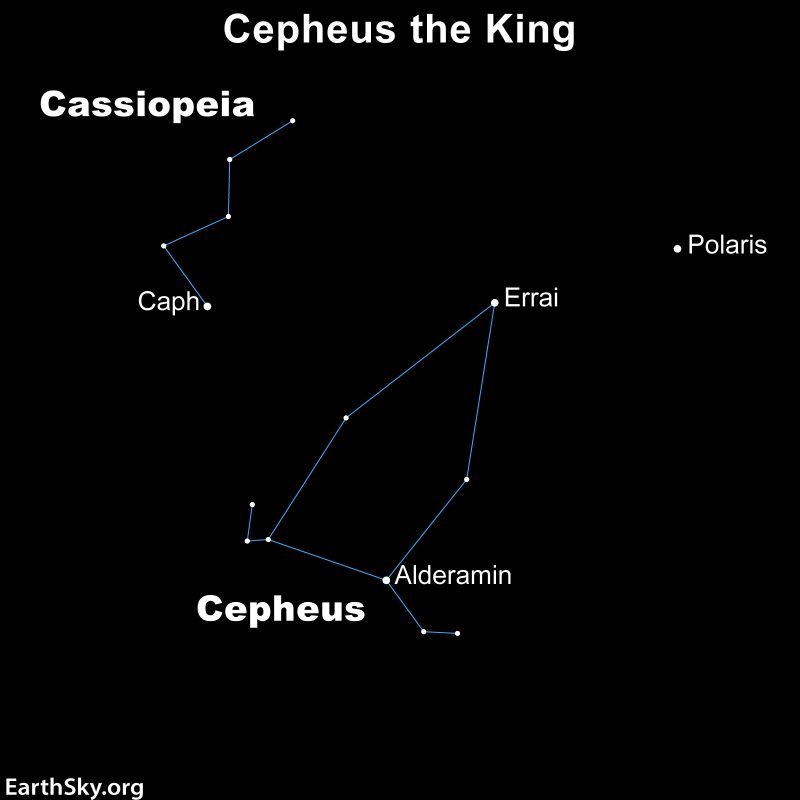
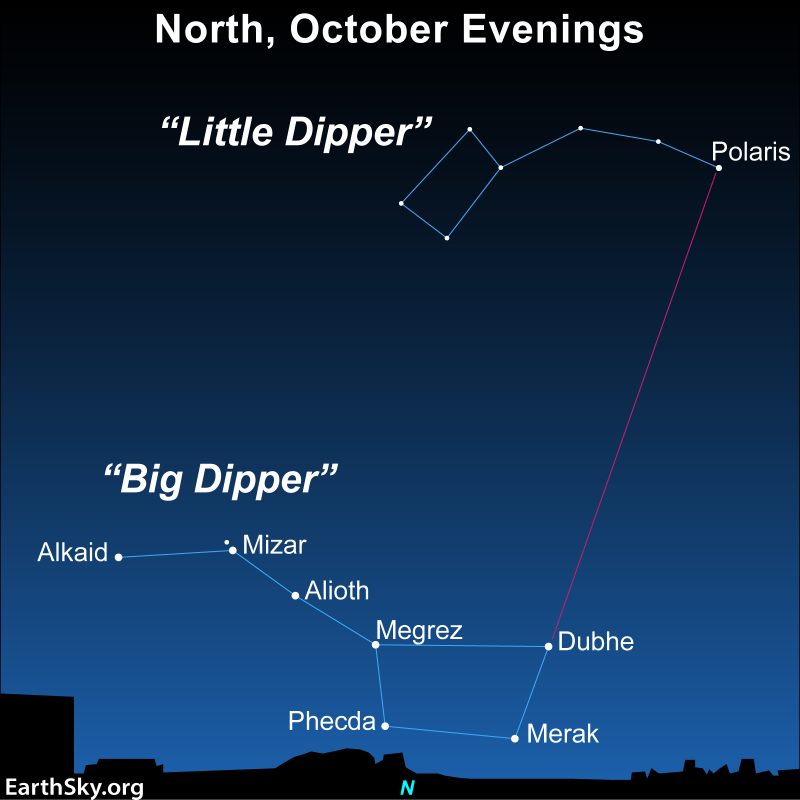
October evening planets
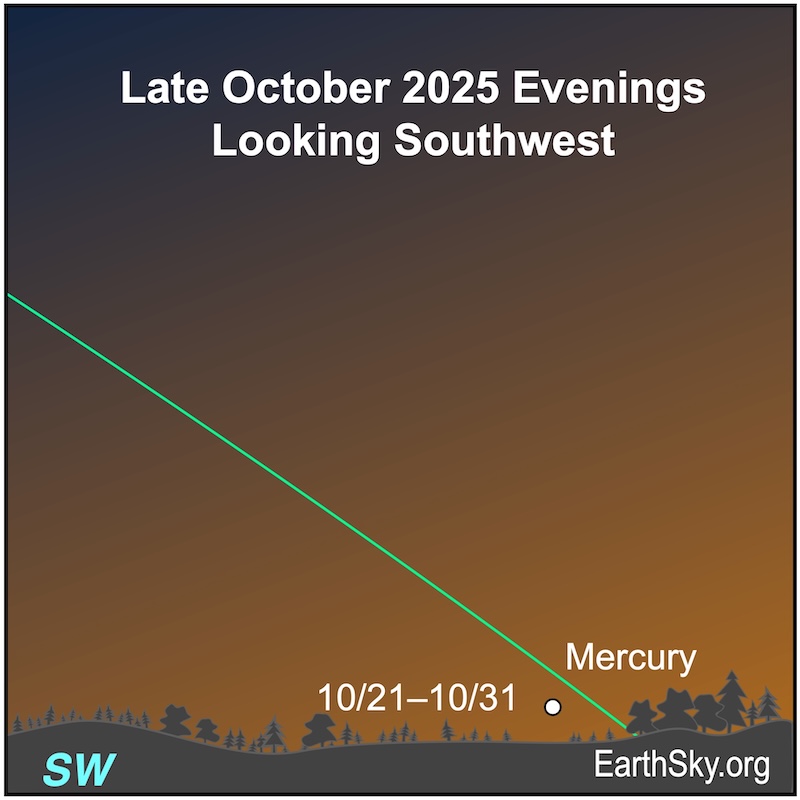

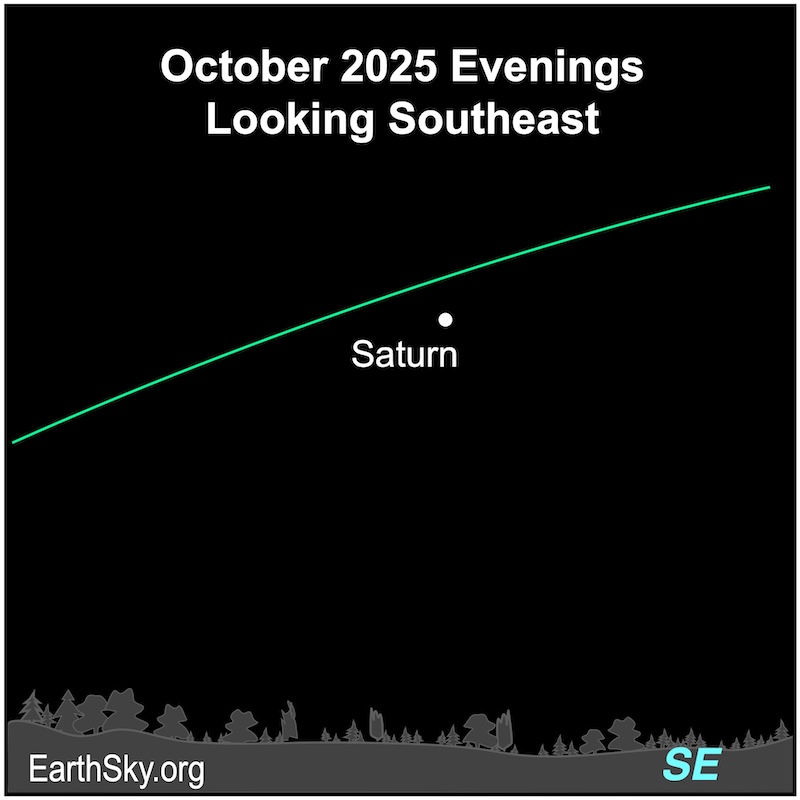
Our charts are mostly set for the northern half of Earth. To see a precise view – and time – from your location, try Stellarium Online.
October morning planets
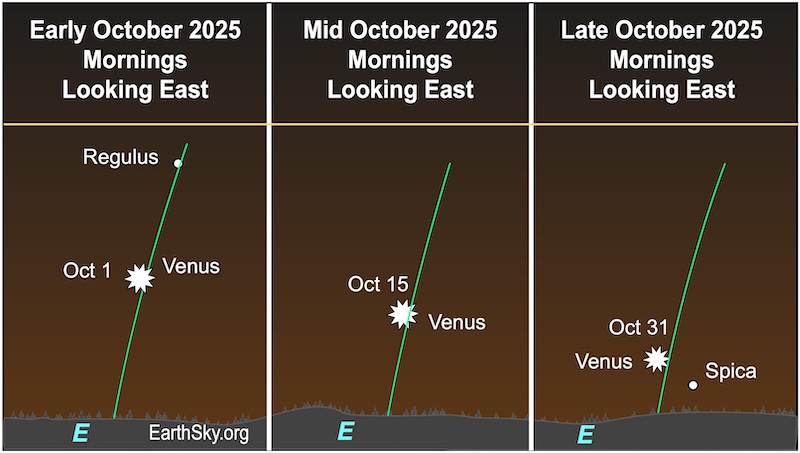
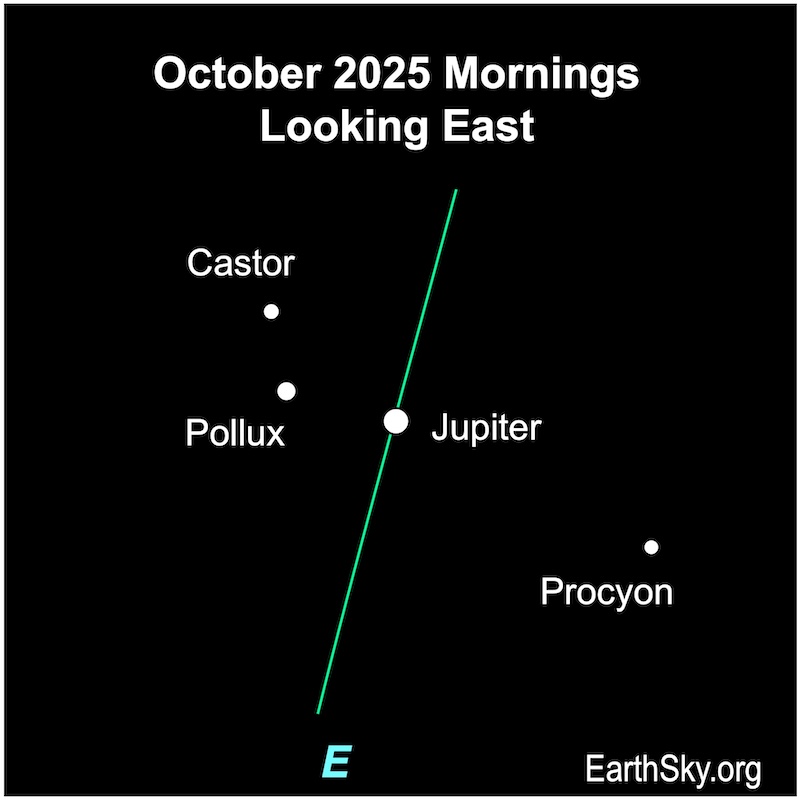
Sky dome map for visible planets and night sky
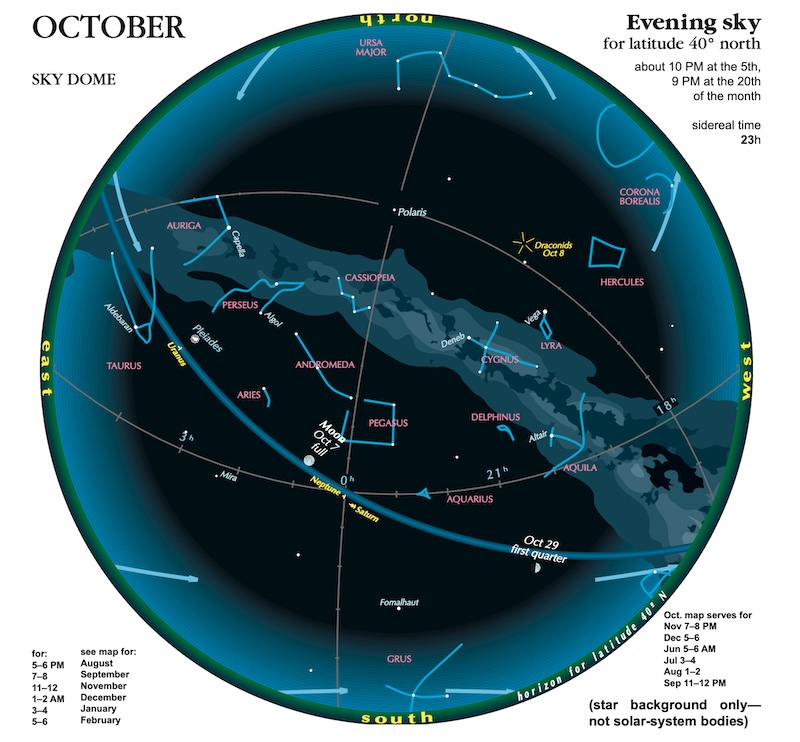
Waterfowl Invasion
The San Francisco Bay and northern California bodies of water host an amazingly large population of ducks that spend the non-breeding season in our area. Survey results indicate half the entire population of Northern Shoveler spend the non-breeding season in northern California, as do an almost equally massive percentage of both Lesser and Greater Scaup populations. By now, you may also spot other returning winter resident waterfowl in open waters, including Canvasback, Redhead (less common), American Wigeon, Green-winged Teal, Ring-necked Duck, Northern Pintail, Red-breasted Merganser, Gadwall, Mallard, Common Merganser, Northern Pintail, and Ruddy Duck — with the latter five species as residents in Marin County that are joined by newly-arriving populations from the north.
Feeder Philosophy With Hummingbirds
When should you stop feeding hummingbirds sugar water nectar? In northern California/Bay Area, you can serve nectar year-round because the Anna’s Hummingbird is a resident. In the Midwest and the East, the answer is less clear. One group of birders believe feeders left stocked in the autumn may imperil hummingbirds because this food source allows foraging to occur later than would be accommodated with a normal bloom of wildflowers. Awakening to an early freeze may be difficult for remaining hummingbirds to survive, argue these experts. Others believe it is okay for nectar feeders to remain well into autumn. Hummingbirds are uninfluenced by food source availability and migrate when prompted by an “inner clock,” according to these people. This viewpoint is in concert with researchers who have studied migration. These experts point out that many species of migrating birds are undistracted by food sources that would normally attract their interest.
Night Aversion: Arctic Tern
It’s well known that the arctic tern makes the longest migration (22,000-25,000 miles roundtrip) of any bird along with the Bristled Curlew that migrates in autumn from the Arctic to the South Pacific. In northern California, you won’t often see them along the coast, while your chances of observation during their migration improve if you take a pelagic boat trip onto the open ocean.
Less publicized is how far our familiar barn swallow travels. Look for them now moving south in groups during the day as they proceed on the southern portion of their roundtrip migration that may amount to as high as 7,000 miles. Some researchers speculate that Arctic Tern populations never see darkness, given their range encompasses living in northern and southern latitudes where 20 or more hours of daylight are normal during summer before the birds again migrate toward an opposite pole as days become shorter in one of the two hemispheres they inhabit.
Prime Time Viewing: Migrating Raptors
Although hawks and eagles begin migration through Mid-Atlantic states before this week, now is an ideal period to see them if you visit a prominent ridge or mountain top to view. Two of the best vistas on separate coasts are both called Hawk Hill. At the West Coast’s Hawk Hill (operated by the Golden Gate Raptor Observatory; for directions,
See: http://www.ggro.org
This raptor monitoring area (for which directions are provided at the above web site) is near Sausalito, California just north of San Francisco overlooking San Francisco Bay and the Pacific Ocean), as many as 19 species of raptors are seen each autumn. Hawk Hill Mountain in central Pennsylvania is another popular vista to observe more than a dozen migrating raptors, the most common raptorial passersby being American kestrels, red-tailed, sharp-shinned and Cooper’s hawks.
Autumn and Winter Residents
Typical winter resident woodland birds you can now (or soon) see in the Bay Area include Golden-crowned Sparrow, Varied Thrush and Ruby-crowned Kinglet. The Golden-crowns are interesting simply because many sing throughout much of the winter even though they do not breed here. More typically, winter residents merely emit simpler call notes, and only begin singing when on breeding grounds. (i.e., The answer as to why this species sings in the winter is not totally clear, but one reason may allude to first-year Golden-crowns practicing their songs before they become truly defined and articulate (crystallization) singers at the age of 11 to 12 months.). At least one subspecies of the White-Crowned Sparrow also visits the Bay Area before migrating north in the spring.
Common Croaker: Sierran Tree Frog
Often unidentifiable and puzzling to listeners, the muffled call of the Sierran tree frog (Pseudacris sierra) (formerly called the Pacific Tree Frog) is more common to hear than many people might believe. Hike through a variety of northern California upland habitats and the quick, low, gruff note of this frog is often present beyond the breeding season. After leaving their watery breeding sites, these frogs seek cover in moist niches in buildings, wells, rotting logs or burrows. Breeding occurs between January and July throughout much of California. In even small bodies of water that are only temporary during these times, look for egg clusters that are deposited on submerged or emergent vegetation.
There Goes The Neighborhood: Coyotes Are Coming
More common in urban and suburban areas than ever, be on the lookout for coyotes in the Bay Area. They are now a permanent resident throughout California, living in almost all habitats and successional stages. Coyotes frequent open brush, scrub, shrub, and herbaceous habitats, and may be associated opportunistically with croplands. They’re also found in younger stands of deciduous and conifer forest and woodland with low to intermediate canopy, and shrub and grass understory. Complaints from people regarding the increased presence of the adaptable coyote are plausible. Then again, many of the complainers have invaded previously natural habitat that was the domain of wild animals for eons before people arrived.
Arboreal Fantasia: Autumn’s Flaming Colors
The intensity of the tree’s fall colors are in part affected by the amount of moisture that fell during the past summer. A dry summer with below normal rainfall tends to mute the golden and red colors so that the leaves on many trees are more uniformly brown. In the West, few deciduous trees exhibit a stunning array of fall colors, though the Big-leaf Maple and the Quaking Aspen wear stunning golden sheens. Elsewhere, my own experience while living in the mid-Atlantic suggests the Black Gum (Nyssa silvatica) is the prettiest in displaying bright rainbow colors, as are Sugar Maples that grow in more northerly and higher elevations locales.
Sky Watch:
Moon & Planet Rise & Set Times For November, 2025
For your area’s moon & planet rise & set times, go to: https://www.timeanddate.com/astronomy/night/
Type in your location’s city and state. Then note the results (below in the table) similar to the ones for my location at latitude: 38:03:38 N, longitude: 122:32:27 W, which is Novato, CA, 20 miles north of San Francisco, CA in Marin County.
November 1 and 2 evenings: Moon and Saturn
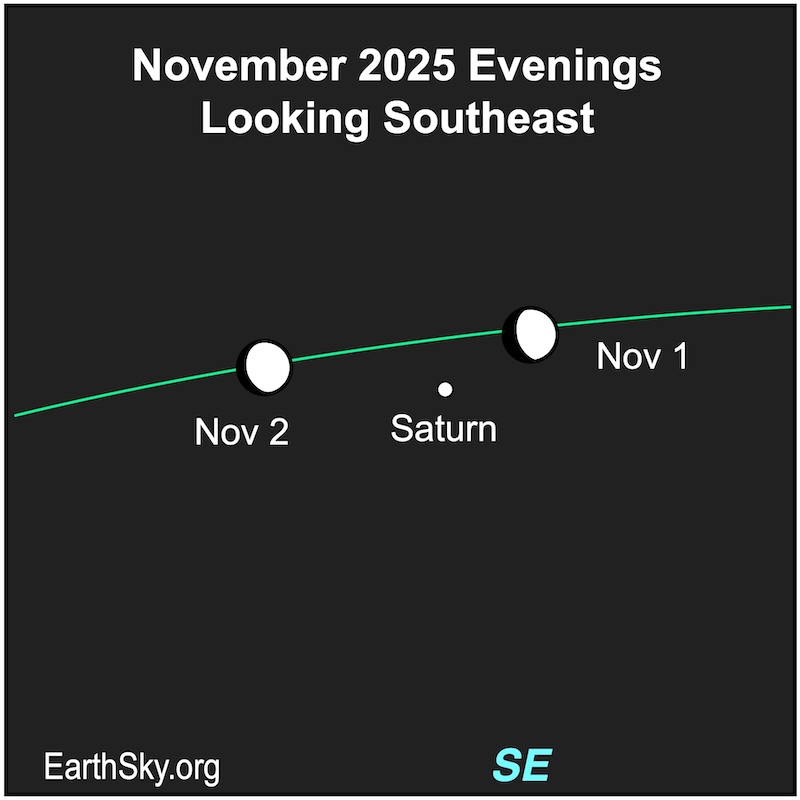
Read more: Saturn’s rings are weird and wonderful: 10 facts here
Our charts are mostly set for the northern half of Earth. To see a precise view – and time – from your location, try Stellarium Online.
November moon phases and alignments
Join EarthSky’s Marcy Curran in a video preview of the moon phases – and planetary alignments – for the month of November 2025. We’ve got the full Super Hunter’s Moon on November 5. It’s the brightest supermoon of the year. The morning planets are Venus and Jupiter. Saturn is visible most of the night with Jupiter rising later in the evening. And Mercury and Mars are low in the western evening twilight and will disappear by mid-month. Watch here or on YouTube for the details.
Early November evening planets
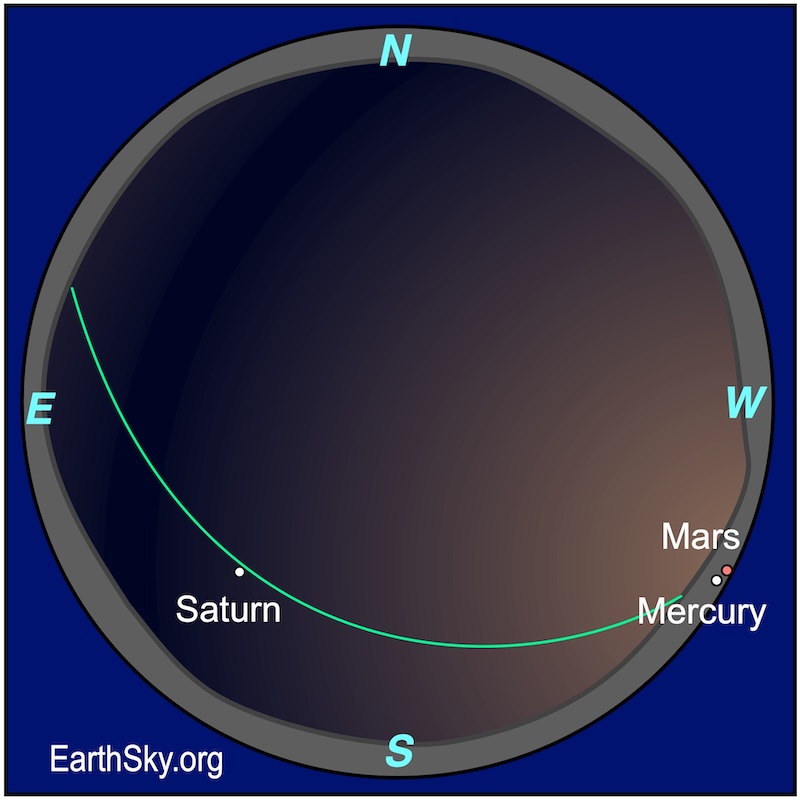
Early November morning planets
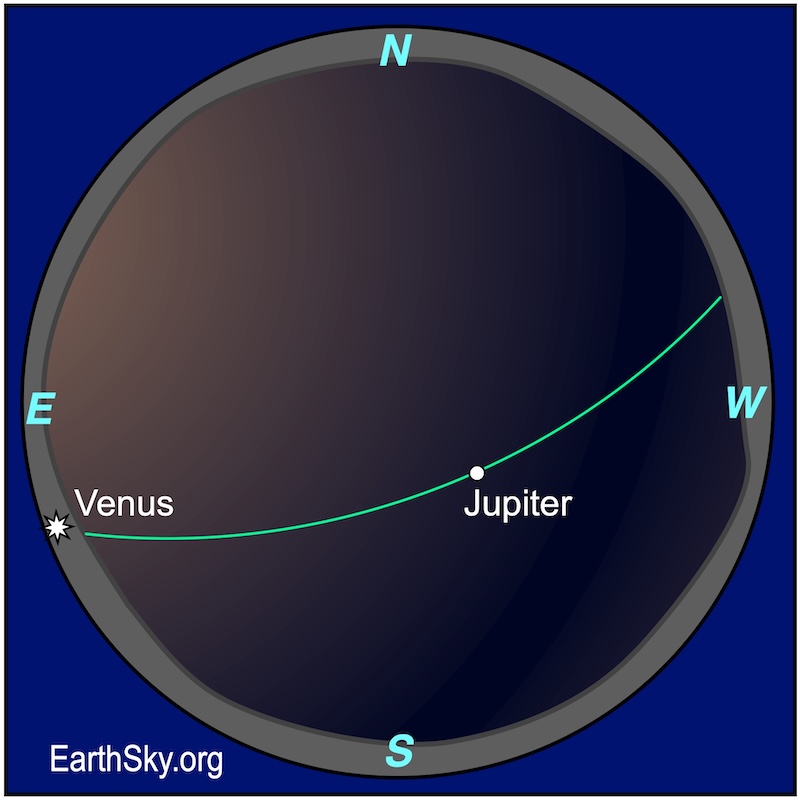
3 comets! See Lemmon, SWAN and ATLAS in your sky
There are three comets currently soaring through the inner solar system that you might be able to see in the coming weeks! Join us as we show you comets Lemmon, SWAN and the interstellar wonder 3I/ATLAS. Whether you’re new to comet-watching or a seasoned skywatcher, we’ll help you appreciate these icy visitors.
November 2: Daylight Saving Time ends
Remember to set your clocks back one hour. Read more: Daylight Time ends Sunday: 7 tips to help you adjust.
November 5 all night: Full Hunter’s Moon is closest supermoon of 2025
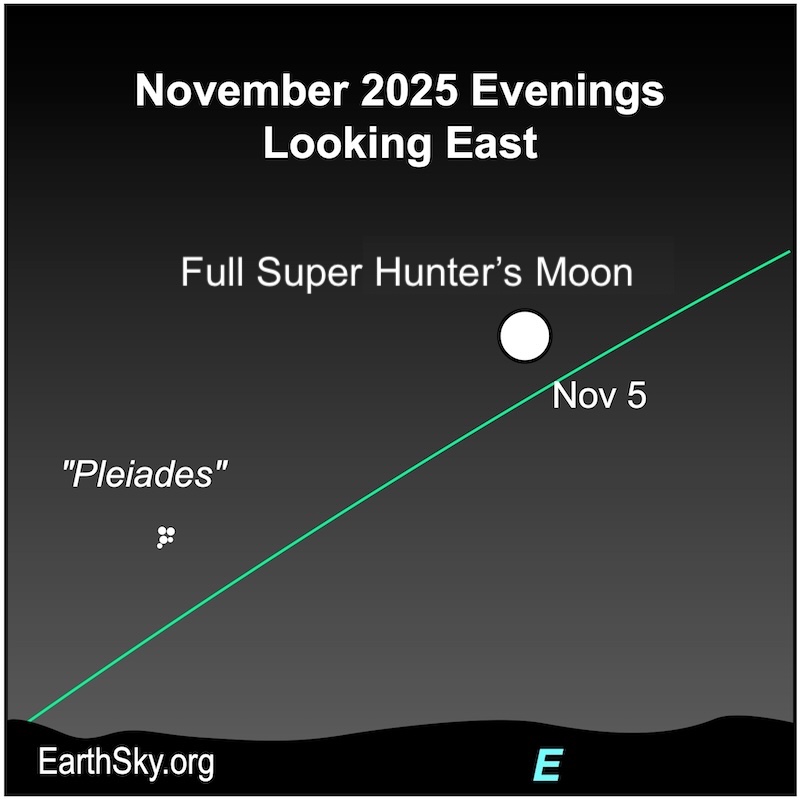
November 5: Moon reaches perigee
The moon will reach perigee – its closest point to us in its elliptical orbit around Earth – at 22 UTC on November 5, 2025, when it’s 221,725 miles (356,833 km) away. And it’ll be the closest full supermoon of 2025. Expect high tides.
Early November meteors … the Southern and Northern Taurids
The South Taurids’ predicted peak is for 13 UTC on November 5, 2025. The North Taurids’ predicted peak is for 12 UTC on November 9, 2025. Both the South and North Taurids don’t have very definite peaks. They are especially noticeable from late October into early November, when they overlap.
Read more: All you need to know about the Taurid meteors
November 6 and 7 evenings: Moon, Jupiter, Capella, Betelgeuse and Aldebaran
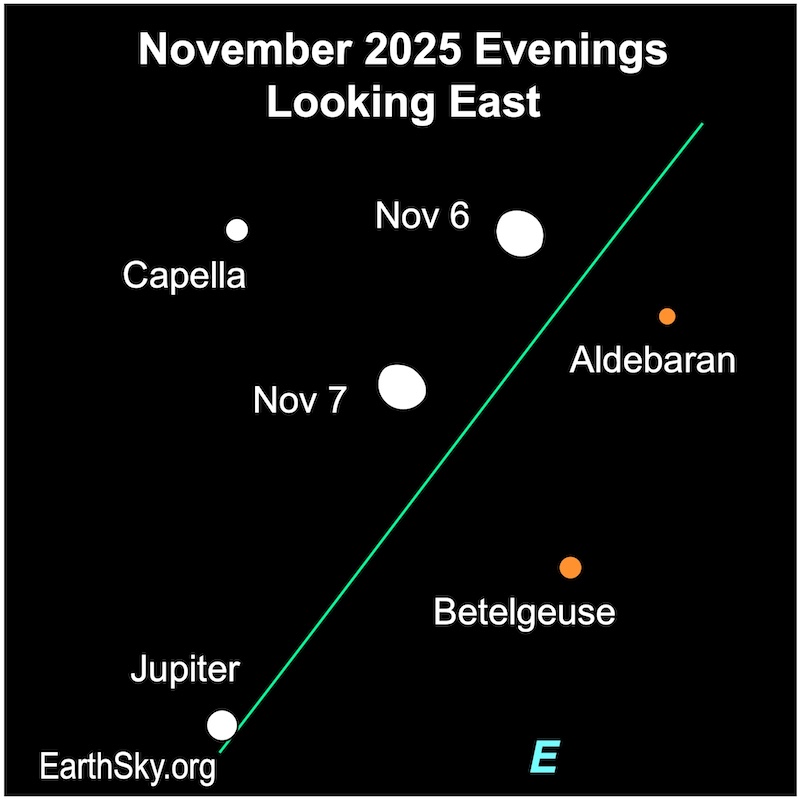
Read more: Companion for Betelgeuse confirmed! Beloved red star has a blue-white buddy
Our charts are mostly set for the northern half of Earth. To see a precise view – and time – from your location, try Stellarium Online.
November 8 and 9 evenings: Moon, Jupiter and twin stars
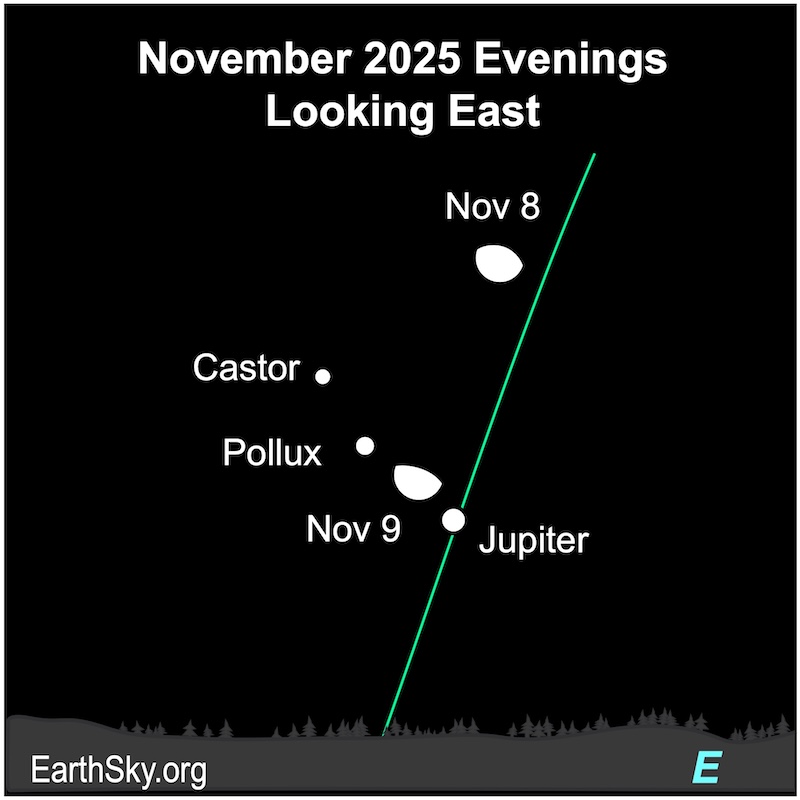
November 10 evening: Moon, Pollux, Castor and the Beehive
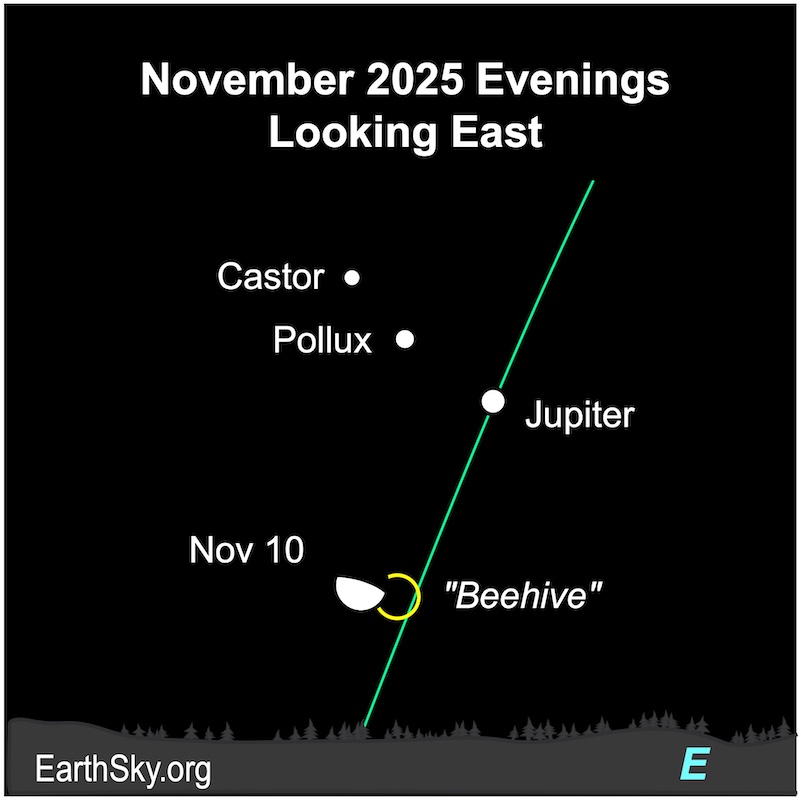
Read more: The Beehive cluster: A swarm of 1,000 stars
November 12: Watch for the 3rd quarter moon
The moment of 3rd quarter moon will fall at 5:28 UTC on November 12, 2025. That’s 11:28 p.m. CST on November 11. It’ll rise after midnight your local time and set around noon. Look for it high in the sky before dawn.
Want more? Here are 4 keys to understanding the moon’s phases.
November 12 and 13 mornings: Moon and Regulus
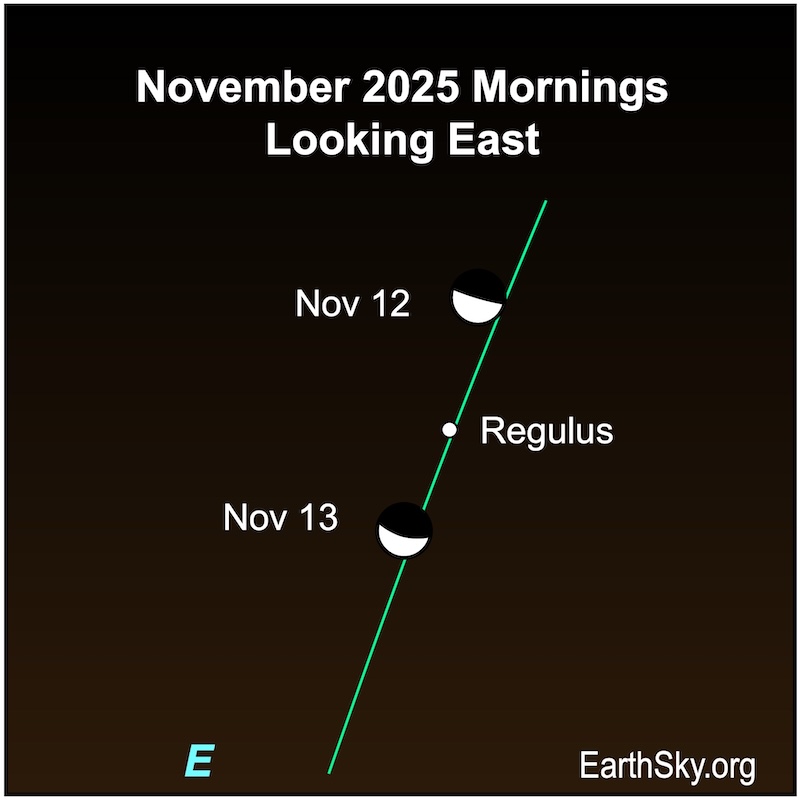
Read more: Meet Regulus, Leo the Lion’s Heart and brightest star
November 16-17 overnight: Leonid meteor shower
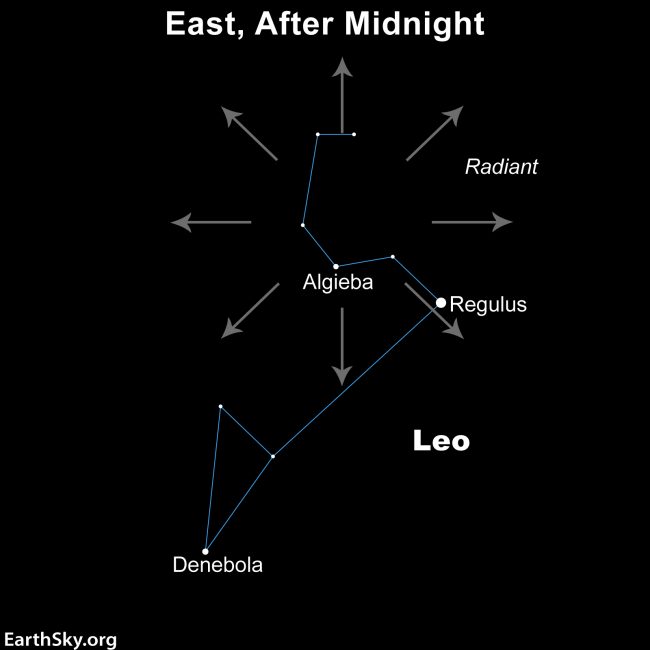
Read more: All you need to know about Leonid meteors
November 16 and 17 mornings: Moon and Spica
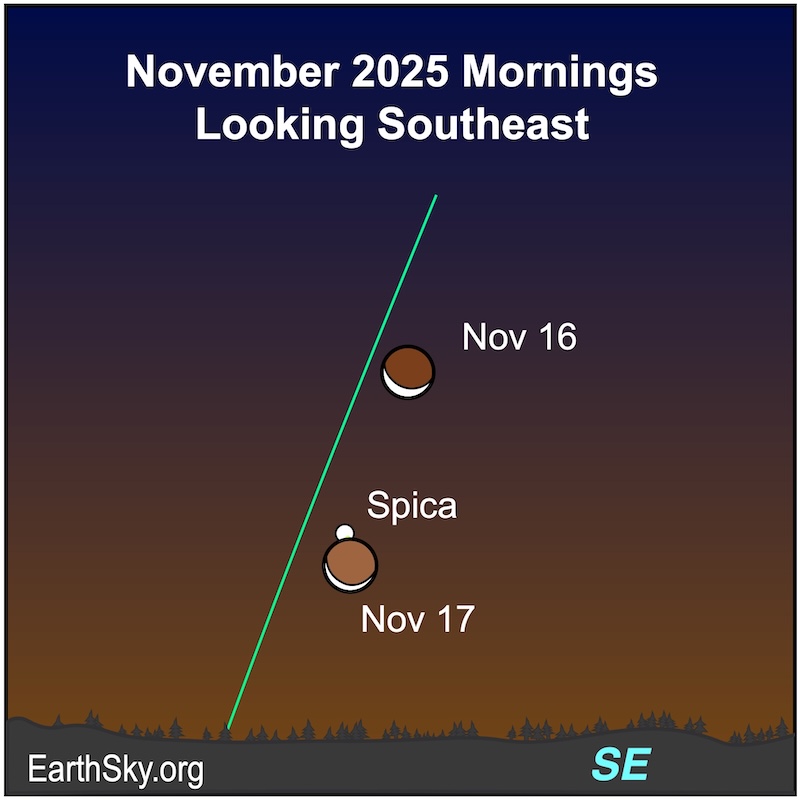
Mid-to-late November evening planets
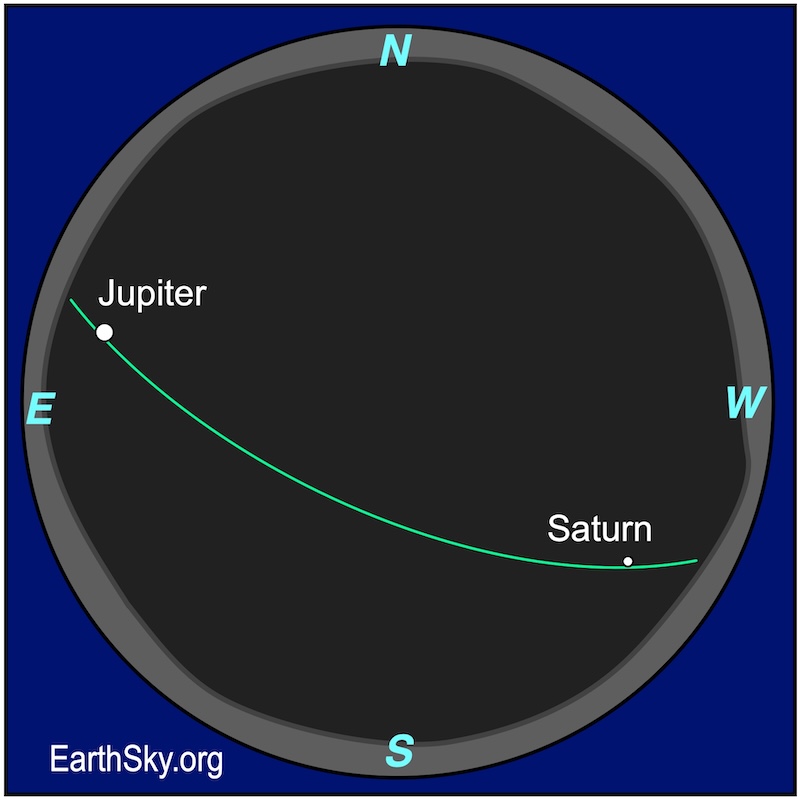
November 20: The most distant new moon of 2025
The moment of new moon will fall at 6:47 UTC on October 21, 2025. That’s 12:47 a.m. CST. New moons rise and set with the sun. Nights around the new moon are perfect for stargazing, and this one is near the peak of the Leonid meteor shower. Plus, this is the second – and farthest – of three new micromoons – or most distant new moons – in 2025. See EarthSky’s best places to stargaze.
Want more? Here are 4 keys to understanding the moon’s phases.
November 20: Moon reaches apogee
The moon will reach apogee – its farthest distance from Earth in its elliptical orbit – at 3 UTC on November 20, 2025, when it’s 252,706 miles (406,691 km) away.
November 20: Mercury at inferior conjunction
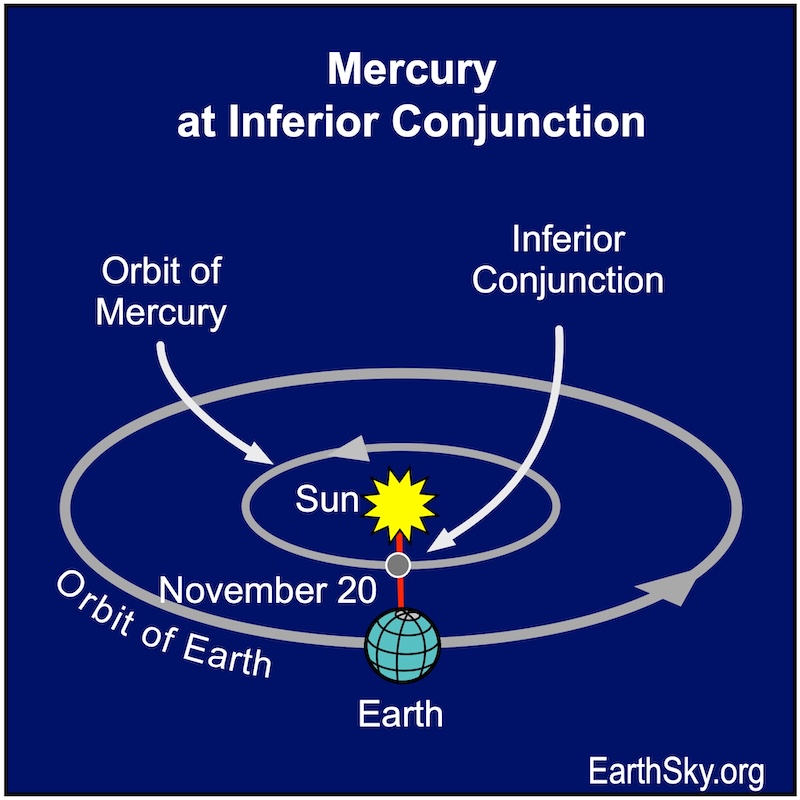
November 22 and 23 evenings: Moon and the Teapot
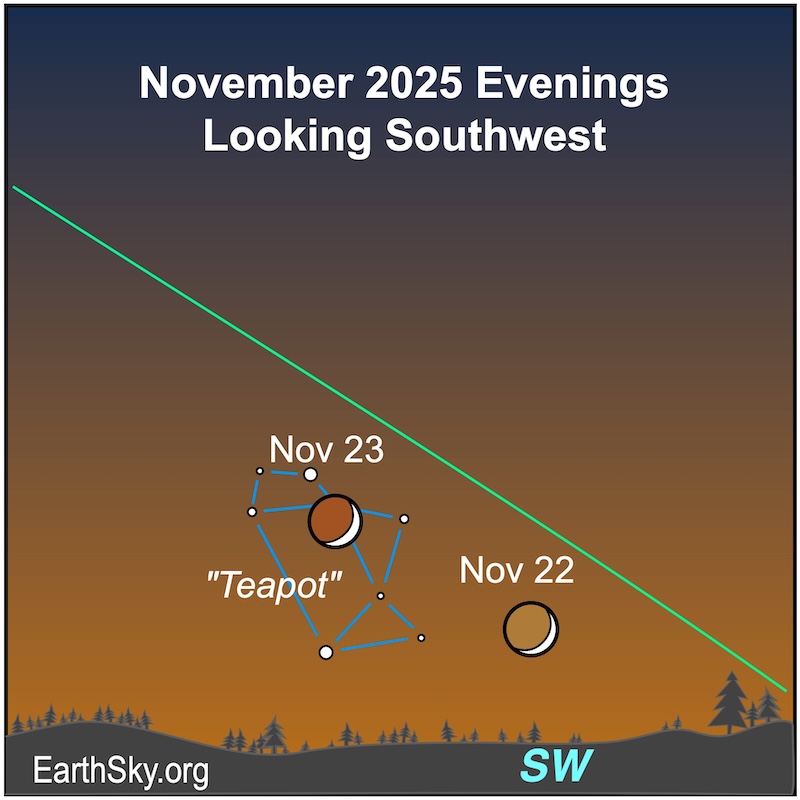
Read more: Teapot of Sagittarius points to Milky Way Center
Our charts are mostly set for the northern half of Earth. To see a precise view – and time – from your location, try Stellarium Online.
November 25 and 26 evenings: Moon and Capricornus
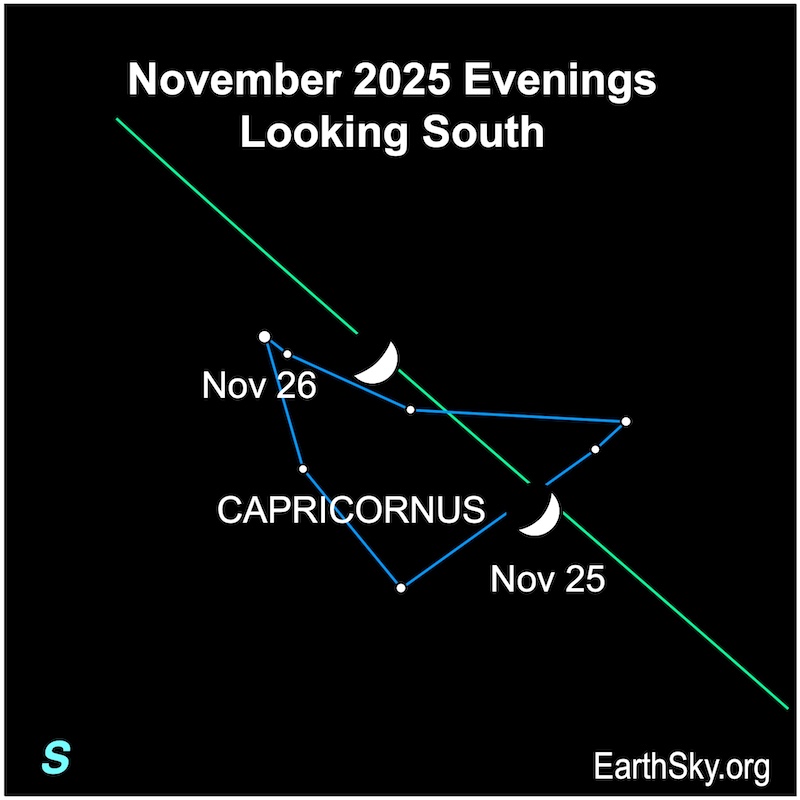
Read more: Capricornus the Sea-goat has an arrowhead shape
November 28: 1st quarter moon
The moment of 1st quarter moon will fall at 6:59 UTC on November 28, 2025. That’s 12:59 a.m. CST. Did you know you can see an X and V on the 1st quarter moon? Here’s how to see them. A 1st quarter moon rises around noon your local time and sets around midnight. Watch for a 1st quarter moon high in the sky at sundown.
Want more? Here are 4 keys to understanding the moon’s phases.
November 28 and 29 evenings: Moon and Saturn
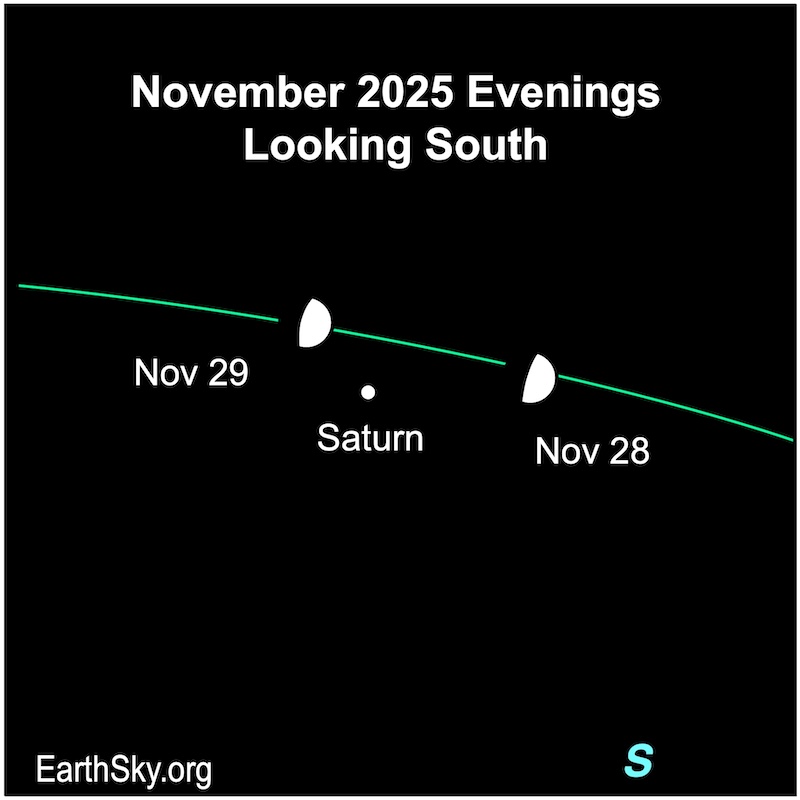
Read more: Saturn’s rings are weird and wonderful: 10 facts here
Our charts are mostly set for the northern half of Earth. To see a precise view – and time – from your location, try Stellarium Online.
October stars and constellations
If you’re out stargazing on any October evening, look for these stars and constellations high in the evening sky while facing north.
Join EarthSky’s Marcy Curran in a video preview of the stars, constellations – and planets – for the month of November 2025. Plus, the rich Milky Way is still prominent overhead under a dark sky.
November stars and constellations
If you’re out stargazing on any November evening, look for these stars and constellations high overhead in the evening sky. Give your eyes time to adjust to the darkness. And consider heading to a dark-sky site for the best views of the stars.
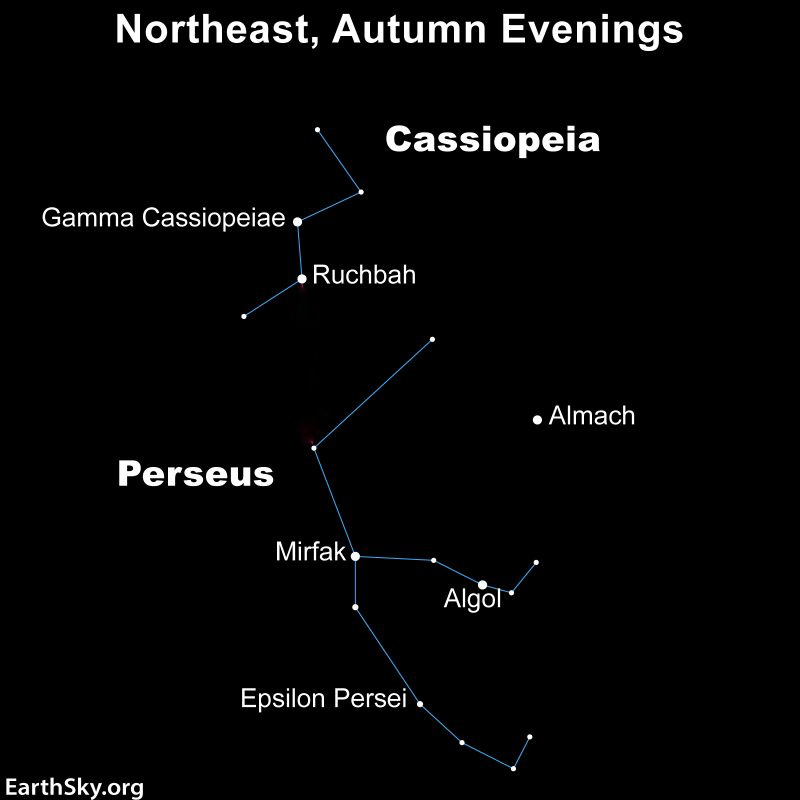
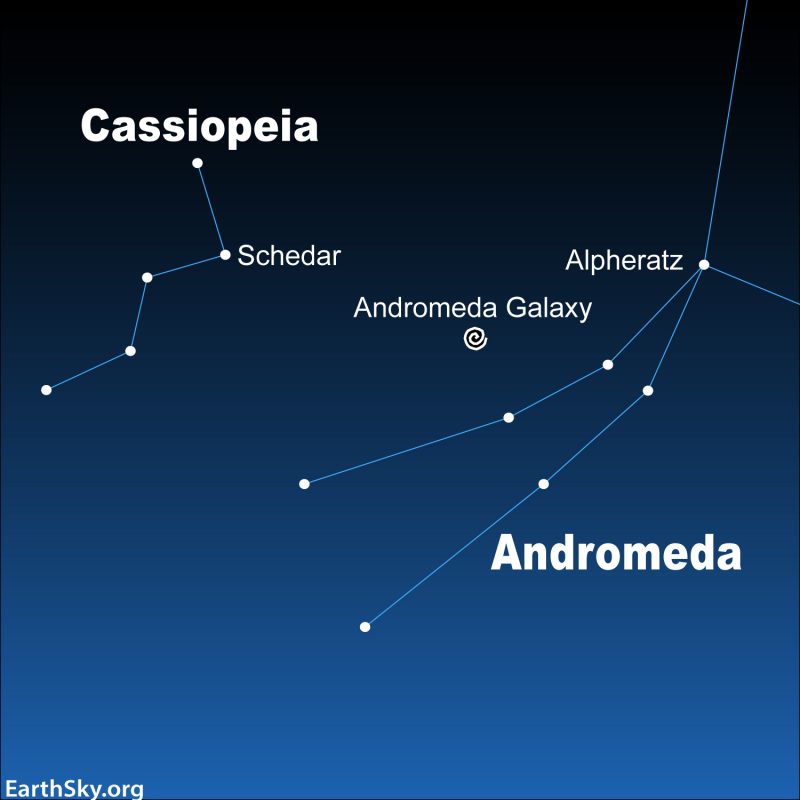
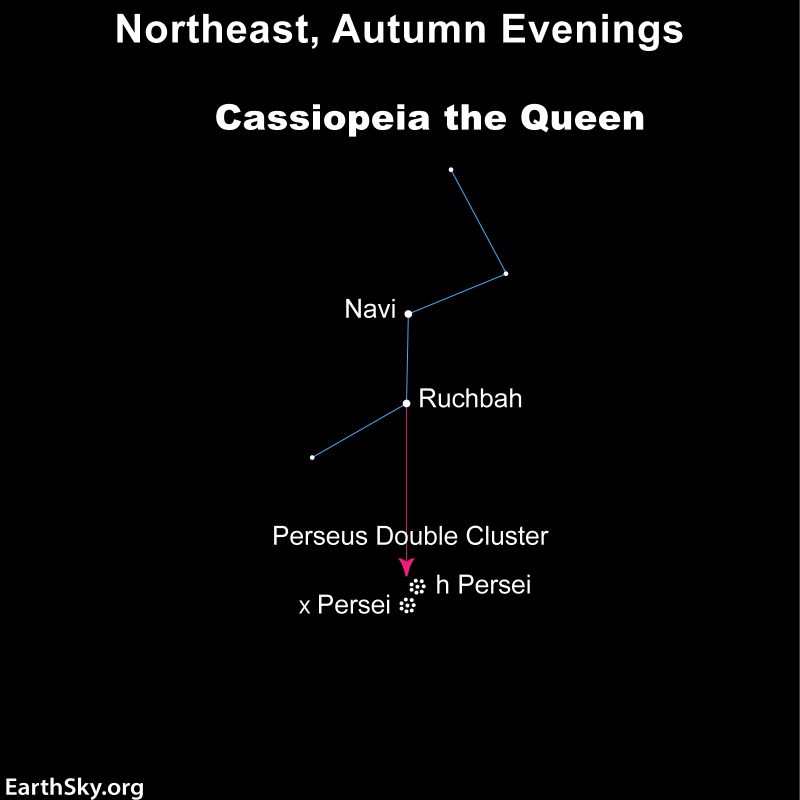
October evening planets
Our charts are mostly set for the northern half of Earth. To see a precise view – and time – from your location, try Stellarium Online.
October morning planets
November evening planets
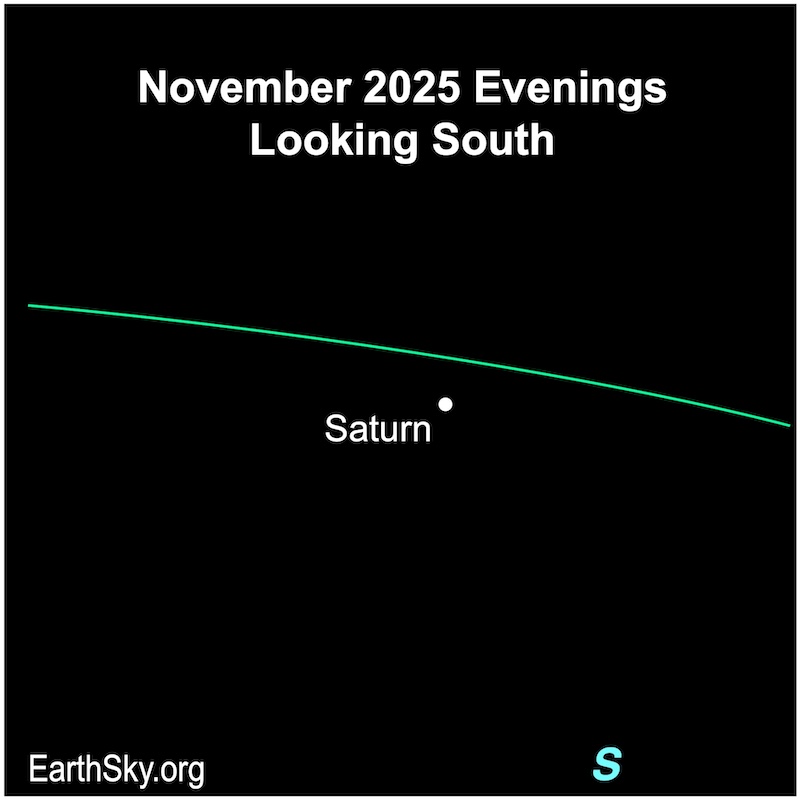
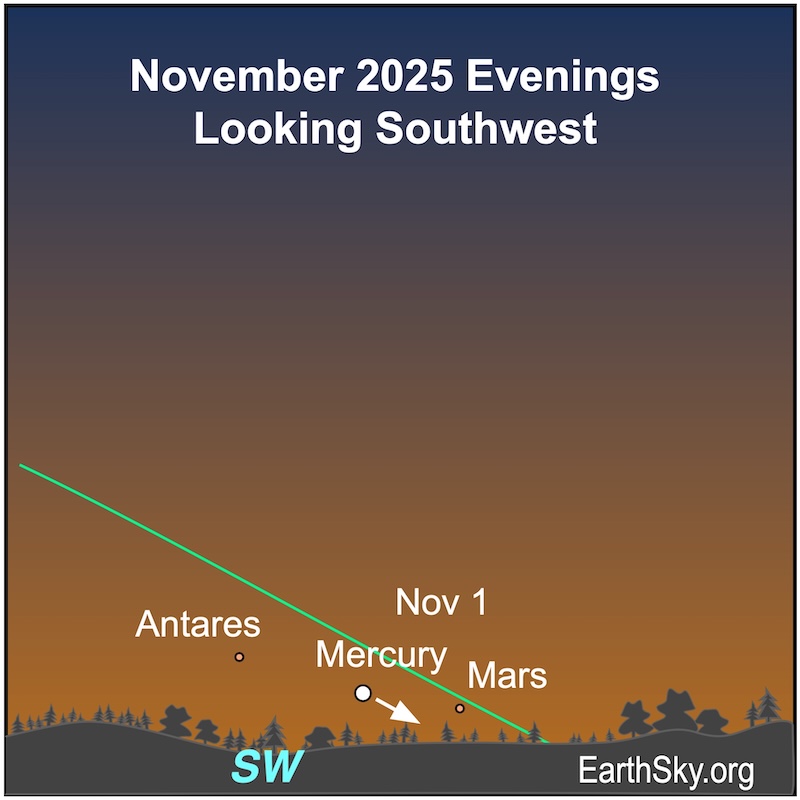
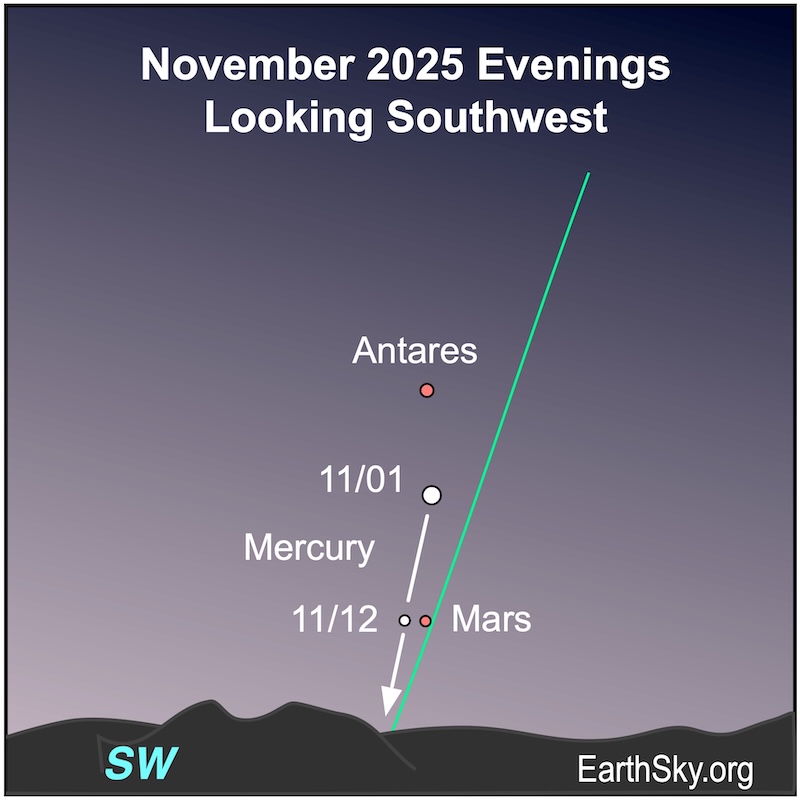
Our charts are mostly set for the northern half of Earth. To see a precise view – and time – from your location, try Stellarium Online.
November morning planets
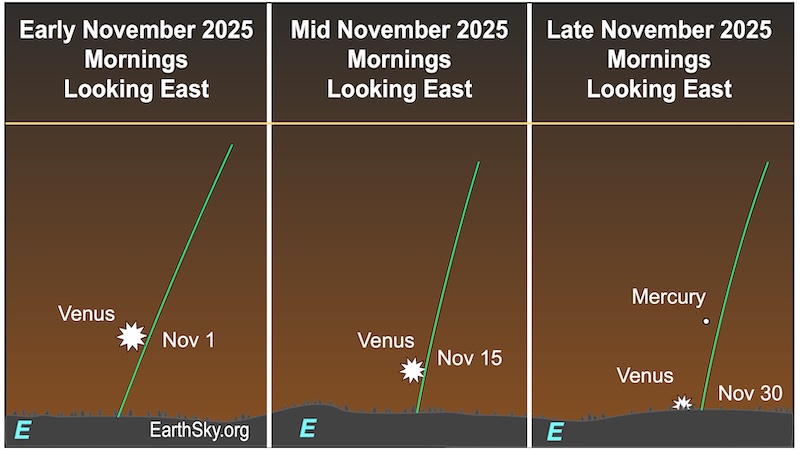
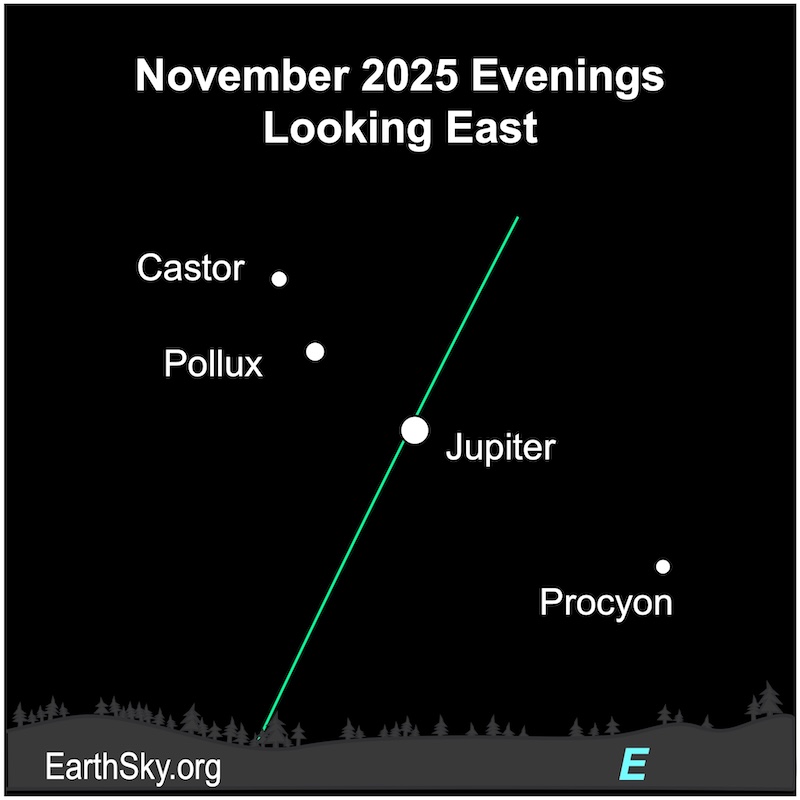
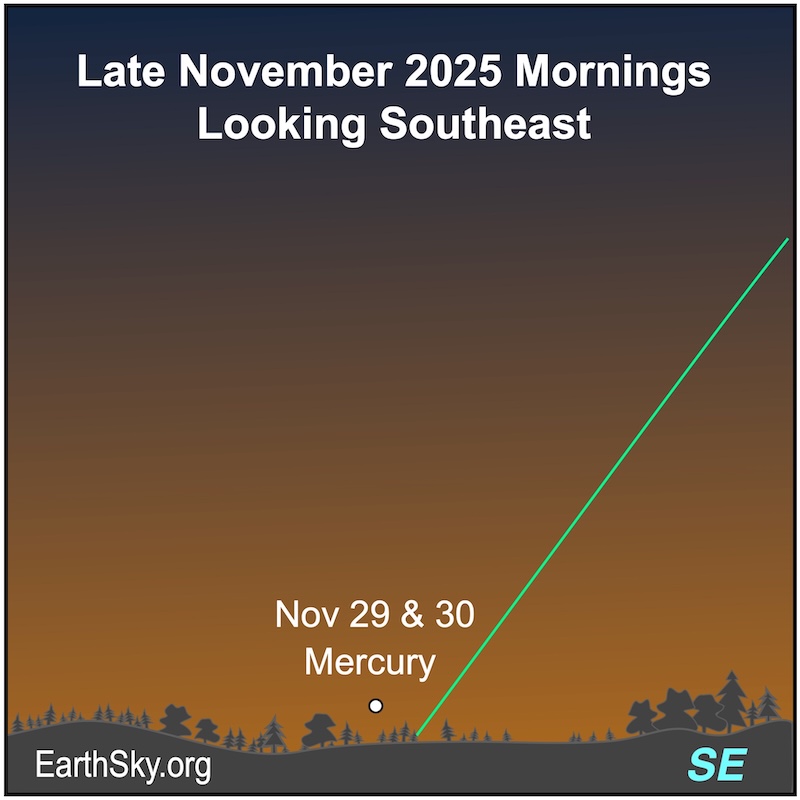
Some resources to enjoy
For more videos of great night sky events, visit EarthSky’s YouTube page.
Don’t miss anything. Subscribe to daily emails from EarthSky. It’s free!
Visit EarthSky’s Best Places to Stargaze to find a dark-sky location near you.
Post your own night sky photos at EarthSky Community Photos.
See the indispensable Observer’s Handbook, from the Royal Astronomical Society of Canada.
Visit Stellarium-Web.org for precise views from your location.
Almanac: Bright visible planets (rise and set times for your location).
Stargazing tips for beginners
Watch a video of the EarthSky’s top 10 stargazing tips for beginning astronomers.
Stars and constellations high in the sky during November
If you’re out stargazing on any November evening, look for these stars and constellations overhead in the sky.
Pegasus the Flying Horse, home to the Great Square
On autumn evenings in the Northern Hemisphere, Pegasus the Flying Horse is ascending in the east in the evening hours and high overhead in the evening. During these same months on spring evenings in the Southern Hemisphere, Pegasus is low in the northwestern sky. You’ll easily notice the giant, square-shaped asterism within Pegasus, called the Great Square.
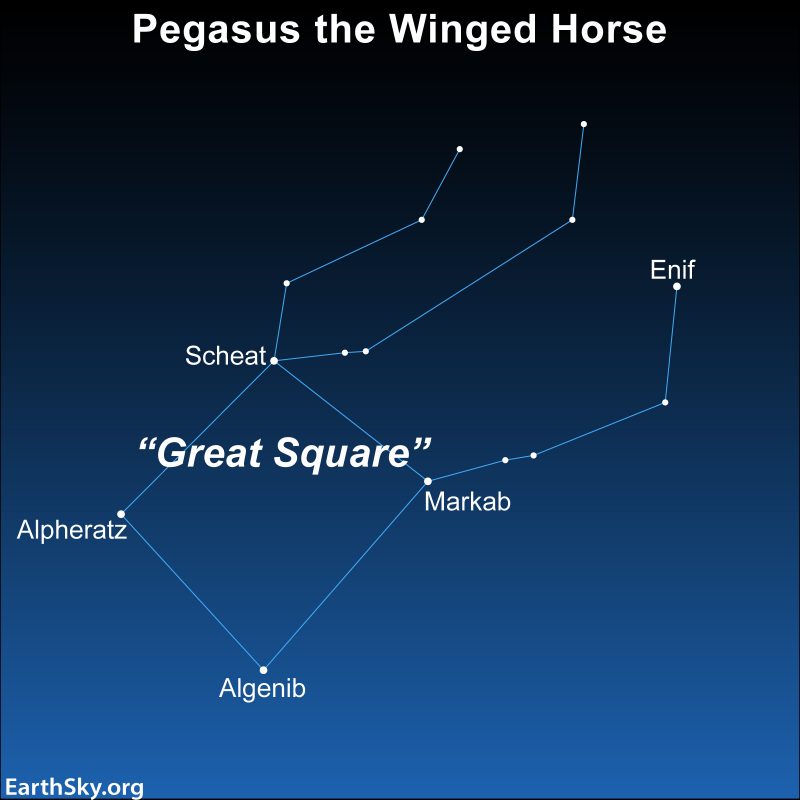
The Great Square of Pegasus
In the north, the Great Square is high overhead in November, and you can use it to find the Andromeda galaxy. Find the Andromeda galaxy (M31) by star-hopping from the Great Square of Pegasus. Try star-hopping using the chart below.
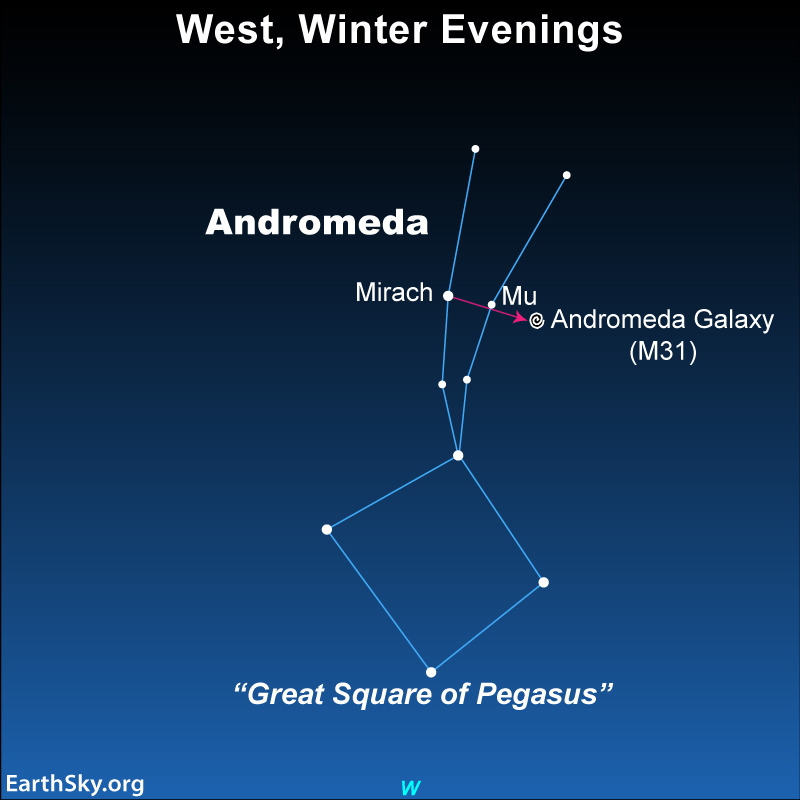
The Double Cluster of Perseus
On any autumn or winter evening, scan between Cassiopeia and Perseus for the magnificent Double Cluster in Perseus. You can see them as a fuzzy patch on the sky under dark skies. They are an easy target in binoculars. The stars in these two clusters are young, hot supergiant suns that are many thousands of times more luminous than our sun. Below is an easy way to use the prominent M or W shape of Cassiopeia to locate the Double Cluster in Perseus.
Our charts are mostly set for the northern half of Earth. To see a precise view – and time – from your location, try Stellarium Online.
November morning planet
In November 2024, red Mars will lie near the twin stars of Gemini: Castor and Pollux. And it’ll make a beeline toward the Beehive star cluster. It’ll rise in the late evening and will be obvious in the sky before dawn. It brightens a bit this month and will be at its closest and brightest again in January 2025.

November planet visible all night
In November 2024, Jupiter will shine brightly near the bright stars of golden Capella, ruddy Betelgeuse and orangish Aldebaran. Also nearby are the open star clusters the Pleiades and the Hyades. Jupiter will rise a few hours after sunset at the beginning of the month and will rise around sunset by month’s end. It’ll be visible through dawn. The moon will be near Jupiter on November 17. Jupiter will be closest and brightest for 2024 in December.

November evening planets
In the first half of November, bright Venus will climb slowly in the southwest about 30 minutes after sunset. The bright – but elusive – little planet Mercury will lie nearby, closer to the horizon. The moon will hang close to Mercury on November 3, and it’ll float close to Venus on November 4. Venus will continue to ascend and become a dazzling evening star through the end of the year. It’ll reach its greatest distance from the sun on the sky’s dome in January 2025. Mercury will lie low in the bright western twilight, look for it about 30 minutes after sunset. It will reach its greatest elongation – greatest distance from the sunset – on November 15-16, 2024.

In the second half of November, bright Venus continues ascending slowly in the evening twilight and will pass the Teapot, an asterism in Sagittarius. Venus will remain a brilliant evening star through the end of the year. It’ll reach its greatest distance from the sunset in January 2025. Meet the Teapot of Sagittarius.

In November 2024, Saturn will be well above the eastern horizon after sunset and will set around midnight your local time. It will be racing away after its closest point to Earth on September 8, when it was directly opposite the sun from Earth. The moon will float near Saturn on November 10. For the rest of 2024, Saturn will remain visible in the evening sky and will disappear in the sunset glare in February 2025. Saturn and the bright star Fomalhaut are the only two bright objects in that area of the sky.

Sky dome maps for visible planets and night sky
The sky dome maps come from master astronomy chart-maker Guy Ottewell. You’ll find charts like these for every month of 2024 in his Astronomical Calendar.
Guy Ottewell explains sky dome maps

Wild Turkeys: Band On The Run
If you’re like most drivers in northern California, you’ve hit the brake to avoid bands of Wild Turkeys crossing the street. Why are they so common? Like many non-natives in northern California, Wild Turkey populations have an easy time in suburban and semi-rural areas where successful predation by Gray Fox, Bobcat, and Mountain Lion remains below this gallinaceous bird’s prodigious breeding rate that usually consists of 10-12 eggs per brood (and multiple broods for some females each breeding season).
In addition, Wild Turkey benefit from joining together in bands of six or more this time of year so that at least one individual is likely to sense any imminent predation attempt and, subsequently, alert other turkeys in a group that quickly flees from harm’s way. Plentiful harvests of acorns are another major factor in supporting large Wild Turkey populations, with native oak species (including Coast Live Oak, Quercus agrifolia) providing ample supplies of these birds’ favorite food. In years when the crop of acorns is low from Coast Live Oak, other native oak species (Black Oak, Quercus kelloggii and Blue Oak, Quercus douglasi) may make up the difference by yielding high acorn numbers. A final reason relates to how mild winter temperatures in our area limit mortality of populations whose odds of perishing increase in more frigid locales within this bird’s range that includes portions of New England and the upper Midwest.
Autumn Chores: Western Gray Tree Squirrel
What are western gray tree squirrels doing now? Many are preparing for winter when they’ll make brood nests in tree and snag cavities, often enlarging an abandoned woodpecker cavity. They are also known to construct nests on branches of oak, fir, or pine trees. If you see a nest, look for it to contain shredded bark, grass, moss, and lichen.
Aquatic Insects Are (Almost) Everywhere
Seeing an abundance of aquatic insects might seem odd at this time of year when the days are getting progressively colder, correct? Not entirely. Many kinds of aquatic insects are actually abundant in many freshwater streams throughout the late autumn and into winter, with some (such as stoneflies) even changing into terrestrial adults and flying into autumn and winter’s landscape. Finding aquatic insects may be easier than you think. Pick up small rocks within shallow creeks and look on their backsides. You may see the diverse homes of caddisfly larva, with a variety materials used by each species in a shelter bound together from a caddisfly’s own secretions.
A Chorus of Crickets?
Are you still hearing crickets? — even though the first frost may have invaded your area. Crickets survive well into autumn because their body fluids contain an “anti-freeze” agent called glycogen. Its composition as an animal starch includes glucose molecules that retard the inevitable freezing of a cricket’s body fluids until more severe and consecutive nights of frigid weather arrive.
Snakes In Winter
Where do snakes hang out now and during the winter? Many retreat to underground dens where they coil en masse together to remain warm. In northern areas, rattlesnakes are particularly known for congregating into large groups (of up to 250 or more). Most live in dens on slopes protected from northern winds that have orientations toward the low winter sun in the south. Sometimes you can see rattlesnakes lie near their den entrances on the last warm days of autumn or on the initial warm days of spring.
Coaxing Deer Into Your View
Coax deer into view throughout the upcoming winter by placing a salt lick block at the edge of woods. However, you may wish to deter deer from eating your property’s plants with a variety of strategies that are too numerous to mention here (See literature distributed free by Sloat Garden Store in the Bay Area.) To limit deer accidents with windows/patio doors, prudent property owners place decals at a deer’s eye level so it will recognize an approaching barrier.
Winter Resident Wood-Warblers
Some brave warblers survive hang out throughout the winter in regions you might not expect. Unlike warblers that have vacated North America for points farther south, Yellow-Rumped Warbler (four subspecies constitute the entire species, including Aububon’s, Myrtle, Guatemalan Goldman’s, and Northwest Mexican Black-fronted*) are able to survive inclement winter weather while living in mid-Atlantic states (Myrtle subspecies) because they are able to digest wax myrtle, juniper and, even, poison ivy berries. These same areas may also host small populations of Pine and Palm warblers throughout the winter in the mid-Atlantic, in addition to occasional yellow-breasted chats and common yellowthroat warblers.
On the West Coast during winter, both Audubon and Myrtle Yellow-Rumped Warbler subspecies may be seen in northern California, with the former more common. In total, we see two of the four subspecies for the Yellow-Rumped Warbler species.
(* = http://www.aou.org/committees/nacc/proposals/pending.php
The above link allows you to access current and past AOS proposals related to potential bird taxonomy changes.
December, 2025
Sky Watch: (courtesy of almanac.com)
1) Moon & Planet Rise & Set Times
……..For your location’s moon & planet rise & set times, see: https://www.timeanddate.com/astronomy/night/usa/tehachapi
or type in at:
https://www.timeanddate.com/astronomy/night/
Then type in your city and/or zip code location to review the results for your rising times.
For example, my location’s information for the 1st of this month (at Latitude: 38:03:38 N, Longitude: 122:32:27 W, which is Novato, CA, 94949 20 miles north of San Francisco, CA in Marin County):
2) Visible planets and night sky events in December 2025 (courtesy of EarthSky.org)
We’ll have another supermoon in December. It crests at 5:14 p.m. CST (23:14 UTC) on December 4. Expect large tides. Let the moon guide you to Jupiter, the brightest planet up in December. And let Jupiter guide you to the radiant point for December’s Geminid meteor shower! Plus … why doesn’t the earliest sunset fall on the shortest day? Two night sky veterans – EarthSky’s Deborah Byrd and John Goss – have all you need to know. Watch at noon CST (18 UTC) on December 3 in the player above, or on YouTube.
December evening planets
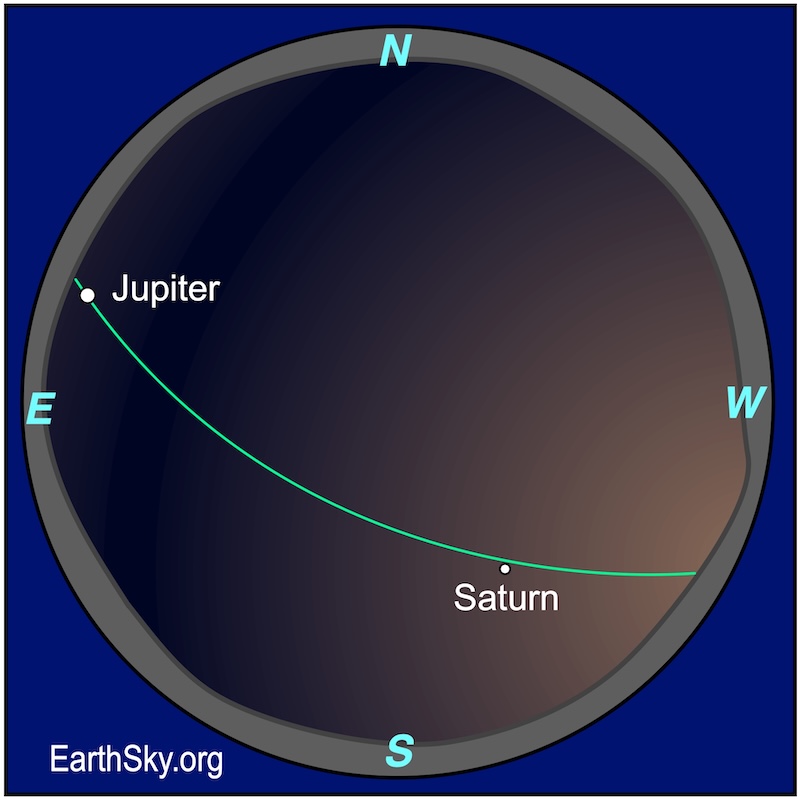
December morning planets
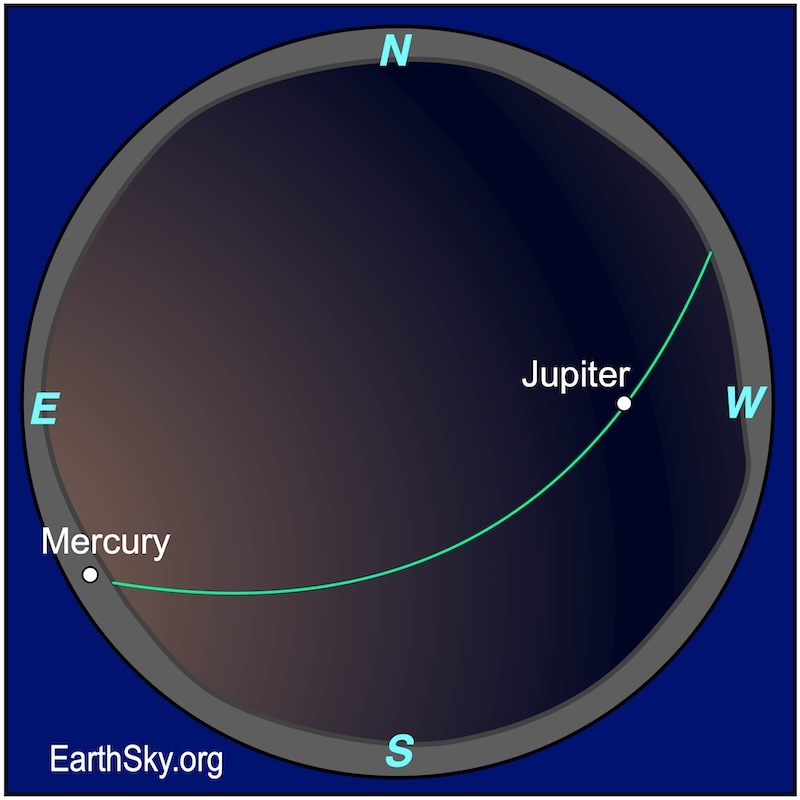
Look for Mercury in the morning
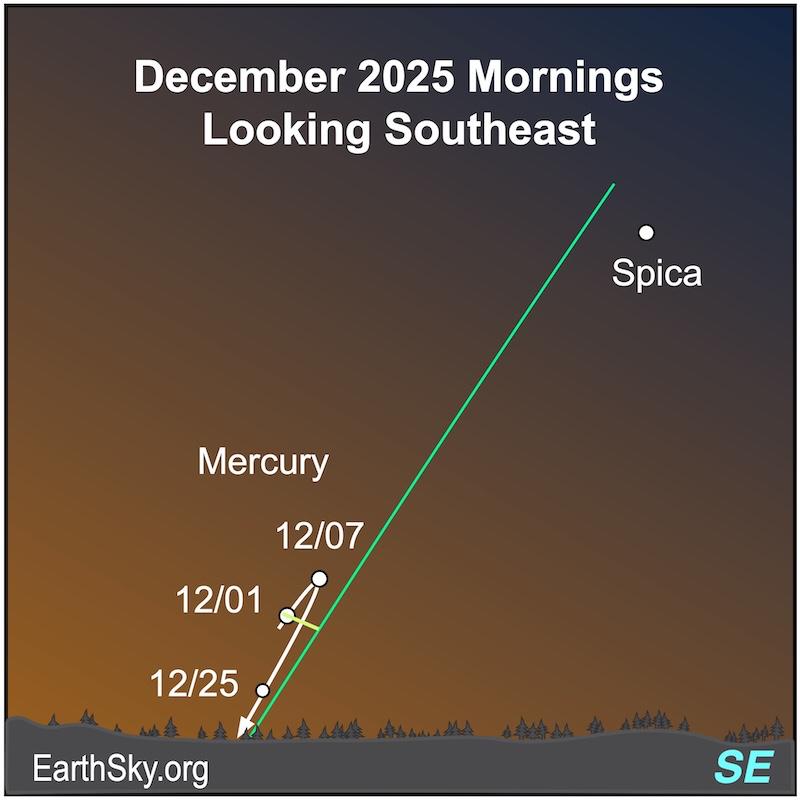
December moon phases and alignments
Join EarthSky’s Marcy Curran in a video preview of the moon phases and planetary alignments for December 2025. We’ve got the full Cold Moon on December 4 and it’s the last supermoon of the year. The morning planets are Mercury and Jupiter. And in the evening, Saturn is visible until after midnight with Jupiter rising soon after sunset. Details here!
December 2 and 3 evenings: Moon and Pleiades
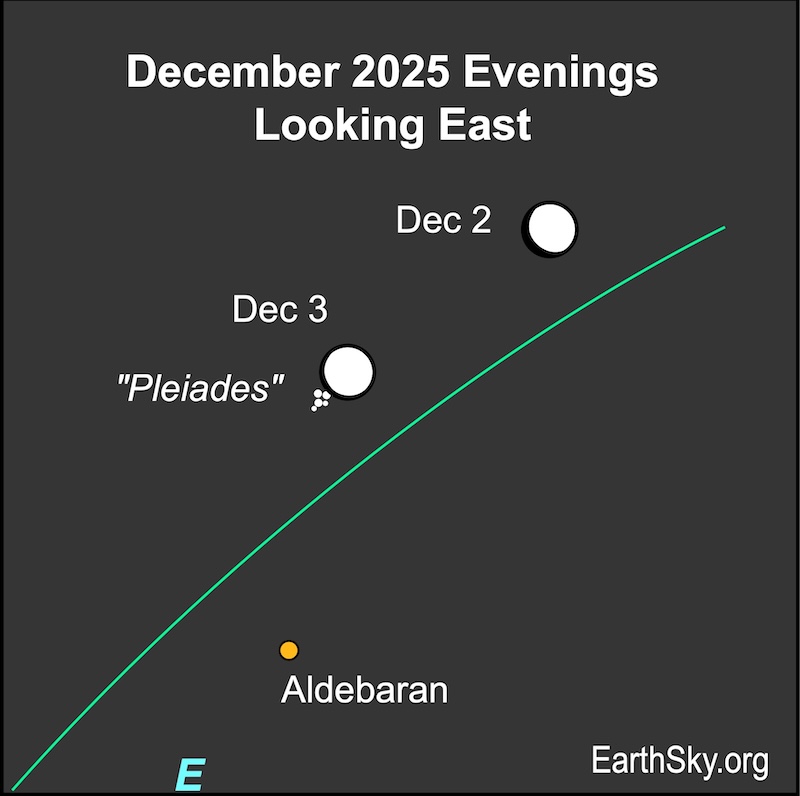
Read more: Lost sisters of the Pleiades are scattered across the sky
Our charts are mostly set for the northern half of Earth. To see a precise view – and time – from your location, try Stellarium Online.
December 3 evenings: Moon blots out some of the Pleiades
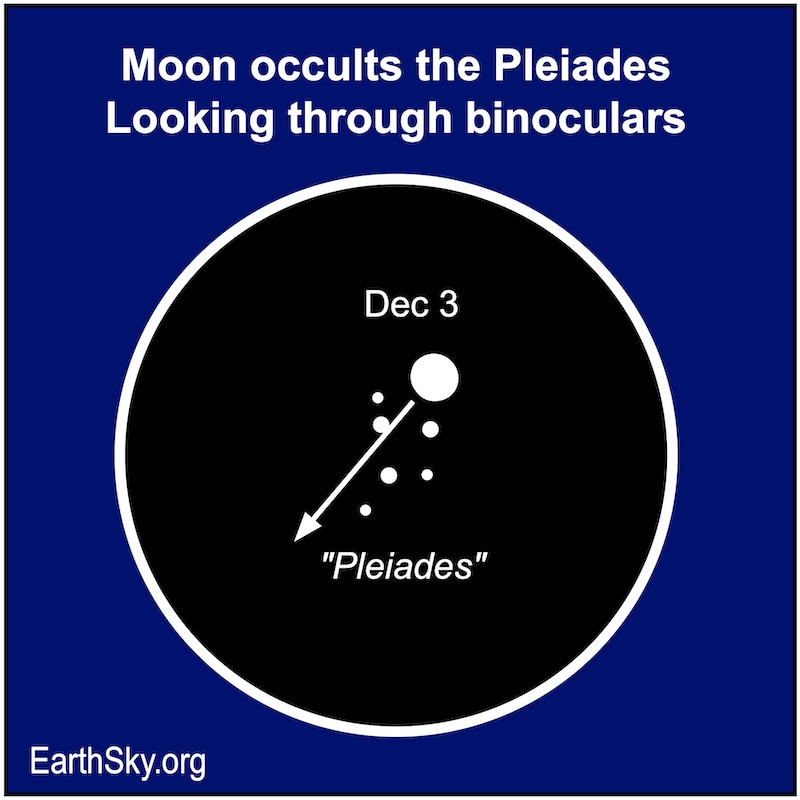
December 4: Moon reaches perigee
The moon will reach perigee – its closest point to us in its elliptical orbit around Earth – at 11 UTC on December 4, 2025, when it’s 221,806 miles (356,963 km) away. And it’ll be a supermoon, the 3rd of 4 in a row. Expect high tides.
December 4 all night: A SUPER full Cold Moon
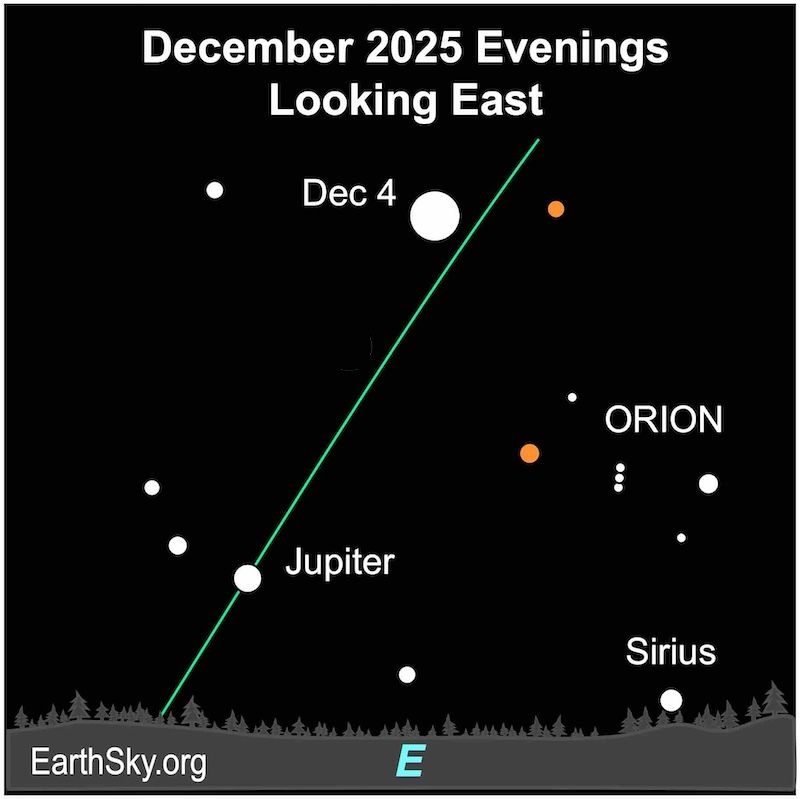
Read more: The December full moon is the Cold Moon and a supermoon
December 5 evening: Moon, Jupiter, Orion and bright stars
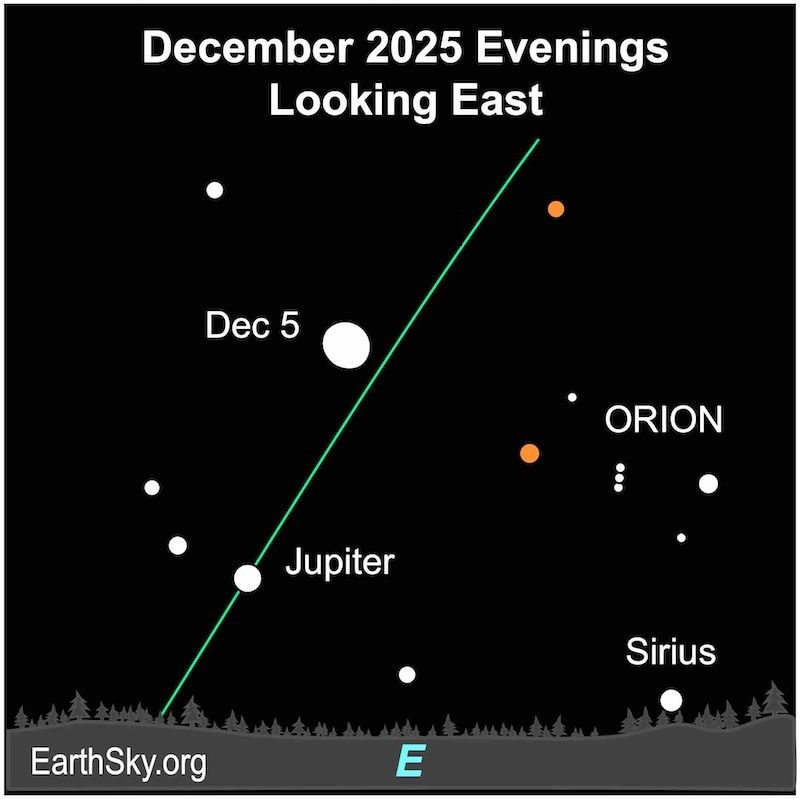
Our charts are mostly set for the northern half of Earth. To see a precise view – and time – from your location, try Stellarium Online.
December 6 and 7 evenings: Moon, Jupiter and twin stars
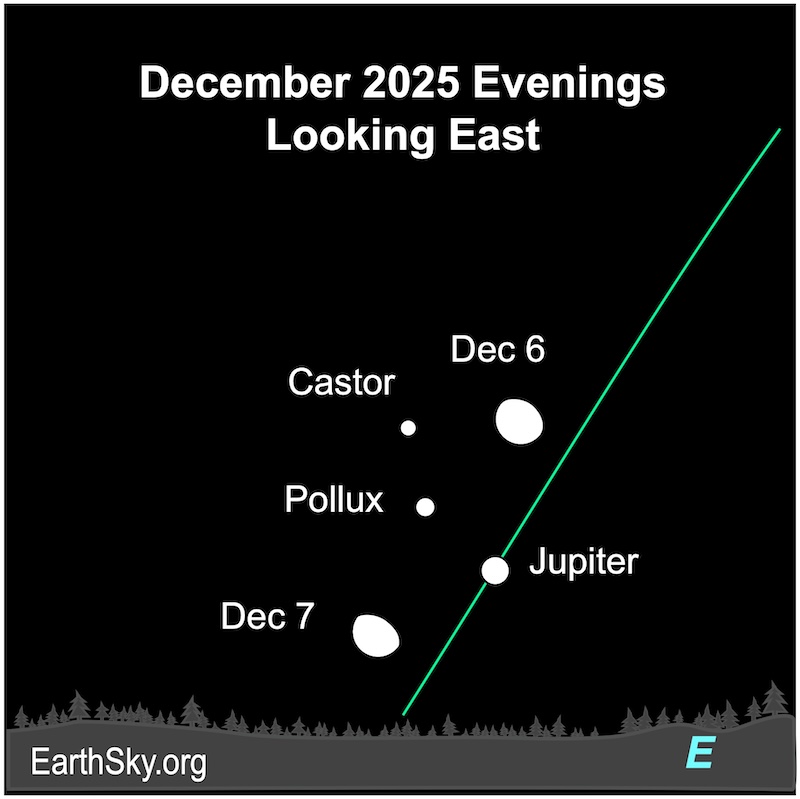
Read more: Meet Gemini the Twins, home to 2 bright stars
December 7: Mercury reaches greatest elongation from morning sun
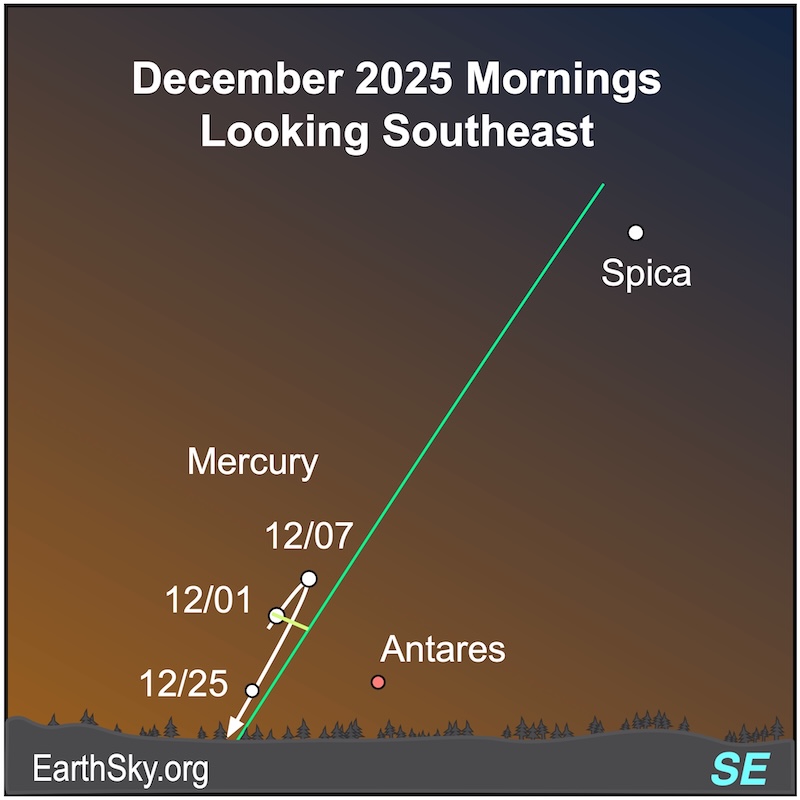
Read more: Look for Mercury farthest from the morning sun December 7
December 9 and 10 mornings: Moon and Regulus
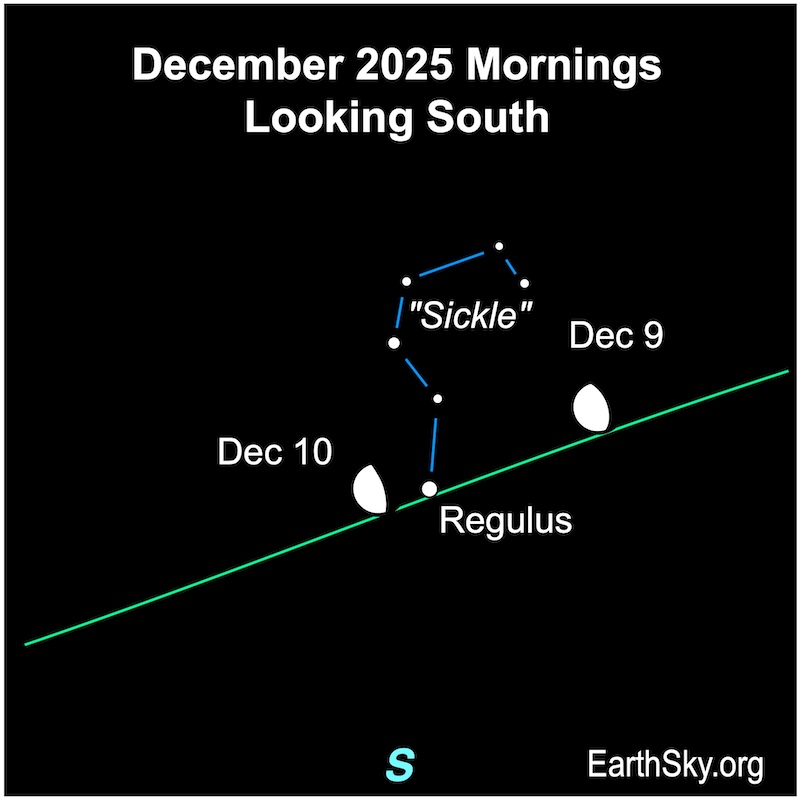
Read more: Meet Regulus, Leo the Lion’s Heart and brightest star
December 11: Watch for the 3rd quarter moon
The moment of 3rd quarter moon will fall at 20:52 UTC on December 11, 2025. That’s 2:52 p.m. CST. It’ll rise after midnight your local time and set around noon. Look for it high in the sky before dawn.
Want more? Here are 4 keys to understanding the moon’s phases.
Mid-December meteors … the Geminids
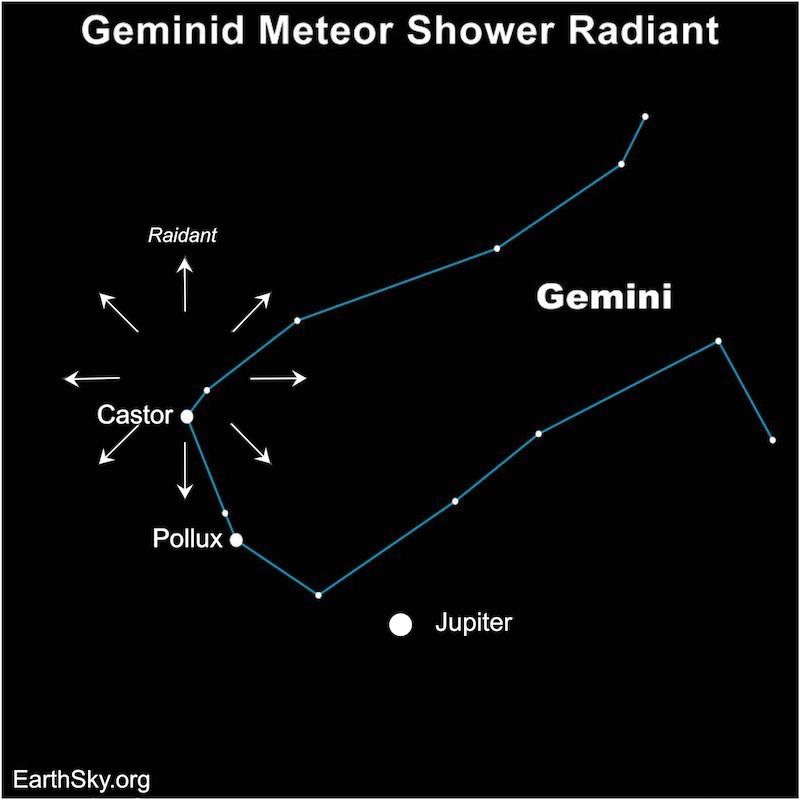
Read more: Geminid meteor shower peaks in dark skies December 13-14
December 14, 15 and 16 mornings: Moon and Spica
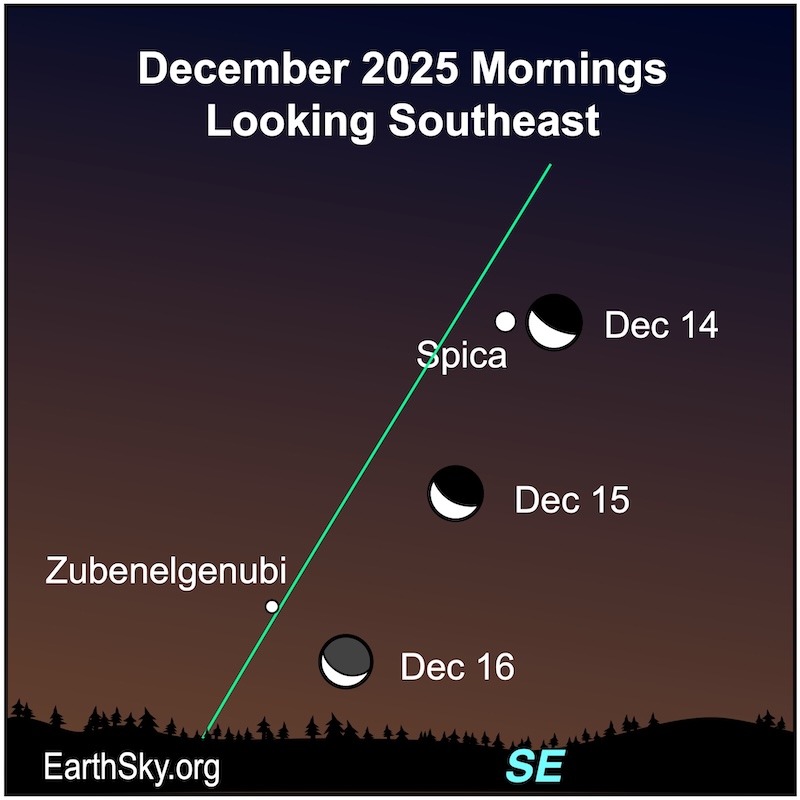
Read more: Spica, the bright beacon of Virgo, is 2 stars
December 17: Moon reaches apogee
The moon will reach apogee – its farthest distance from Earth in its elliptical orbit – at 6 UTC on December 17, 2025, when it’s 252,476 miles (406,322 km) away.
December 17 morning: Moon, Mercury and Zubenelgenubi
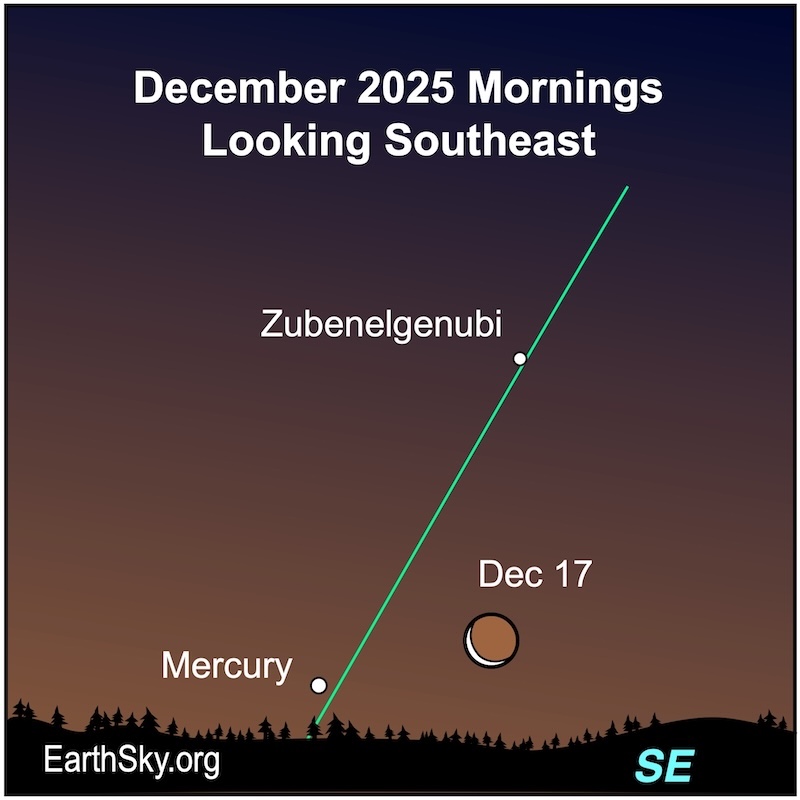
Zubenelgenubi is the alpha star of Libra the Scales
December 20: New moon
The moment of new moon will fall at 1:43 UTC on December 20, 2025. That’s 7:43 p.m. CST on December 19. New moons rise and set with the sun. Plus, this is the 3rd of 3 new micromoons – or most distant new moons – in 2025. Nights around the new moon are perfect for stargazing, and this one is near the peak of the Ursid meteor shower. See EarthSky’s best places to stargaze.
Want more? Here are 4 keys to understanding the moon’s phases.
December 21 solstice
The 2025 December solstice will happen at 15:03 UTC. That’s 9:03 a.m. CST in North America. For us in the Northern Hemisphere, the December solstice marks the longest nights and shortest days of the year. For the Southern Hemisphere, it marks the shortest nights and longest days. After this solstice, the sun will begin moving northward in our sky again. Happy solstice to all!
Read more: Happy December solstice: All you need to know
December 21, 22, 23 and 24 evenings: Looking at holidays lights? Watch for the young moon!
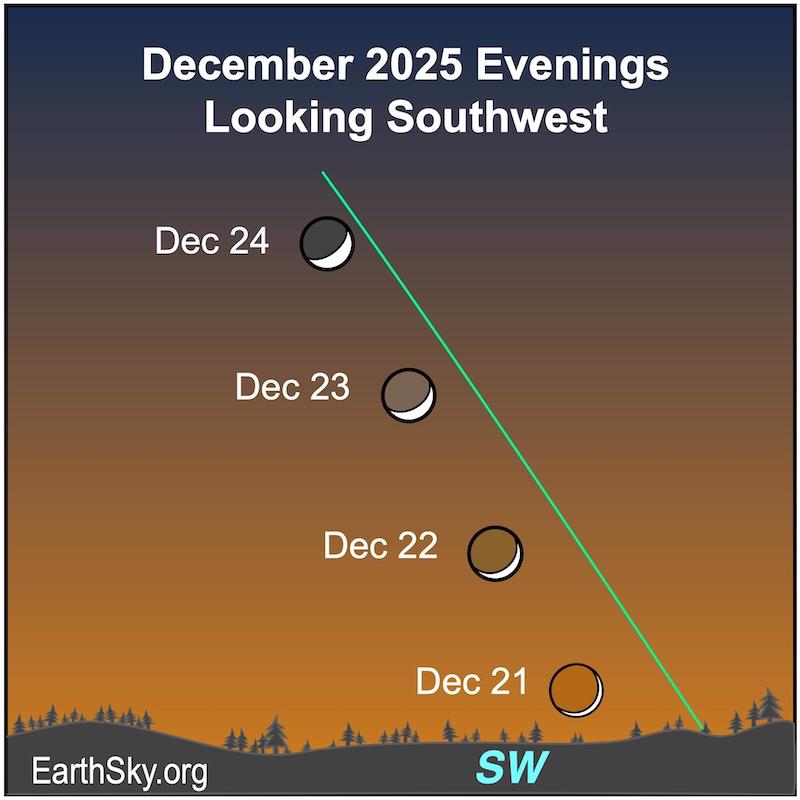
Read more: Do you love twilight? The 3 stages explained
Ursid meteor shower overnight December 22
The best time to watch for Ursids is before dawn on December 22. In 2025, the new moon occurs a few days before the Ursids peak, so you can watch for them in a dark sky. For the best view, find a dark country site to watch the starry sky. Under ideal conditions you might see 5-10 meteors an hour. Read more about the Ursid meteor shower.
December 26 evening: Moon slips by Saturn
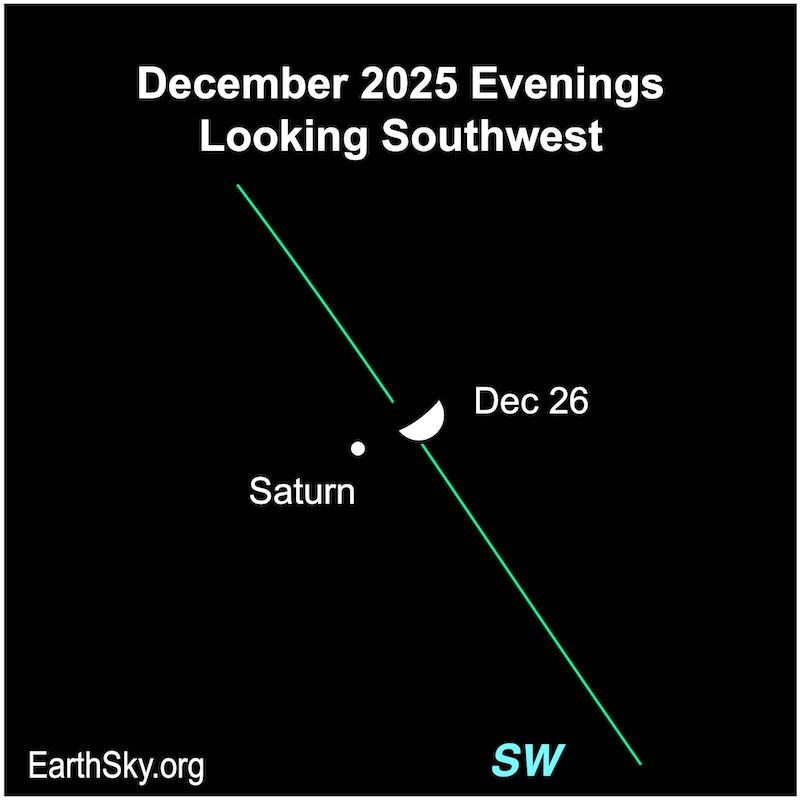
Read more: Saturn’s rings are weird and wonderful: 10 facts here
December 27: 1st quarter moon
The moment of 1st quarter moon will fall at 19:10 UTC on December 27, 2025. That’s 1:10 p.m. CST. Did you know you can see an X and V on the 1st quarter moon? Here’s how to see them. A 1st quarter moon rises around noon your local time and sets around midnight. Watch for a 1st quarter moon high in the sky at sundown.
Want more? Here are 4 keys to understanding the moon’s phases.
December 30 and 31 evenings: Moon, Pleiades and Aldebaran
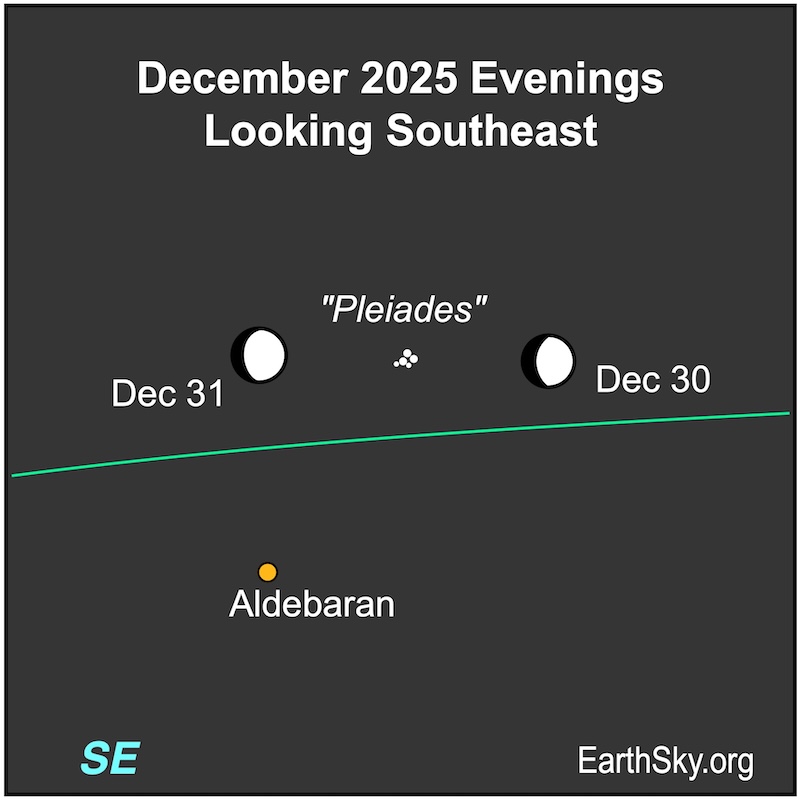
Our charts are mostly set for the northern half of Earth. To see a precise view – and time – from your location, try Stellarium Online.
December stars and constellations
If you’re out stargazing on any December evening, look for these stars and constellations high overhead in the evening sky. Give your eyes time to adjust to the darkness. And consider heading to a dark-sky site for the best views of the stars.
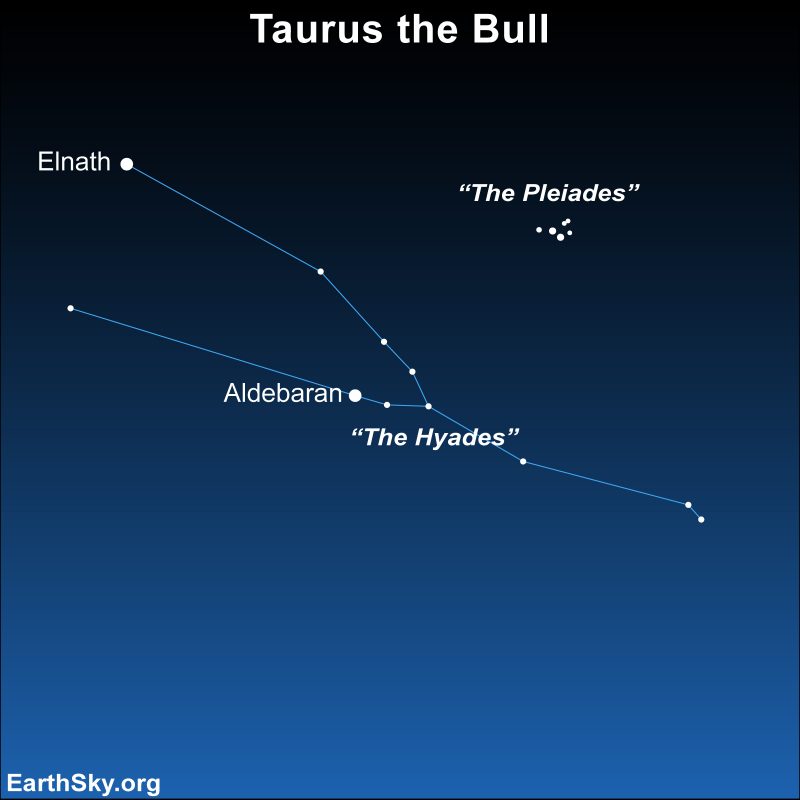
December evening planets
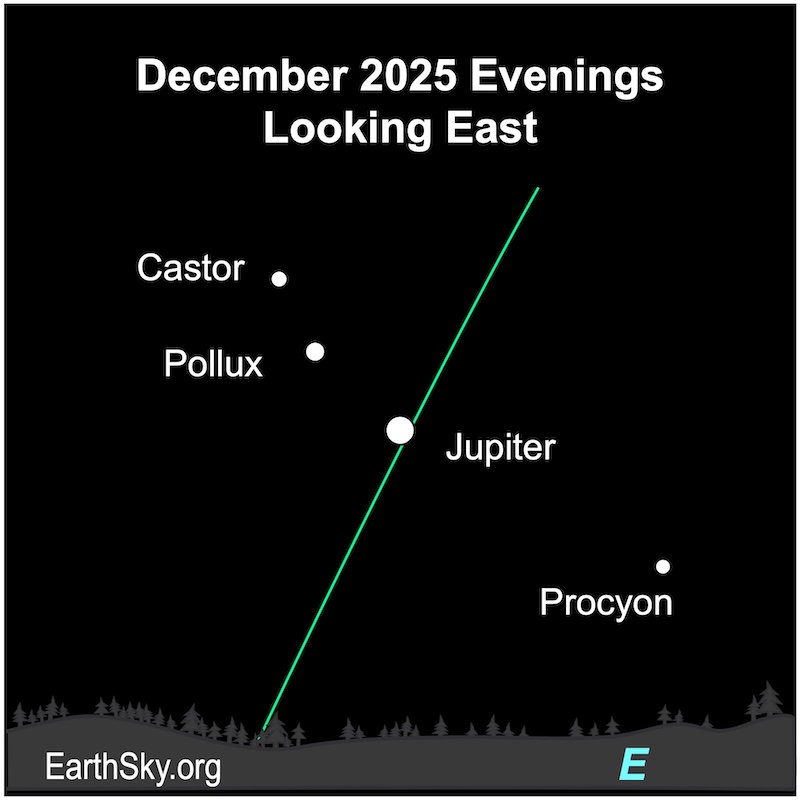
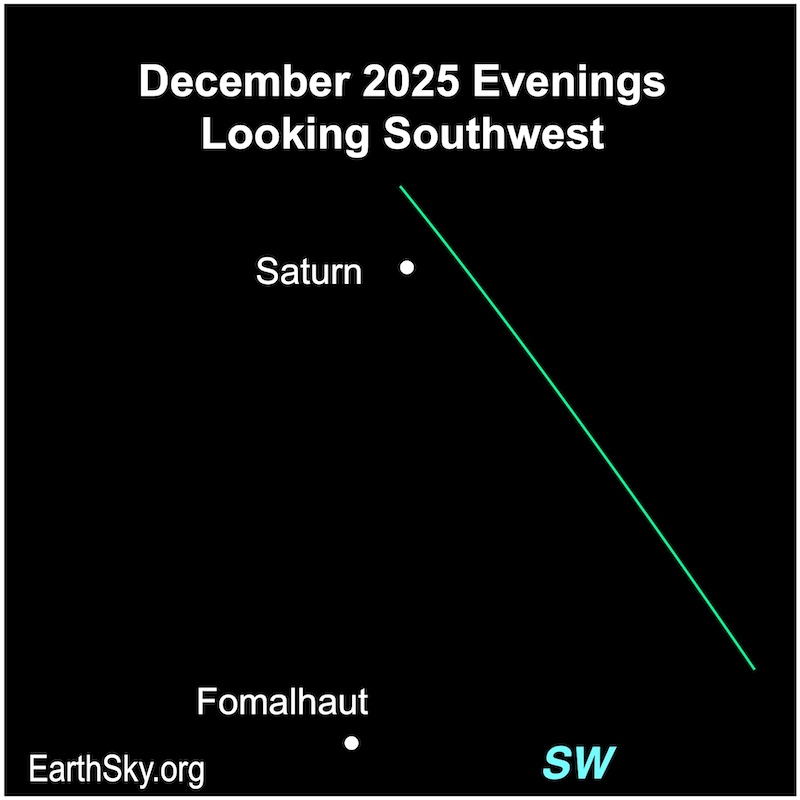
December morning planets
Snake Look-Alike: Pacific Slender Salamanders
Pacific slender salamanders are active underground from April or May until November or December when northern California’s initial “winter” season rains often begin. After the first rains occur, when moisture and temperature conditions are favorable, they increase surface activities. Normally, they are active at night, and return to cover during daylight. If exposed to periods of extended rainfall, they may remain on the surface during the day to feed. Surface activity is limited by extremes of temperature and unfavorable moisture conditions.
Feeding Winter Birds
In some potentially inclement northern California locations (especially inland), now’s the time to make sure you have a waterproof, shock-proof heater to place in a backyard water pan or birdbath so that when overnight temperatures dip below freezing the birds still have a water source for drinking and bathing. Look for them at Wild Bird Center outlets (a national chain of stores).
Basking Garter Snakes
On warm days, look for the common and widespread Western Terrestrial Garter Snake. Sometimes you’ll see them basking in the sun at the entrances of hibernacula where snakes gather together during the winter to preserve and conserve their body temperatures as temperatures plummet.
Likely places to see them extend from the Oregon border south throughout northern California and south to southern Santa Barbara Co., in addition to various locales in the Sierra Nevada mountains south to southern Tulare County. Courtship begins in spring soon after their emergence. Seven to 30 young are born in July and August.
Four Thrush Species Occur Here in Winter?
Which thrush family members are you likely to see during the winter in northern California? In the Bay Area, for example, look for Hermit Thrush, Varied Thrush, American Robin, and Western Bluebird. The initial two on the list are especially breathtaking to view, as their abrupt entrance onto the landscape is punctuated with their subtle hues of rust and orange. The eerie, shrill, one-note song of the Varied Thrush adds additional intrigue to the damp forests they inhabit while only temporarily visiting our area during the winter.
Strangely, though the Hermit Thrush is seen throughout the year in Marin County, it’s probable that individuals we see during the non-breeding season arrived here from where they breed farther to the north as far as Alaska. During the summer (after migration), Hermit Thrush in Marin County are uncommon and found only at higher altitudes where they breed sporadically throughout the county.
How Many Salamanders Can You Find?
From now through late winter, look for seven species of salamanders that live in the San Francisco Bay area. Perhaps the most common to see is the California slender salamander, which looks like a large worm with tiny legs. Look for them in damp places, especially under logs and in leaf litter. The six other species to find are the arboreal, yellow-eyed, Pacific giant salamander and three newts: California, rough-skinned and red-bellied. The California newt is the most common one to see nearby and within Marin County riparian/creekside areas (while rough-skinned is the next most common species that I see; red-bellied is much less common and is restricted to portions of the coastal areas of Marin County.)
Backyard Feeder Advice
Simplifying the best and most efficient ways to feed backyard birds throughout the winter is not easy. However, if you were forced to choose two of the best foods to feed birds, the best choices are black sunflower seeds and niger thistle. Both have been proven over the years to attract a more diverse group of winter avian visitors than other food options, such as millet, cracked corn and striped sunflower seeds. Suet (either chicken or beef) feeders are also usually successful in attracting chickadees, nuthatches and various woodpeckers.
Irruptive Birds Erupt On The Landscape
Non-seasonal movements of birds, or “irruptions,” may begin occurring around now through the rest of winter, depending on the supply of food in a bird’s normal range. Without adequate mast crops of spruce and pine cones, some finch family members (Red and White-winged Crossbills, Pine Grosbeaks, Evening Grosbeaks, Pine Siskins, Redpolls) may appear farther south in the East,
Midwest and Mid-Atlantic than in years when normal tree seed harvests are present. “Short-stopping” is another term applied to these bird species that roam farther south during some winter seasons in search of resources, “(short) stopping” when they find food, often at backyard feeders that remain a loitering spot for extended periods. Evening Grosbeak fits the bill (bada bum; sorry!) as a “short-stop” species, with occasional to frequent localized sightings of it in the Midwest and West illustrative of their nomadic tendency during the non-breeding season.
Detecting these “irruptive” movements to the south is sometimes easier if your feeders are filled with niger thistle seed, a favorite substitute feed source for many of these wayward winter species. As a word, “irruptive,” is appropriate because it means “bursting in” or “surprise,” in the way these irruptive species catch us off guard when they make their cameo appearances. In Marin County where I live, irruptions are not necessarily the appropriate term to apply to the Red Crossbill and Pine Siskin appearing on the landscape, given these birds nest in the state. Detecting them remains rare to occasional only because they are nomadic in their behavior while searching vast areas for abundant food resources.
Offering niger thistle as a backyard feeder food in the Bay Area is an excellent way to see Pine Siskin during the winter. I’ve never seen Red Crossbill at my feeders nor heard of other folks attracting them to California feeders.
Courting Owls
Courting Great Horned owls soon begin laying their eggs, with babies hatching by January (or February) throughout much of this bird’s vast North American range. Be careful while attempting to hear their vocalizations by mimicking their calls. All birds, including owls, are known to feel stress when provoked to investigate an incoming airwave encounter they did not expect. In addition, using a recording of a Northern Pygmy or Western Screech Owl, for example, may also create similar anxiety among owls. As a result, owl calling should be limited to rare occasions and only for a few minutes at an area you visit
 Warbler Watch
You must be logged in to post a comment.