If so, I have answers for you. I’m Daniel Edelstein — Independent, Consulting Biologist, Birding Guide (since 1988), college Birding Instructor (WarblerWatch.com) and DanielEdelstein@att.net — who ponders: Are there any Wonders In Our World more fascinating than the elegant beauty of wood-warblers?
New World wood-warblers {that are not closely related to the various Old World warblers in the Eastern Hemisphere (e.g., Europe, Asia)} are often identified to number as 112-115 species, occurring among 24-26 genera. The centers (or “epicenters”) of their breeding areas occur in eastern North America, the West Indies, Mexico and Central America, and Andean South America.
The majority of northern-latitude breeding species migrate, but many island and tropical species are sedentary. Many of these latter species remain close to their birthing areas or perform short-distance, post-breeding altitudinal/elevation migrations. As for myself, I often see 20-30 wood-warbler species during early May when I return to homecoming birding forays in the Midwest (and, concurrently, attend the annual Wisconsin Society For Ornithology conference).
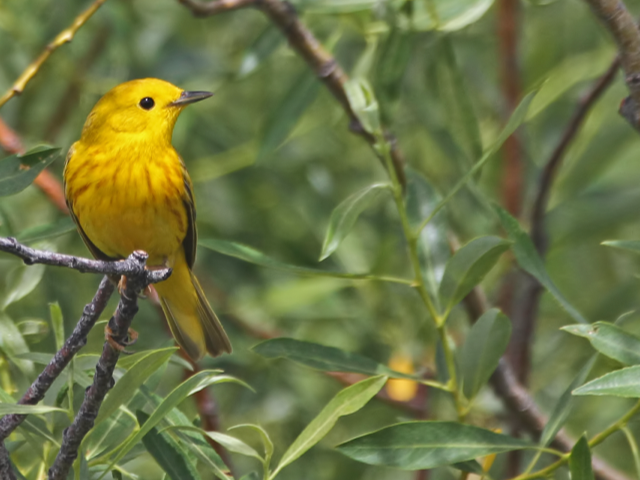
Last year, for example, I was lucky to visit Wisconsin to attend the conference during the peak of neotropical songbird migration, so I tallied more than 25 wood-warbler species. Then, when I returned in August, I began seeing southbound migrants in the northern portion of the state. Milwaukee County (in s. WI) was nearly devoid of warbler detections, except for probable nesting species such as American Redstart and Yellow Warbler.
In contrast, my n. CA residency, yields more warbler species during the breeding season — a result that surprises many people because the West is thought to host far fewer warbler species. For example, in Marin County (Bay Area) where I live, I often detect at least eight warbler species annually and, in the Sierra Nevada Mountains (near Yuba Pass and/or amid the Gold Lakes country off of Highway 49 near Bassetts), I sometimes successfully sleuth out nine warbler species.
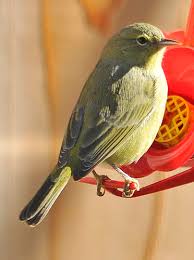
Although it sounds strange, a few warbler species visit hummingbird feeders, including Orange-crowned, Nashville, Virginia, Yellow, Black-throated Green, Prothonotary, and Cape May.
(Above, Orange-crowned Warbler feeding at a hummingbird feeder)
The initial above three species tend to have longer bills that are adapted to successfully obtain the sweet elixir (that provides them supplementary carbohydrates beyond the protein-rich insects they seek).
Cape May, by the way, even gobbles jelly birders serve to tanagers and orioles in their yards — so be on the watch for warblers at your bird feeders, folks.
Or simply grab your binoculars and enjoy a walk down your favorite trail.
Happy birding to you, Daniel
WarblerWatch.com {features several free birding information handouts (including some excellent articles by David Sibley) via my “Birding Links” area and information about my 25+ years of birding tours and bird guiding services (via my “Birding Tours” area)}
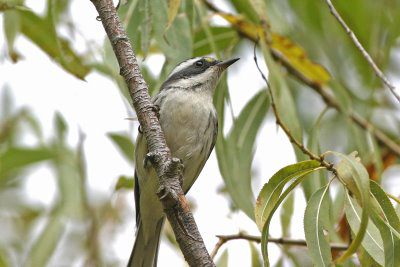
(The Black-throated Gray Warbler in the above photo is one of five species within the Black-Throated Green superspecies group.)
Thanks for the query, Ms. Jones (in Santa Barbara, CA).
Think of a superspecies as a group of related species that evolved from a common ancestor, but live in distinct ranges apart from each other. A good example of a superspecies is the Black-throated Green Warbler group that includes this species as well as Townsend’s, Hermit, Golden-cheeked, and Black-throated Gray Warblers.
Each of the latter four species in the above group is thought to have evolved from its Black-Throated Green ancestor. As this species expanded from its southeastern USA deciduous forest territory into coniferous forest created by the most recent glacial advances, isolation occurred among populations.
As generations of separated populations slowly spread west and north throughout lower North America, each population became a divergent “island.” Gene flow ceased as reproductive isolation caused speciation to occur over eons. The resulting five species share various field marks, but also express their own unique characteristics.
Nonetheless, despite their status as species, hybridization sometimes occurs among species within a superspecies, including the Black-Throated Green superspecies wherein populations of Townsend’s and Hermit hybridize in Oregon and Washington.
To simplify, where both species occur, over time Townsend’s appear to usually dominate and increase in number.
More technical, the five species within the Black-throated Green superspecies have parapatric distributions. That is to say, each of the five species has ranges that do not significantly overlap but are immediately adjacent to each other (and/or occur together in a narrow contact zone, with the aforementioned reference to Townsend’s and Hermit Warbler hybridization a scenario where overlapping occurs).
To learn more about this subject, read a classic article by R.M. Mengel titled “The probable history of species formation in some northern wood warblers.” One source where this article appears is in a 1964 edition of “Living Bird” (page 943). Note: R.M. Mengel’s book is accessed via: https://www.amazon.com/PROBABLE-FORMATION-NORTHERN-WARBLERS-PARULIDAE/dp/B000WQF1WE
….as this site a composite list featuring all the listserv sites in California where birders add their bird sightings.
At sialia.com, you’ll see a left column by which you can one-by-one click on a chosen region of California….Upon doing so for one region, you’ll see a list of the latest bird sightings lists posted by birders.
As for common annual and upcoming migration, I am pleased to note that I currently have begun to hear the courtship “peek” sound from male Anna’s Hummingbirds (and, actually, since October, 2022).
During this process, males descend during their courtship dance, air rushing through their tail feathers at the bottom of their elevator drop initiates the “peek” sound.
By December annually, eggs are added to nests in the SF Bay Area, with Great Horned Owl joining the maternity ward by January annually as females incubate eggs or hatch them.
Interestingly, also, the earliest returning Allen’s Hummingbirds may begin returning by next and beyond through February and March to SF Bay Area coastal breeding locations. I expect the initial report of a returning Allen’s Hummingbird to appear at sialia.com by 1/15/23 or soon after.
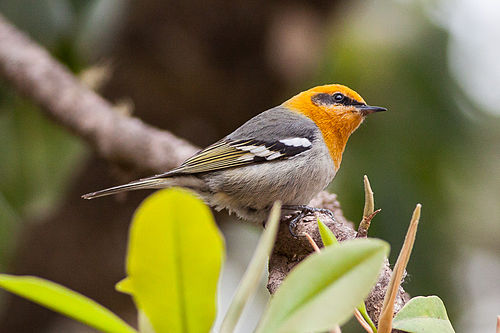
Indeed, there the Olive Warbler, Peucedramus taeniatus, is a small passerine bird. It is the only New World warbler species member of the genus Peucedramus in its own family, the Peucedramidae.
Breeding from southern Arizona through New Mexico and south into Mexico and Nicaragua, the Olive Warbler is the only member of the genus Peucedramus and the family Peucedramidae. All our other New World warblers in the continental USA are in the Parulidae family (except for rare to occasional vagrant sightings of Old World Warbler sightings — among them being Arctic and Dusky Warbler).
The Olive Warbler status in its one-member family is distinctive in that it’s the only bird family endemic to North America (including Central America). Before it was classified into its current family, this warbler was considered a Parulidae, but DNA studies suggest that it split early in its evolutionary history from the other related passerines prior to the differentiation of the entire New World warbler/American sparrow/Icterid group.
Where should you look for this species?
Like many other New World warblers, it is an insectivorous species of coniferous forests. According to the iBird Pro app I used to interpret its distribution range, Olive Warbler is restricted to breeding in central/east-central Arizona and a small portion of southwestern New Mexico. It’s non-breeding season range includes southern Arizona most of western Mexico and a restricted area of northeastern Mexico immediately south of Texas.
Though it is often said to be non-migratory, most New Mexican birds typically leave the state from November to late February.
New World wood-warblers (that are not closely related to the various Old World warblers in the Eastern Hemisphere (e.g., Europe, Asia) are often identified to number as 112-115 species, occurring among 24-26 genera. The centers (or “epicenters”) of their breeding areas occur in eastern North America, the West Indies, Mexico and Central America, and Andean South America.
The majority of northern-latitude breeding species migrate, but many island and tropical species are sedentary. Many of these latter species remain close to their birthing areas or perform short-distance, post-breeding altitudinal/elevation migrations.
As for myself, I often see 20-30 wood-warbler species during early May when I return to homecoming birding forays in the Midwest (and, concurrently, attend the annual Wisconsin Society For Ornithology conference).
My total 16 species during my May, 2025 foray to southwestern and western Wisconsin was fewer than the typical amount, but still an enjoyable memory.
Most wood-warbler species are rare to absent by November in Wisconsin, except for the occasional remaining American Redstart, Common Yellowthroat, Palm Warbler, and Yellow-rumped Warbler. The latter three may sometimes be detected during southern Wisconsin Christmas Bird Counts, with Yellow-rumped the most typical one seen.
In contrast, my n. CA residency, yields more warbler species during the breeding season — a result that surprises many people because the West is thought to host far fewer warbler species. For example, in Marin County (Bay Area) where I live, I often detect at least eight warbler species annually and, in the Sierra Nevada Mountains (near Yuba Pass and/or amid the Gold Lakes country off of Highway 49 near Bassetts), I sometimes successfully sleuth out nine warbler species.
Indeed, there the Olive Warbler, Peucedramus taeniatus, is a small passerine bird. It is the only New World warbler species member of the genus Peucedramus in its own family, the Peucedramidae.
Breeding from southern Arizona through New Mexico and south into Mexico and Nicaragua, the Olive Warbler is the only member of the genus Peucedramus and the family Peucedramidae. All our other New World warblers in the continental USA are in the Parulidae family (except for rare to occasional vagrant sightings of Old World Warbler sightings — among them being Arctic and Dusky Warbler).
The Olive Warbler status in its one-member family is distinctive in that it’s the only bird family endemic to North America (including Central America). Before it was classified into its current family, this warbler was considered a Parulidae, but DNA studies suggest that it split early in its evolutionary history from the other related passerines prior to the differentiation of the entire New World warbler/American sparrow/Icterid group.
Where should you look for this species?
Like many other New World warblers, it is an insectivorous species of coniferous forests. According to the iBird Pro app I used to interpret its distribution range, Olive Warbler is restricted to breeding in central/east-central Arizona and a small portion of southwestern New Mexico. It’s non-breeding season range includes southern Arizona most of western Mexico and a restricted area of northeastern Mexico immediately south of Texas.
Though it is often said to be non-migratory, most New Mexican birds typically leave the state from November to late February.
The answer is complex, but here’s a few simplified, applicable principles:
1. For the majority of wood-warbler species in the Lower 48 of the USA, an initial clutch of newborns has already occurred.
Likewise, a good percentage first-year individuals have already dispersed from their natal nest origin.
This behavior may include foraging nearby where they were born, but not yet migrating by night to a non-breeding, “over-wintering” territory.
2. Which species are early dispersers (and migrators)?
In the West where I live (in the San Francisco Bay Area), Orange-crowned Warbler has completed its nesting cycle. Both young and adults have dispersed elsewhere, including (in some cases) to higher elevation “intermediate” staging areas where foraging opportunities are more successful where larger blooms of insects remain robust compared to the dry, often hot weather in non-coastal Bay Area locations.
In many cases, true southbound migration will follow by August and September.
In the East and Midwest, early dispersers include Tennessee and Yellow Warbler. By late July and August, I have periodically seen banders nets hosting these two species in areas where they do not nest.
3. As for more peak periods of warbler migration, it’s fair to suggest that August and September are more common to note larger pulses of many other warbler species during the day as they forage before migrating at night to areas that range from southern states to Central America.
Then again, in my area, we welcome back a plentitude of Townsend’s Warbler individuals by September and October as they return for the non-breeding season from more northern latitude breeding grounds.
Helen (in Modesto, CA)…Thanks for the question, Helen.
Here’s two fast relief pills to take online for learning bird vocalizations and, in particular, wood-warbler songs: 1. Go to xeno-canto.org
Type in the name of the nemesis bird that has you flummoxed (It’s free, but you need to create an account with your use name and password).
2. To assess warbler species’ songs and calls, go to the following web site that’s associated with the excellent, incisive book The Warbler Guide (by Scott Whittle and Tom Stephenson):
and click on the “Companion Guide” button on the right side……Comprehensive information (!)
Otherwise, feel free to see my web site’s home page and the “Birding Links” tab pulldown menu where a free handout titled “Top 10 Tips To Improving Your Birding By Ear” appears.
Happy birding and warbler hunting to all, Daniel
WarblerWatch.com (Hosts my resume and “Birding Tours” information)
Here, you’ll see the publication whose cover is shown below.
It’s an excellent resource to read analysis of the status of California’s at-risk birds using the latest data to describe current populations, ranges, and threats.
Species highlighted in this 450-page book include seabirds, raptors, shorebirds, waterfowl, and perching birds, all of which are represented on a Bird Species of Special Concern list.
This list also notes California habitats with high numbers of special concern bird species, including wetlands, scrublands, grasslands, and riparian forests.



 Warbler Watch


You must be logged in to post a comment.