Unknown's avatar

About Daniel Edelstein

1) Consulting Biologist (and Certified Wildlife Biologist Asc.) — Conducting wildlife and plant surveys for common and special-status species, with federal permits for Ridgway's Rail (formerly CA Clapper Rail), California Tiger Salamander, and California Red-legged Frog, in addition to California Department of Fish and Wildlife (CDFW) general scientific permit, and CDFW general plant permit. Secure permits for clients who must comply with local, state, and federal regulatory measures. Since 1998, author of more than 100 Initial Studies, Biological Assessments, EIR "Biological Resource" chapters, habitat alteration plans, and planting plans. 2) Adjunct faculty at Merritt College, teaching all its bird classes to adults (see warblerwatch.com and its "College Classes & Slide Shows" area to note some of my birding class theme options). 3) Birding Guide — Birding Guide in Marin County, Birding Guide in Sonoma County, San Francisco birding guide, and California birding guide. (See warblerwatch.com and click on "Birding Tours" tab.)

Warbler Guy, I’m soon visiting California, meaning I’ll be looking for rare birds in your state. Where do I find recent rare California bird sightings on a listserv?

Hi Jeremiah….and your query is a periodic question I receive, so I’m glad to help, below.

Here’s the answer to your question, above: I suggest your first move is to check:
http://digest.sialia.com/?rm=all_lists

….as this site a composite list featuring all the listserv sites in California where birders add their bird sightings.

At sialia.com, you’ll see a left column by which you can one-by-one click on a chosen region of California….Upon doing so for one region, you’ll see a list of the latest bird sightings lists posted by birders.

As for common annual and upcoming migration, I am pleased to note that I 
currently have begun to hear the courtship “peek” sound from male Anna’s Hummingbirds (and, actually, since October, 2022). 

During this process, males descend during their courtship dance, air rushing through their tail feathers at the bottom of their elevator drop initiates the “peek” sound.

By December annually, eggs are added to nests in the SF Bay Area, with Great Horned Owl joining the maternity ward by January annually as females incubate eggs or hatch them.

Interestingly, also, the earliest returning Allen’s Hummingbirds may begin returning by next and beyond through February and March to SF Bay Area coastal breeding locations. I expect the initial report of a returning Allen’s Hummingbird to appear at sialia.com by 1/15/23 or soon after.

Other questions? Glad to help: danieledelstein@att.net

Please feel free to see the “Birding Tours” and “Birding Links sections.

Regards, Daniel

Warbler guy, are there any new world warbler that occur in their own family and where shall I look?

Hello Jeremy (in Toledo, OH):

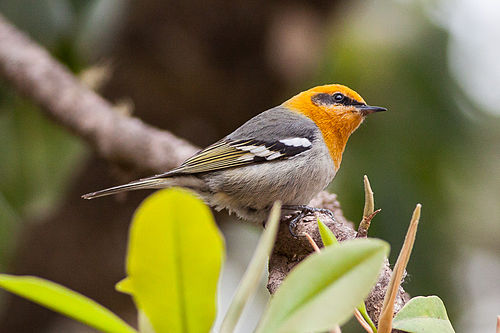
Indeed, there the Olive Warbler, Peucedramus taeniatus,  is a small passerine bird. It is the only New World warbler species member of the genus Peucedramus in its own family, the Peucedramidae.

Breeding from southern Arizona through New Mexico and south into Mexico and Nicaragua, the Olive Warbler is the only member of the genus Peucedramus and the family Peucedramidae. All our other New World warblers in the continental USA are in the Parulidae family (except for rare to occasional vagrant sightings of Old World Warbler sightings — among them being Arctic and Dusky Warbler).

The Olive Warbler status in its one-member family is distinctive in that it’s the only bird family endemic to North America (including Central America). Before it was classified into its current family, this warbler was considered a Parulidae, but DNA studies suggest that it split early in its evolutionary history from the other related passerines prior to the differentiation of the entire New World warbler/American sparrow/Icterid group.


Where should you look for this species?

Like many other New World warblers, it is an insectivorous species of coniferous forests. According to the iBird Pro app I used to interpret its distribution range, Olive Warbler is restricted to breeding in central/east-central Arizona and a small portion of southwestern New Mexico. It’s non-breeding season range includes southern Arizona most of western Mexico and a restricted area of northeastern Mexico immediately south of Texas.

Though it is often said to be non-migratory, most New Mexican birds typically leave the state from November to late February.

Warbler Guy, how many wood-warblers exist? How many do you see?

New World wood-warblers (that are not closely related to the various Old World warblers in the Eastern Hemisphere (e.g., Europe, Asia) are often identified to number as 112-115 species, occurring among 24-26 genera. The centers (or “epicenters”) of their breeding areas occur in eastern North America, the West Indies, Mexico and Central America, and Andean South America.

The majority of northern-latitude breeding species migrate, but many island and tropical species are sedentary. Many of these latter species remain close to their birthing areas or perform short-distance, post-breeding altitudinal/elevation migrations.

As for myself, I often see 20-30 wood-warbler species during early May when I return to homecoming birding forays in the Midwest (and, concurrently, attend the annual Wisconsin Society For Ornithology conference). 

My total 16 species during my May, 2025 foray to southwestern and western Wisconsin was fewer than the typical amount, but still an enjoyable memory.

Most wood-warbler species are rare to absent by November in Wisconsin, except for the occasional remaining American Redstart, Common Yellowthroat, Palm Warbler, and Yellow-rumped Warbler. The latter three may sometimes be detected during southern Wisconsin Christmas Bird Counts, with Yellow-rumped the most typical one seen.

In contrast, my n. CA residency, yields more warbler species during the breeding season — a result that surprises many people because the West is thought to host far fewer warbler species. For example, in Marin County (Bay Area) where I live, I often detect at least eight warbler species annually and, in the Sierra Nevada Mountains (near Yuba Pass and/or amid the Gold Lakes country off of Highway 49 near Bassetts), I sometimes successfully sleuth out nine warbler species.
Warbler Guy, are there any new world warbler that occur in their own family? Where shall I look for them?

Hello Jeremy (in Toledo, OH):

Indeed, there the Olive Warbler, Peucedramus taeniatus,  is a small passerine bird. It is the only New World warbler species member of the genus Peucedramus in its own family, the Peucedramidae.

Breeding from southern Arizona through New Mexico and south into Mexico and Nicaragua, the Olive Warbler is the only member of the genus Peucedramus and the family Peucedramidae. All our other New World warblers in the continental USA are in the Parulidae family (except for rare to occasional vagrant sightings of Old World Warbler sightings — among them being Arctic and Dusky Warbler).

The Olive Warbler status in its one-member family is distinctive in that it’s the only bird family endemic to North America (including Central America). Before it was classified into its current family, this warbler was considered a Parulidae, but DNA studies suggest that it split early in its evolutionary history from the other related passerines prior to the differentiation of the entire New World warbler/American sparrow/Icterid group.


Where should you look for this species?

Like many other New World warblers, it is an insectivorous species of coniferous forests.
According to the iBird Pro app I used to interpret its distribution range, Olive Warbler is restricted to breeding in central/east-central Arizona and a small portion of southwestern New Mexico. It’s non-breeding season range includes southern Arizona most of western Mexico and a restricted area of northeastern Mexico immediately south of Texas.

Though it is often said to be non-migratory, most New Mexican birds typically leave the state from November to late February.

Warbler Guy, it’s almost July, so I wonder: Is it too early to see dispersing and migrating wood-warblers? When does warbler migration begin?

 Good question, Altuve (in Florida):

The answer is complex, but here’s a few simplified, applicable principles:

1. For the majority of wood-warbler species in the Lower 48 of the USA, an initial clutch of newborns has already occurred.

Likewise, a good percentage first-year individuals have already dispersed from their natal nest origin.

This behavior may include foraging nearby where they were born, but not yet migrating by night to a non-breeding, “over-wintering” territory.

2. Which species are early dispersers (and migrators)?

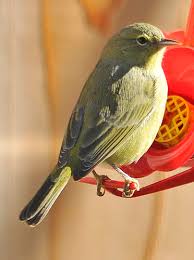
In the West where I live (in the San Francisco Bay Area), Orange-crowned Warbler has completed its nesting cycle. Both young and adults have dispersed elsewhere, including (in some cases) to higher elevation “intermediate” staging areas where foraging opportunities are more successful where larger blooms of insects remain robust compared to the dry, often hot weather in non-coastal Bay Area locations.

In many cases, true southbound migration will follow by August and September.

In the East and Midwest, early dispersers include Tennessee and Yellow Warbler. By late July and August, I have periodically seen banders nets hosting these two species in areas where they do not nest.

3. As for more peak periods of warbler migration, it’s fair to suggest that August and September are more common to note larger pulses of many other warbler species during the day as they forage before migrating at night to areas that range from southern states to Central America.

Then again, in my area, we welcome back a plentitude of Townsend’s Warbler individuals by September and October as they return for the non-breeding season from more northern latitude breeding grounds. 

I hope this explanation helps.

Regards, Daniel

Birding Guide

Avian Biologist

WarblerWatch.com

Warbler Guy, what’s one quick tip to improve my birding by ear? Bird song memory is hard! — so tips to learning bird songs and bird calls would be appreciated.

 Helen (in Modesto, CA)…Thanks for the question, Helen.

Here’s two fast relief pills to take online for learning bird vocalizations and, in particular, wood-warbler songs:
1. Go to xeno-canto.org

Type in the name of the nemesis bird that has you flummoxed (It’s free, but you need to create an account with your use name and password).

2. To assess warbler species’ songs and calls, go to the following web site that’s associated with the excellent, incisive book The Warbler Guide (by Scott Whittle and Tom Stephenson):

Click to access TheWarblerGuideAudioCompanion_Booklet.pdf

You may also wish to view:

thewarblerguide.com

and click on the “Companion Guide” button on the right side……Comprehensive information (!)

Otherwise, feel free to see my web site’s home page and the “Birding Links” tab pulldown menu where a free handout titled “Top 10 Tips To Improving Your Birding By Ear” appears.

Happy birding and warbler hunting to all, Daniel

WarblerWatch.com (Hosts my resume and “Birding Tours” information)

WarblerWatch.blogspot.com (This blog’s #)

Warbler Guy, how do I know if my California bird sightings are rare ones? Are species of special concern in California present in a book?

Sherry, feel free to see:

http://www.dfg.ca.gov/wildlife/nongame/ssc/birds.html

Here, you’ll see the publication whose cover is shown below. 


It’s an excellent resource to read analysis of the status of California’s at-risk birds using the latest data to describe current populations, ranges, and threats. 

Species highlighted in this 450-page book include seabirds, raptors, shorebirds, waterfowl, and perching birds, all of which are represented on a Bird Species of Special Concern list.

This list also notes California habitats with high numbers of special concern bird species, including wetlands, scrublands, grasslands, and riparian forests.

Warbler Guy, when you are a Birding Guide for a tour, where do you go in California? For warbler watchers like me, where’s the best warbler viewing spots in California?

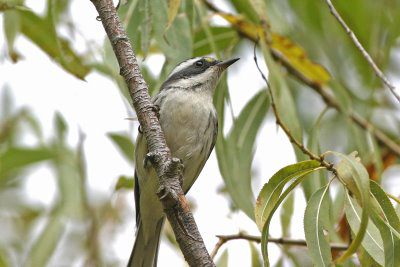
Jasper (in Fresno), that’s a fine question. Here’s some simplified thoughts: 1) Depending on when you’re pursuing wood-warblers, I vary where I go — and I’ll limit my answer to the northern California area where I typically guide birders on outings; 2) That written, it’s often best to visit forested areas featuring needle (conifer) trees for finding species such as Hermit (male, below photo) and Black-throated Gray Warbler whose greatest numbers begin returning to breeding grounds in, say, Marin County (1st county north of the Golden Gate Bridge) by April, while MacGillivray’s is far more uncommon and returns a little later to sporadic SF Bay Area nesting venues;

3) Other wood-warbler species in the SF Bay Area and close to it may be year-round, including Common Yellow-throat, Yellow-rumped Warbler (nests at higher elevations at selected Bay Area locations), and, more rare) Yellow Warbler (extirpated/locally extinct in most of the eight SF Bay Area counties; and 4) Townsend’s is restricted to the non-breeding season, but is common and easy to find from autumn through early spring throughout the SF Bay Area. Obviously, in sum, the five aforementioned species are FAR fewer than Midwestern and East Coast diversity and numbers. And, as mentioned, my overview above is a general introduction* to which species are potential observations. (* = You may have noticed I did not mention Yellow-breasted Chat, which is no longer designated a wood-warbler and is in its own family.)

Warbler Guy, I’m wondering which wood-warblers sing first in the spring (especially in the southeast USA where I live)?

Josie (in North Carolina): Perhaps you’re soon hearing Pine Warbler? — given they are year-round residents that are early singers in your region. Another candidate is Common Yellowthroat, some of which I believe could be year-round residents who do not leave.

Wish to explore this question to find your own answers, Josie? A good source is eBird, of course….where you can click on the “Explore” menu bar item at its home page. Then, look at checklists from March (and April) annually. In turn, when a wood-warbler species is present on a checklist, note whether the observer mentions singing as part of the identification.

I’ll write more about this topic soon….For now, it’s time to lead a birding tour as I guide local San Francisco Bay area folks to Bodega Bay in Sonoma County (~50 miles north of San Francisco). A Yellow-billed Loon remains present, so I suspect a weekend day will not find our group alone.

Regards, Daniel, WarblerWatch.com

Warbler Guy, I’m soon visiting California, meaning I’ll be looking for rare birds in your state. Where do I find rare California birds on a listserv?

Hi Jeremiah….and your query is a periodic question I receive, so I’m glad to help, below.

Here’s the answer to your question, above: I suggest your first move is to check:
http://digest.sialia.com/?rm=all_lists

….as this site a composite list featuring all the listserv sites in California where birders add their bird sightings.

At sialia.com, you’ll see a left column by which you can one-by-one click on a chosen region of California….Upon doing so for one region, you’ll see a list of the latest bird sightings lists posted by birders.

As for common annual and upcoming migration, I am pleased to note that I 
currently have begun to hear the courtship “peek” sound from male Anna’s Hummingbirds (and, actually, since October, 2022). 

During this process, males descend during their courtship dance, air rushing through their tail feathers at the bottom of their elevator drop initiates the “peek” sound.

By December annually, eggs are added to nests in the SF Bay Area, with Great Horned Owl joining the maternity ward by January annually as females incubate eggs or hatch them.

Interestingly, also, the earliest returning Allen’s Hummingbirds may begin returning by next and beyond through February and March to SF Bay Area coastal breeding locations. I expect the initial report of a returning Allen’s Hummingbird to appear at sialia.com by 1/15/23 or soon after.

Other questions? Glad to help: danieledelstein@att.net

Please feel free to see the “Birding Tours” and “Birding Links sections.

Regards, Daniel